All Around the World with the Most Travelled Indian
 By Nitin Gairola
Everyone has heard of the ‘big 5’ in the world of wildlife. Every safari tourist asks about the big 5 when in Africa and wants to capture it in film or image. In fact, I was recently in the rainforests of Borneo (which is naturally far removed from Africa) but there too the local boat operators had coined their own big 5 which even included a magnificent and rare bird (the Rhinoceros Hornbill, named so because its colourful beak had the appearance of a horn).
But the big 5 has quite a dark history going back to late 19th century. In the 1880s, the big game hunters from Europe used to go to Southern and Eastern Africa (their colonies at the time) to chase and kill the ‘most dangerous beasts’ on Earth. And unlike Corbett who used to mostly kill Tigers & Leopards to protect villagers in our own Uttarakhand (on the Kumaon side), for the European game hunters in Africa, it was primarily about bragging rights. As per them, the big 5 were not necessarily the biggest 5 animals in terms of size or weight, rather it was those which were the most difficult and dangerous to chase on foot and kill. And all of these ‘moving targets’ had very bad tempers when cornered (who wouldn’t?). Hence the giraffe was out since it was an easy target and didn’t really have a bad temper except when it kicked the stuffing out of you. The hippopotamus had a very bad temper (it still does) but because it didn’t need the thrill of the chase it was out of the list as well. You really do not have to chase an animal which lazes in shallow mud pools most of the time, taking its mud-bath and basking in the sun.
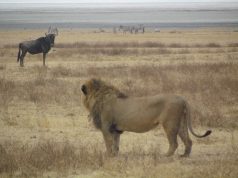
So, the 5 unfortunate ones who made it to the ‘hit list’ were the African Bush Elephant, the Rhinoceros (both black & white species), the ill-tempered Cape Buffalo and the two most deadly felines of Africa – the Lion and the Leopard.
Today trophy hunting is a very controversial topic in the field of conservation since the economics it brings, accordingly to some, actually gives incentives to locals to save a specific species and in fact, to make it successfully breed and thrive (leave aside the morality of all of this for a moment). However, there are many other conservationists who point out that a lot more sustainable protection of wildlife comes from ‘photo-hunters’ aka the safari tourists or the ‘safari heroes’ as I call them (do google my ‘Safari Heroes’ article). So, for them, it is safari tourism which is the panacea for saving endangered keystone species from poachers and eventual extinction, and to avoid the tragic fate of the Northern White Rhino.
I will dwell on this in more detail in a future ‘Safari Heroes Vs Evil Hunters’ feature (do note the satirical tone as I make it sound like a DC comic ‘Batman Vs Joker’ duel, since real life is never so black & white). But a good starting point for today is to remember what Sir David Attenborough once said – ‘No one will protect what they don’t care about and no one will care about what they have never experienced’. And my humble aim is to have more and more people know and experience the joys of the wild and the wildlife in it. So, in this feature, let me write a little bit about the largest terrestrial mammal and basically the latest terrestrial animal on Earth – the African Bush Elephant. I have had a few hairy and scary encounters as well with these mostly gentle and graceful giants, who can tend to throw their ‘weight’ around from time to time. But they do so only if you get up their nose, which as you can imagine means really getting ‘up’ their nose to a point when they are unable to blow their own trumpet since some human is blowing theirs.
Humour aside, these sentient beings generally live in families headed by a matriarch (largest female elephant in herd) and have very strong social structures and bonds. They roam the grassland savannahs, deep forests and even the southern deserts of this great continent. And while the iconic Elephant can be seen in almost all known national parks of Africa, the best among them for viewing the pachyderm are Amboseli National Park in Southern Kenya, which has Mount Kilimanjaro as it’s backdrop, Kidepo Valley & Queen Elizabeth national parks of Uganda, the famous Serengeti in Tanzania, South Luangwa in Zambia, Okavango Delta & Chobe in Botswana and the Kruger in South Africa. There are also elephants which have adapted to the harsh desert conditions found in north-west Namibia, in particular Kaokoland and Damaraland areas and in Etosha National Park.
The elephants in Africa belong to 2 species – the bush or savannah elephants and the forest elephants. They both live upto 60 – 70 years in the wild. The bush elephants can weigh upto 6 tonnes where the forest ones only upto 2 tonnes. The 3rd species is of course the Asian elephant. Unlike their Asian cousins, of which only males have tusks, here both male and female African elephants can be tuskers. The Asian elephants weigh about 4 tonnes i.e. are smaller than the African bush elephants but larger than African forest elephants. Even the elephant babies, called calves, can have a birth weight of upto 100-120 kgs, much more than an adult man.
Elephants, besides being social, are also very intelligent. Amongst land animals, right after the primates which include the great apes i.e. humans, gorillas, chimpanzees, bonobos and orangutans, the elephant brain is the most developed. They are one of the few animals that recognize themselves basis their reflection in mirror or water, which is a sign of greater self-awareness. Elephant families collaborate in raising and caring for the young, travel long distances together in search of food, assist those who are injured and even mourn the dead at times. They have amazing long-term memories and also feel empathy for their companions. They have been known to comfort other elephants in distress often by putting their trunks into the other’s mouth. This gives reassurance to the one who is feeling sad.
Elephants are by and large peaceful and gentle beings but there are cases of human-wildlife conflict due to encroachment into their living spaces. Also, young male bull elephants can be very aggressive during the mating season (called musth) when their testosterone levels increase to more than 50 times normal.
These giant herbivores naturally have a huge diet, eating a wide variety of plants including grass, leaves, shrubs, flowers, fruits, and even dig for roots after the rains. They also have crops such as millet. An adult elephant needs to eat upto 150 kgs of food in a day or 50 tonnes a year.
Now there is a ‘World Elephant Day’ too (12th August) and this has been added to the so-called ‘wildlife calendar’ to bring back focus of people & politicians on the plight of these lumbering giants as their populations dwindle in the wild. Just a 100 years ago, there were 3-5 million of them in Africa and now are down to around 500,000 (0.5 million). Their numbers are down by over 80%, due to relentless killing by poachers for their ivory tusks.
Nowadays, due to the worldwide awareness and concern, especially of the global youth towards the environment and animals, things are changing for the better. Your tourist bucks will go a long way in funding for Elephant protection. So, besides the phenomenal experience of seeing the modern-day mastodons and mammoths, you will actually contribute to the greater good of the planet by contributing to preserve these vulnerable giants.
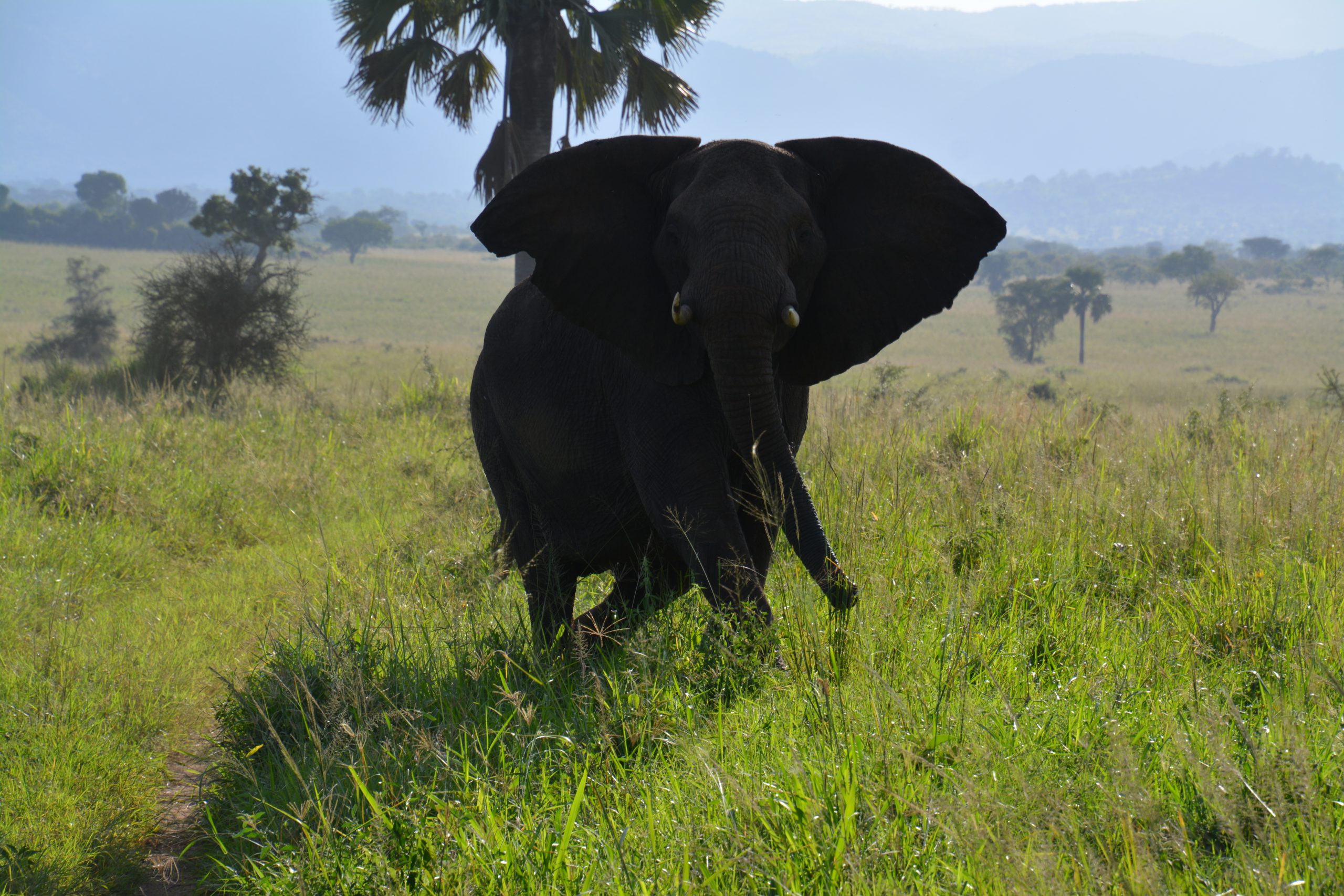
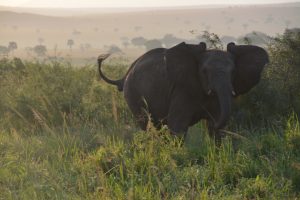
We had a few amazing experiences with this massive mammal. In Kidepo Valley (Uganda-South Sudan), we saw a large herd passing us by, so we naturally stopped our jeep to have a closer look (though not too close). But since a few of the elephant babies were looking concerned, our driver decided to pull the jeep back a bit. As we did so, the back wheels got stuck in the mud and then we couldn’t go backwards, forward nor turn left or right. This is since the mud path was narrow and on the left and right it was covered with tall grass on semi-marshy ground. Then we had the moment when the huge matriarch raised its ears, trumpeted and charged at our jeep. She stopped just short of it but we were sitting ducks really had this mock charge (to warn) been an actual one. The matriarch simply was protecting her herd and when they had crossed our jeep, one by one, she also moved on. And while I couldn’t take her photograph when she was nearest to our jeep (you can understand why), I did take a great snap of hers turning towards us, showing her big ears and starting her run. There was another snap of hers turning away from us. It was a heart stopping moment and even our safari driver panicked a bit. There were truly just the 3 of us in the middle of nowhere in a trans-frontier grassland. No other tourist jeeps in sight unlike what you would have in Masai Mara or Serengeti.
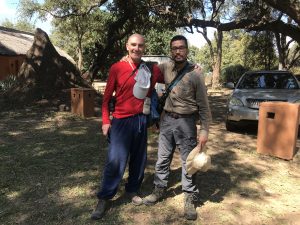
We also have some great memories from South Luangwa N.P. in Zambia during both our walking safaris and night safaris (something that is not allowed in national parks of Kenya or Tanzania other than in few private ranches and wildlife concessions). Richa and I, along with a German named Till, were just 100 meters away on ground from a bull elephant with tuskers. However, we were reading his body language carefully and he did not seem aggressive at all, so we took quite a few photographs before we felt we shouldn’t test our luck any further. We got a stern warning (and rightly so) from a safari driver who was passing by and that time we also got acquainted with Michael Roberts (or Bernie) who was standing nearby and is quite a traveller and wildlife enthusiast himself. He is currently somewhere in Meso-America between Mexico and Guatemala. Even after 7 years, he remains one of our very close friends from our travels around the world.
In Zambia itself during our night jeep safaris, I got some nice views of these giants in the dark, which you don’t normally get in most of the national parks. But on the last night in Luangwa, an angry elephant actually came into our camp and was violently shaking a tree. It did so for few minutes before moving on and I am glad he didn’t shake any of us, who were anyway quite shaken. I recall well that both David (another wonderful person we met in Zambia) and Bernie were there too and it was a good way for Richa and I to say goodbye to these 2 safari heroes.
You know the elephant is iconic when Kenya’s favourite beer is called ‘Tusker’ – something of a ritual at sundown in the savannah. So just pick your dusty safari hat, your trusty camera and binoculars and head for Africa to gaze at these massive creatures. I am so glad that shooting wildlife doesn’t mean what it once used to.
Nitin Gairola, often considered the ‘Most Travelled Indian’, is a Natural World Traveller from Dehradun. Inspired by Sir David Attenborough, he is on a quest to become the first person to travel to the entire natural world of every major forest, desert, grassland, tundra & ice biome on Earth, besides every major country. This multi-year project is called ‘Borderless Biomes’ and Nitin has also set world travel records certified by India Book of Records, has written for Lonely Planet, holds National Geographic conservation certifications, is a senior corporate executive in an MNC and loves bio-geography. In his early days, he used to be a published poet as well. Join him @ www.instagram.com/MostTravelledIndian/