Book Review
 By Soumitra Banerjee
———-
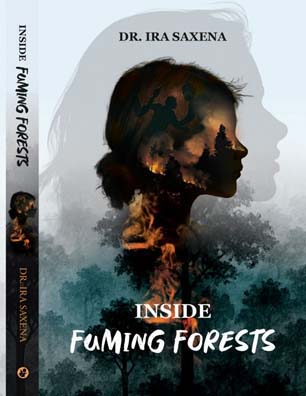
Inside Fuming Forests
By Dr Ira Saxena

———-
Dr Ira Saxena’s well researched work of fiction, ‘Inside Fuming Forests’ is a poignant and sensitively narrated exploratory story of a land caught in a tragic paradox. Through the eyes of her protagonist, Dr Saxena peels back the layers of the Bastar region in Chhattisgarh, revealing a world where the breathtaking serenity of nature clashes violently with a gritty, deep-seated insurgency.
Here is a review of the narrative’s ability to capture the soul and the struggle of the tribal heartland.
The author excels at painting Bastar not just as a conflict zone, but as a living, breathing entity. The “Fuming Forests” of the title are initially introduced through their majestic, ancient beauty.
The prose captures the rhythmic pulse of tribal life—the vibrant haats (markets), the intoxicating scent of Mahua flowers, and the deep reverence the Gond and Muria tribes have for the earth.
The forest isn’t just a setting; it’s a character. The author depicts it as a sanctuary of culture and tradition that has remained unchanged for centuries, offering a glimpse into a way of life that values communal harmony over individual greed.
The “fuming” nature of the forest refers to the simmering heat of the Naxalite movement. The story masterfully illustrates the precarious tightrope the tribals walk every day.
It is a Double-Edged Sword: For the tribals…the risk is existential. They are squeezed between the Red Corridor insurgents and the state paramilitary forces. Dr Ira Saxena highlights the terrifying reality where a simple act—like providing food or information—can be labeled as “collateral damage” or “treason” by either side.
The narrative doesn’t shy away from the brutality of landmines, tactical ambushes, and the psychological toll of living in a permanent state of surveillance.
The irony remains – Progress versus Preservation.
The most “interesting” facet of Saxena’s storytelling is her sharp eye for the ironies embedded in the conflict.
Inside Fuming Forests is more than a political commentary; it is a human-centric drama. Dr Ira Saxena manages to humanise the “faceless” tribals often lost in news headlines. She captures the bittersweet irony that the very isolation that preserved the beauty of Bastar is the same isolation that allowed the seeds of conflict to take root.
The book serves as a haunting reminder that beneath the smoke of the “fuming forests” lies a culture gasping for air, caught in a war they did not start but are forced to finish.
The vocational training school started by Malu Bua (one of the key characters) is the vital micro-ecosystem where Dr Ira Saxena weaves all the competing forces of the novel together. It acts less like a cold brick institution and more like a neutral clearing in the dense jungle—a crucible where the narrative’s central tensions melt and collide.
By grounding this school deep within the forest, the author integrates the story’s core elements through several layers. Narratively, the school serves as the vital intersection where the paths of the main characters cross and complicate the plot. It functions as a sanctuary where outsiders like Anjula, haunted individuals like Sameer, and fiercely protective locals like Mahua find common ground.
By bringing these disparate souls under one canopy, Malu Bua’s school serves as the structural heartbeat of the book. It is the physical manifestation of hope—proving that the “fuming forests” do not just cultivate smoke and conflict, but also the quiet, resilient seeds of a self-sustaining future.
This engrossing story hits at the very heartbeat of Dr Ira Saxena’s work. When a narrative moves past mere geographical description and transforms into an immersive ecosystem, the reader ceases to be a detached observer; they become a resident of the canopy.
Dr Ira Saxena’s pen flows in English and Hindi, drawing real life dramas, incredible characters tickling with humour, stirring adventures, jungle sprees, moving tales, and exciting computer-crime thrills in stories and novels. Many of them have been awarded for writing – The Virus Trap (White-Raven recognition, Germany), Gajmukta ki Talaash (Shanker’s Medal in All-India Competition for Writing), Manmauji Mamaji (Humorous stories collection in CBT Competition for Writing) and competitions by Tinkle (IBH) and Saptahik Hindustan weekly.
On a serious note, she has woven her belief in Gandhian thought and non-violence, inspired by her mother, Kamala Chaudhri, a freedom fighter and author, who was involved in drafting the Indian Constitution as a member of the Constituent Assembly and Lok Sabha, later. Ira Saxena related India’s Freedom Story (HarperCollins) and has written tales of the unsung heroes of freedom in her forthcoming book, Warriors of Non-Violence (HarperCollins).
She is one of the founding members of Association of Writers and Illustrators for Children established to promote Children’s literature in India and, later, was elected to the Executive of International Board on Books for Young People (IBBY). She is spearheading the campaign on Book Therapy or reading literature for healing stress in our day-to-day lives.
(Soumitra Banerji is an acclaimed Indian author and writer, best known for his thought provoking novel “Liminal Tides”.)