Book Review
 By Devender Singh Aswal
The decade of the Twenty-Twenties has unleashed the Fourth Industrial Revolution triggered by Artificial Intelligence. While the previous revolutions enhanced humongously the physical human capability, AI has emerged as a multiplier of cognitive capability. All AI assistants like ChatGPT, Gemini, Claude, Perplexity, DeepState, etc., work on algorithms. Jensen Huang, the founder of Nvidia, who spearheaded global AI infrastructure development and is considered one of the Architects of AI, describes Algorithm as instructions that drive traditional computing, whereas AI represents a new computing paradigm in which machines learn and generate intelligence. Algorithms are being increasingly used across sectors like law, education, public health, fraud detection, tax compliance, industry, trade and commerce and defence. In fact, AI has become a primary driver of modern military operations as well as a powerful tool for career advancement. Algorithm has become an idiom for doing things faster, accurately and efficiently.
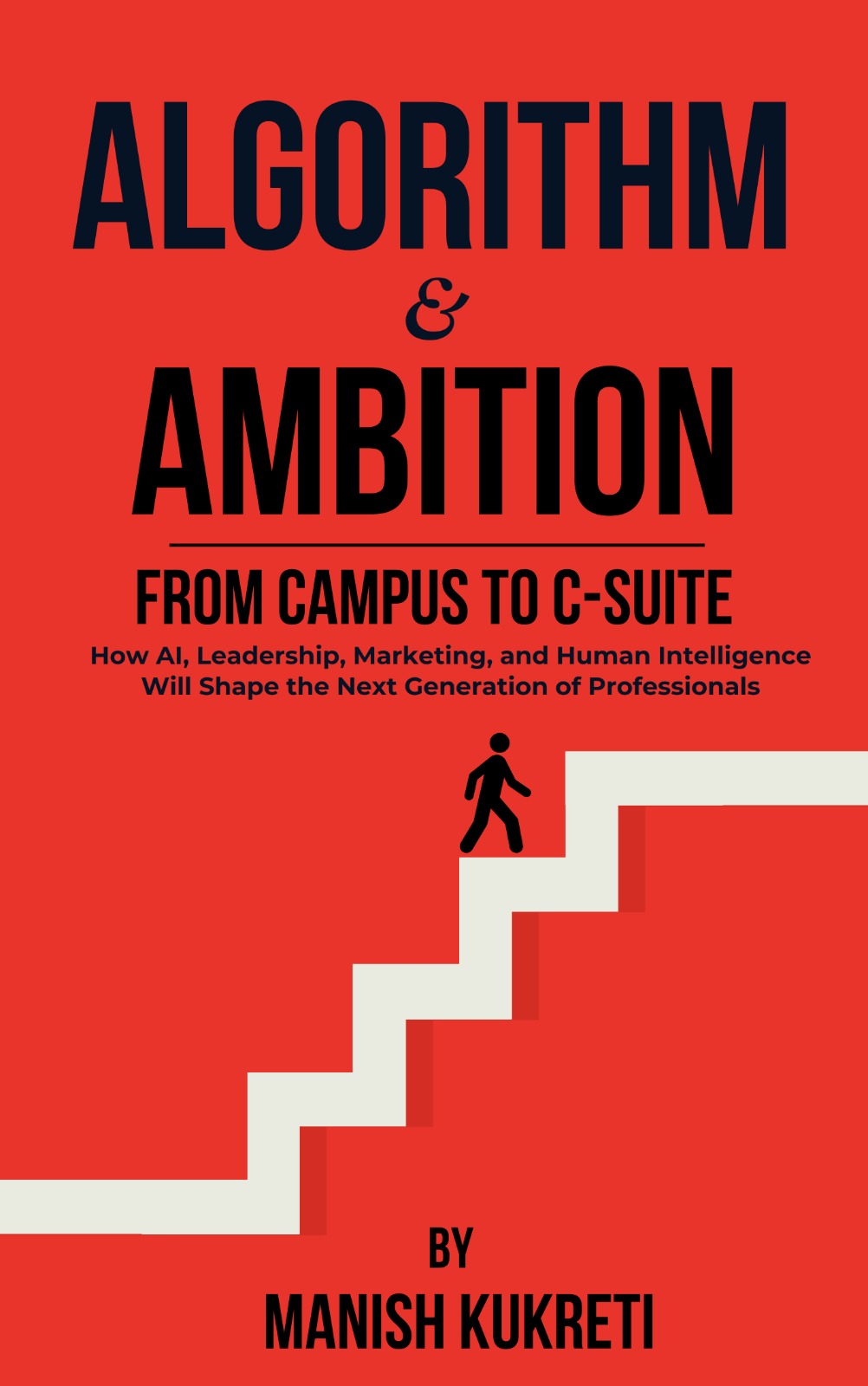
The arrival of a new book, ‘Algorithm and Ambition-From Campus to C-Suite’, by Manish Kukreti has filled a much felt void. The author explores the intersection of artificial intelligence, career growth and leadership in corporate governance. Certainty, it must have been a very arduous and challenging task to write on such a novel, fast evolving and contemporary subject. An aspirant, who notes the title, will be compelled to glance through the book, and add it to personal collections. In its titular appeal, the book is reminiscent of Dale Carnegie’s, ‘How to Win Friends and Influence People’.
‘Algorithm & Ambition’ is a compelling title. The sub title – ‘From Campus to C-Suite’ is all the more beguiling and powerful. Arguably, the title is reflective of the professional knowledge depth and the romantic imagination of the author. Its cover is a treat in visual psychology. The Chief Operating Officer or the CEO, the highest ranking executive equipped with enormous functional power and authority, is allotted a huge suite called-C suite, from where, probably, the subtitle has been inspired. The central argument of the book is that the ambition to reach the C-Suite can fructify if the right algorithm is followed with tenacity of purpose and determination, embracing the constantly expanding horizons of knowledge, more so of emerging technologies. It’s inconceivable to navigate through the AI centric professional landscape and to rise to the pinnacle of corporate ladder without application of AI tools and professional competence.
‘Algorithm’, ex facie, sounds like some kind of a poetic rhythm. Geoffrey Chaucer, considered the father of modern English poetry, composed the Canterbury Tales in the 14th Century. Literary critics and digital humanists use the phrase- Chaucer’s algorism – a poetic precursor of algorithm – to describe how he systematically built the stories, structured his verse and calculated his poetic meter – the iambic pentameter. The etymology of the word algorithm is rooted in history. It is around 825 CE that the Persian scientist and polymath Muḥammad ibn Mūsā al-Khwārizmī wrote two books – kitāb al-ḥisāb al-hindī, that is, “Book of Indian computation”, and-kitab al-jam’ wa’l-tafriq al-ḥisāb al-hindī, that is, “Addition and subtraction in Indian arithmetic”. This fortifies the claim of ancient India as a Vishwaguru in the field of mathematics.
One who spent over two decades at the intersection of media, marketing and digital transformation, working with brands, leading teams and teaching students and professionals, Mr Kukriti could write such a treatise. The author has used Algorithm as a metaphor for speedy career advancement while laying stress on adapting to new AI tools. The book focuses on the benefits and advantages of algorithm and how its application can help navigate to reach the top decision making position in corporate governance. Indubitably, the Ambition to reach the destination can be propelled by following strenuously a well designed purposive algorithm. As GPS algorithm is used to reach the destination faster, so can one use appropriate algorithm to fulfil his cherished ambition.
This book tells us in an engaging manner how AI, leadership, Marketing and Human Intelligence will shape the Next Generation of Professionals. The book is rich in content, its prose is crisp and clear and is without daunting excess of pages. It is highly contemporary, contextual and resonates with a wider readership. It has the defining features of a popular book in the context of emerging tools of cognitive intelligence.
The author also underscores the imperative need for professional ethics and organisational integrity. If a CEO or the C-Suitor, departs from professional ethics, it can have dangerous consequences. One cannot be oblivious to the story of a trailblazing Indian-American – Rajat Gupta – who reached the pinnacle of corporate America but had a meteoric downfall as he was tried and convicted for insider trading. So, ambition must be tempered by professional ethics. The author underlines five human capabilities that compound in the AI era, namely, ethical reasoning, emphatic leadership, creative synthesis, contextual judgement and communication that moves people. More significantly, these capabilities are structurally beyond the extant AI system.
The book explains lucidly the potential role of AI in corporate governance, the overwhelming importance of data and demography and the lead that India enjoys, and the imperative need for constant learning and re-skilling in the hyper-competitive world. Emphasising the importance of data, the author observes tritely ‘in God we trust. All others must bring data’. Ascent to the summit is challenging but if one follows the right algorithm with tenacity of purpose and determination, one can surely occupy the C suite. But once in the C-Suite, the author argues persuasively, there is all the more a paramount need for maintaining professional integrity and honesty. Each chapter has been condensed and encapsulated in the form of takeaways, giving a synoptic view of the main findings and observations. The author hits the nail when he pleads that history rewards those who adapt at the inflection point, not after it. Indeed, the global AI literacy of India coupled with deep contextual intelligence must remain ahead in the competing world. Replete with nuggets of wisdom, the author cautions and exhorts – ‘the algorithm can be extraordinarily powerful. The ethical compass it requires is yours to supply.’ ‘The algorithm can optimise a route. Only you can choose the destination.’ Surely, the book would prove a treasure trove for all those aspiring to occupy the top executive positions.
The book was released on 10 August at the Press Club of India by Dr Bharat Nager, Senior Advocate Supreme Court of India, Rajendra Singh, former member of the National Disaster Management Authority of India, Dr Vijay Dhasmana, President and Chancellor SRH University, Devendra Singh Aswal and Pawan Kumar Maithani, General Secretary, Garhwal Hiteshini Sabha, New Delhi.
The book has been published by Adroit Publishers, New Delhi.
(The author is ex Additional Secretary, Lok Sabha.)