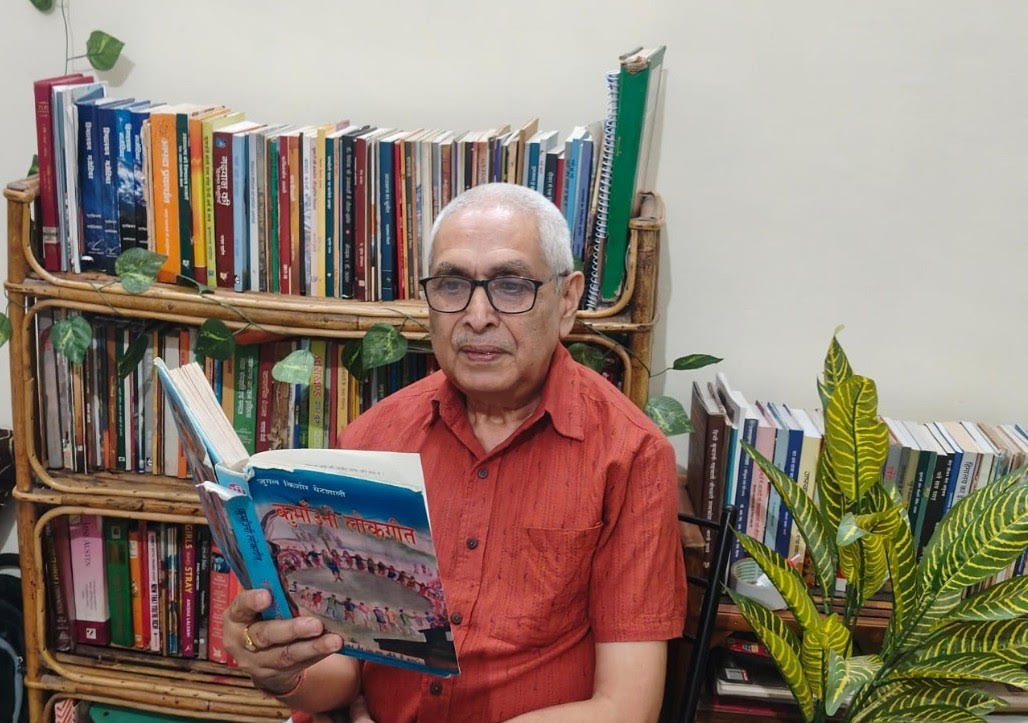
Books From My Shelves
By Chandrashekhar Tewari
To think of a bookshelf only as a place to keep books is to limit its real meaning. Over time, books become connected with a person’s interests, memories and experiences, and a bookshelf slowly turns into a private world of its own. My bookshelf is something like that for me. The books kept there are not merely books collected for reading; they are a way of staying connected with the Himalaya, especially the land, society, culture, memories and lived experiences of Uttarakhand.
I have always been more interested in books written by authors whose work is deeply connected with the social and cultural life of Uttarakhand. They include storytellers, poets, researchers, historians, geographers and writers who write in local dialects and languages. These books have helped me understand that knowing Uttarakhand requires more than established histories and well-known literature. A village story, a collection of folk songs, a dictionary of a local dialect or the biography of a relatively unknown person can also reveal aspects of mountain society that often remain outside larger narratives.
Fiction has an important place on my bookshelf. Along with established and important writers such as Shailesh Matiyani, Shivani, Batrohi, Devendra Mewari, Vidyasagar Nautiyal, Harisuman Bisht and Dr. Shekhar Pathak, I also have books by storytellers such as Shurveer Singh Rawat, Mukesh Nautiyal, Shambhu Rana, Trepan Singh Chauhan and Anil Karki.
What makes these writers special is their closeness to the life around them. Their writing reflects ordinary people, their struggles, relationships, poverty, migration, memories and a changing social life. A writer who lives in a small town or village observes the life around him with a closeness and intimacy that often makes his/her writing deeply realistic.
I am particularly drawn to books on local history, culture, socio-economic life, geography and the environment. In Uttarakhand, forests, rivers, fields, springs, villages, migration, folk traditions and changing livelihoods are closely connected. Migration cannot be understood only through statistics. It also brings with it abandoned fields, weakening traditional knowledge, changing festivals and folk arts, and changes in the social structure of villages.
Books written in local dialects and languages have a special attraction for me. A local word does not carry only its dictionary meaning; it often contains a sense of geography, folk memory, tradition and a particular way of looking at life. That is why literature and dictionaries in local languages are also important cultural records for future generations.
Many books on my shelf have also come to me through personal and literary relationships. Writers, poets, researchers, friends and publishers who visit the Doon Library often gift me their new books. Sometimes a poet gives me a new collection, sometimes a storyteller gives me a book of stories, and sometimes a researcher shares the result of years of study. In this way, my bookshelf has not been shaped only by my own choices; it also carries conversations, friendships and the warmth of writers.
The literature of any region is not created only by its well-known writers. The language of a village, its river, its forests and the circumstances of a particular time also preserve the memories of that society.
A Brief Introduction to Some Books on My Shelves
Shilatirth
The work ‘Shilatirth’ by the renowned Odia thinker-travel writer Chittaranjan Das is a poignant document of the spiritual and cultural journey of the Himalayas. The title means – the pilgrimage of rocks. In it, the author sees the snow-clad peaks, especially places like Kailash-Mansarovar, not merely as geography, but as symbols of consciousness, penance and folk faith. The book presents a profound reflection on the softness hidden in the harshness of the mountains, the coexistence of nature and man, and the changing nature of pilgrimage. Written in a simple, poetic and philosophical style, this work leads the reader towards reverence for nature and self-introspection.
Mera Jeevan, Mera Anubhav
This collection is based on the life story of Chandrashekhar Lohumi, a folklorist popularly known as Kuri Wale Massab. It has been compiled by his son, Harihar Lohumi. The book is an insightful document of the educational world, farming and rural life of Kumaon. It also presents, in simple language, his work on controlling lantana and the Kurmula Chalmora pest, along with his contribution to folklore studies. With an introduction by Devendra Mewari, the book reflects the inspiring legacy of an individual driven by his own passion and dedication to the service of folk knowledge.
Gangotri Glacier of Himalaya: Paradise in Peril
This important scientific work by geographer and mountaineer Dr. Mahendra Singh Miral focuses on the Gangotri Glacier. It examines the mythological and cultural beliefs associated with the source of the Ganga, geology, the condition of glaciers, global warming, biodiversity, glacier retreat, disasters, unplanned tourism and the effects of climate change.
Enriched with rare photographs and a travel account of the Gomukh–Badrinath–Kalindi Khal route, the book was published by Samay Sakshya, Dehradun. It is a useful work for researchers and anyone interested in the changing Himalayan environment.
Seemant Lok Ki Kahaniyan
Mukesh Nautiyal’s collection Seemant Lok Ki Kahaniyan is a remarkable collage of memories, folk knowledge and mountain life. Its 24 short stories bring together childhood memories, the pain of migration, disappearing seeds, vanishing forests and the sensitive world of human relationships. Stories such as Iktara Bole, Gaon Ko Thenga, Ganja Pahad, School Mein Anna and Muhansa bring environmental awareness and nostalgia alive through vivid images and situations.
Batui: Kumaoni Poetry Collection
Gyan Pant’s Kumaoni poetry collection Batui—a word suggesting a sob or the longing for one’s loved ones—is a vivid document of the soul of the mountains. It contains 258 short poems in a haiku-like form and 35 longer poems. The poet, living away from home in Lucknow, carries in his mind memories of his village Garau in Pithoragarh, along with the pain of migration, deserted homes, nature, culture and the sweetness of the local language. In a simple, satirical and sensitive style, he expresses concern about corruption, politics and the decline of mountain society, while making a moving appeal to remain connected with one’s roots.
Yaayavar Ki Yaadein
This book is a collection of memories of remarkable people whom writer Devendra Mewari encountered during his long journey through life. It includes memories of writers such as Bhisham Sahni and Shailesh Matiyani, people’s poets such as Viren Dangwal and Girda, scientists such as Prof. Yashpal, Dr. A.P.J. Abdul Kalam and Dr. Khadg Singh Valdiya, science-fiction writer Kailash Sah, science writer Gunakar Mule, and Ramesh Dutt Sharma, Premanand Chandola, filmmaker Arun Kaul and artist Saeed Sheikh. A Hindi science writer for nearly six decades, Mewari brings together literature, science and art in an intimate and accessible style. The book also underlines the importance and richness of science writing.
Hari Bhari Umeed
This book by historian and scholar of the Chipko movement Shekhar Pathak is a vivid account of Uttarakhand’s environmental movements, particularly the intellectual and social legacy of Chipko. Drawing on decades of research, journeys on foot and direct conversations with activists, the author brings out the close relationship between forests, water, land and people. The book is not merely a narration of the past. It also raises contemporary questions about development, displacement, the climate crisis and democratic resistance, while keeping alive a “green hope”. Its simple, factual and intimate style makes it relevant to researchers, activists and general readers alike.
Garbha-Griha Mein Nainital
Written by the renowned Uttarakhand storyteller Prof. Laxman Singh Bisht ‘Batrohi’, Garbha-Griha Mein Nainital is a widely discussed and significant novel. Written in an autobiographical style, the novel uses Nainital as a lens through which to explore the tragedy of an entire culture and environment becoming shaped by colonial influence. The book brings together history, myth and lived reality in a remarkable collage and offers a deep look at the society and changing identity of the Himalayan region.
He Bwari
Set in the Garhwal region, He Bwari is a moving novel about the struggles, dignity and resilience of the mountain woman—the bwari, or daughter-in-law of the household. As villages empty because of migration, it is often the women who remain behind to carry the burden of farming, livestock, family and culture. Through the character of the bwari, the novelist brings out the realities of patriarchy, alcoholism, unemployment, failed development and the double burden carried by women. Rich in Garhwali expressions, folk sayings and regional imagery, the novel is not merely the story of one woman. It becomes a document of the pain, strength and resilience of the wider mountain society. For many readers, it successfully captures the changing social landscape of the hills.
Raag-Bhaag: Kali Kumaon
Written by Dr. Ram Singh, Raag-Bhaag: Kali Kumaon is an important historical document on the historical and cultural richness of the Kali Kumaon region of Uttarakhand. The book offers a detailed and authentic account of the area’s local history, folk culture, oral traditions and social fabric. Rich in stories and oral histories, it brings before the reader the villages, traditional divisions, local narratives and older social landscape of Kali Kumaon in an engaging and realistic manner.
I do not see my bookshelf as a complete or final collection. Every new book adds something to it—a forgotten memory, the voice of a village, a writer’s perspective or an experience from another part of the Himalaya. In this sense, my bookshelf grows not merely in the number of books, but in the relationships I develop with them.
That is why, for me, “Books From My Shelves” is not simply an introduction to books. It is an attempt to listen to the voices through which a society understands itself. My books repeatedly take me back to my own land, my mountains and the people who live there. At the same time, books about the wider Himalayan world remind me that the deeper I try to understand my own mountains, the more important it is to listen to the voices of the mountains that stretch beyond them.
Perhaps this is the greatest strength of books: they connect us to our own place while giving us a wider perspective to understand the world.
(Chandrashekhar Tewari writes on subjects related to mountain development, planning, environment, culture and society. Seven of his books have been published on Himalayan society, folk life, culture and geographical environment. He is currently associated with Doon Library and Research Centre, Dehradun.)