 By Rati Agnihotri
The worship of the divine feminine has always been an integral part of Hinduism. The Mother Goddess or Shakti is invoked in many Hindu rituals and modes of worship. When we talk of feminism, we often look at the west as a reference point. The western feminism started with the women’s suffrage movement – the struggle of women to get a right to franchise. Then it extended to women’s fight for their rights in different domains – social, political, economic, cultural, biological, etc.
We recently celebrated Women’s Day that called for women’s equity instead of equality. While we have certainly made numerous strides in women empowerment, we somehow fail to appreciate the strong agency that Indian culture already provides to women. The relegation of women to the household sphere and the so-called backwardness that’s come to be associated with many of the Indian rituals is more of a problem of interpretation than the tradition itself.
There is perhaps no better example of the invocation of feminine consciousness in Indian culture than the Hindu festival of Navaratri.
There exist a few times in the year in the Vedic calendar when the divine feminine aspects of consciousness are collectively invoked.
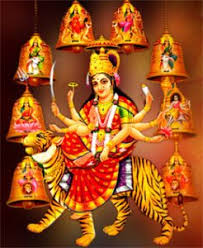
Navaratri celebrates the divine feminine over a period of nine days. During this time, nine forms or embodiments of Goddess Durga or Shakti are worshipped. Each day is dedicated to celebrating one embodiment of the Goddess. The nine forms of Durga traditionally worshipped are Shailaputri, Brahmacharini, Chandraghanta, Kushmanda, Skandamata, Katyayani, Kalaratri, Mahagauri, and Siddhidatri. Each form of Goddess Durga represents a particular set of qualities and attributes. Navaratri then becomes akin to exploring and celebrating myriad notes of feminine consciousness. In Hinduism, there is no strict binary between so-called masculine and feminine attributes. Rather, there is a wide spectrum of attributes and qualities that women exhibit as per the demands of the time and occasion. In Navaratri, the same Goddess can be an embodiment of peace and tranquility one day, and she can be a powerful force wreaking havoc on evil forces, the next.
At a symbolic level, Navaratri calls for the celebration of the inherent feminine consciousness in all, irrespective of their gender. It is a time for the purification of the body and the soul through fasting and a process of deep introspection. It is a time to reconnect with women’s feminine attributes of grace, sensitivity, creativity, beauty, kindness, righteousness, etc.
Some people celebrate Navaratri by worshipping Goddesses Durga, Lakshmi, and Saraswati. The celebration happens in a cycle where the first three days are dedicated to Goddess Durga, the next three days to Goddess Lakshmi, and the remaining three days to Goddess Saraswati. According to this version of Navratri, there are three embodiments of the Goddess on the three sets of days symbolise Tamas, Rajas, and Sattva, respectively. The first three days of Navaratri are embodied with raw energy where the Goddess is fierce. This is a period of connecting with the earth. The next 3 days of Navratri are a period of action, signifying a spirit of intense involvement with the practical pursuits of life. The last 3 days of Navaratri are a period of refinement; the Goddess inspires you to refine the physical, mental, and emotional planes of your existence. Once the soul cleansing is done, you will experience utmost bliss.
The worship of the feminine divine existed in all ancient societies. But, unfortunately, western society witnessed the enormous wiping out of all Goddess temples because of the crackdown on paganism and idol worship. Even today, in tribes where nature worship takes place, different manifestations of nature are worshipped in feminine form. Hinduism is perhaps the only surviving religion that worships the divine feminine on such a large scale. Not just that, it also gives freedom to its practitioners to create and worship their own version of the Goddess as per their local history, culture, and folklore.
On the 8th and 9th days of Navaratri, little girls are worshipped as Devis and offered meals and goodies in an auspicious feast. This becomes a definitive note to the celebration of the divine feminine on all nine days of Navaratri. It becomes essentially an act of humbling – touching the feet of little girls who are the manifestation of the feminine divine as one invokes the feminine in their own self.
As the world grapples with multiple issues – climate change, poverty, gender discrimination, terrorism, etc., we must constitute our own indigenous lens in examining and addressing these issues. We don’t have to abandon the western paradigm. But, it’s high time we also constitute our own paradigms and look for points of empowerment in our own culture and tradition.
(Rati Agnihotri is a freelance journalist and writer, with about 10 years of experience across broadcast, radio and digital media. She is also a bilingual poet. Her first book of English poems ‘The Sunset Sonata’ has been published by Sahitya Akademi, India’s National Academy of Letters. Her second book of poems ‘I’d Like a Bit of the Moon’ has been recently published by Red River. Rati’s Hindi poems have appeared in a number of literary journals. Rati has completed her M.A. (International Journalism) from University of Leeds, U.K. and B.A. (Hons) English Literature from Miranda House, Delhi University.)