 By Arun Kumar Singhal
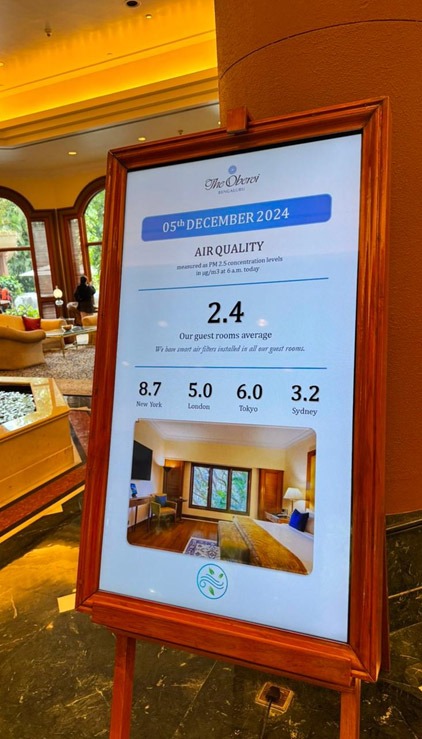
Basking in the morning sun, my phone buzzed with a WhatsApp message from a professional acquaintance. Curious, I opened it to find two striking images that initially brought a smile but quickly shifted my thoughts to the gravity of their environmental message. The visuals, though simple, conveyed an alarming truth about air pollution and its impact on the environment. The two pics below I am referring to are from the renowned Five Star Taj Hotel and Oberoi Hotel. Both are self-explanatory with a big, loud message.
Well, the Air Quality Index (AQI) is the centre theme of this piece. We all know pollution levels of 0-50 signifies good air quality, 51-100 is satisfactory with minor discomfort for sensitive individuals, while 101-200 indicates moderate pollution, affecting people with pre-existing respiratory or heart conditions. Beyond 200, air quality becomes poor, causing visible breathing discomfort with prolonged exposure.

Concerned by these statistics, I immediately checked Dehradun’s AQI, as I’ve been coughing intermittently for the past few days. My wife’s knowing glance affirmed what I feared: Dehradun, like many other cities, is grappling with growing unchecked pollution. Google confirmed the AQI levels were far from ideal, raising a crucial question: Are we unwittingly fostering a new kind of pandemic by letting air quality deteriorate so severely by our unthinkable moves? It’s a sobering thought, especially when juxtaposed with images promising “pure air” in luxurious spaces—a privilege not everyone can access.
This isn’t just about Dehradun or any other part of the country. Air pollution is a global crisis, impacting human health, ecosystems, and economies. Harmful pollutants like PM2.5, nitrogen oxides, and sulphur dioxide infiltrate lungs and bloodstreams, leading to respiratory issues, cardiovascular diseases, and even cancer. WHO estimates over 7 million premature deaths annually are linked to air pollution, making it one of humanity’s most pressing health challenges.
Environmentally, pollutants like carbon dioxide and black carbon accelerate climate change, melting glaciers and disrupting ecosystems. Ground-level ozone affects vegetation and crop yields, threatening food security. Economically, healthcare costs and lost productivity from pollution-related illnesses create a heavy burden, especially in developing nations.
Air pollution knows no boundaries. Transboundary pollution demonstrates how emissions from one region can impact neighbouring areas, making it a shared global challenge. Addressing this issue requires international cooperation—a topic already widely discussed on global platforms—with governments enforcing stricter emission norms and promoting renewable energy. Additionally, initiatives like expanding urban greenery, adopting clean cookstoves, and embracing sustainable practices can significantly reduce pollution. However, true success depends on individual action; every person must consciously contribute to the solution.
I feel the technology to address air pollution exists. Advanced sensors, satellite data, and predictive models help pinpoint pollution hotspots and guide targeted interventions. Public awareness campaigns in an even bigger way can play a vital role in encouraging lifestyle changes, like reducing vehicle use, minimising waste, and adopting eco-friendly habits.
So, why share this? To question the legacy, we’re leaving behind. Are we prioritising development at the cost of a liveable future? It’s time to reconsider our actions and mindset, discouraging practices that harm the environment. Change starts with individuals making conscious choices to protect our air and health.
Air quality is not just an environmental issue; it is a call to our shared responsibility. Addressing this challenge requires immediate and unified action. Together, we can strive for cleaner air, paving the way for a healthier and more sustainable future for generations to come.
Let us work towards a world where placards like the ones in the pictures are not a necessity but a reminder of a problem we successfully overcame.
While sharing this piece may not present ground-breaking information—many are already well-versed in this subject, some even more deeply than I—it is my small effort to inspire a shift in mindset. By fostering awareness and encouraging change, I hope to contribute to a liveable future. I’m doing my part—are you?
Photo Credit: Public Platform.
(Arun Kumar Singhal is a resident of Doon. He has been a social worker, an author, and a writer specialising in energy and environmental issues for over three decades.)