 By Dr Sanjeev Chopra
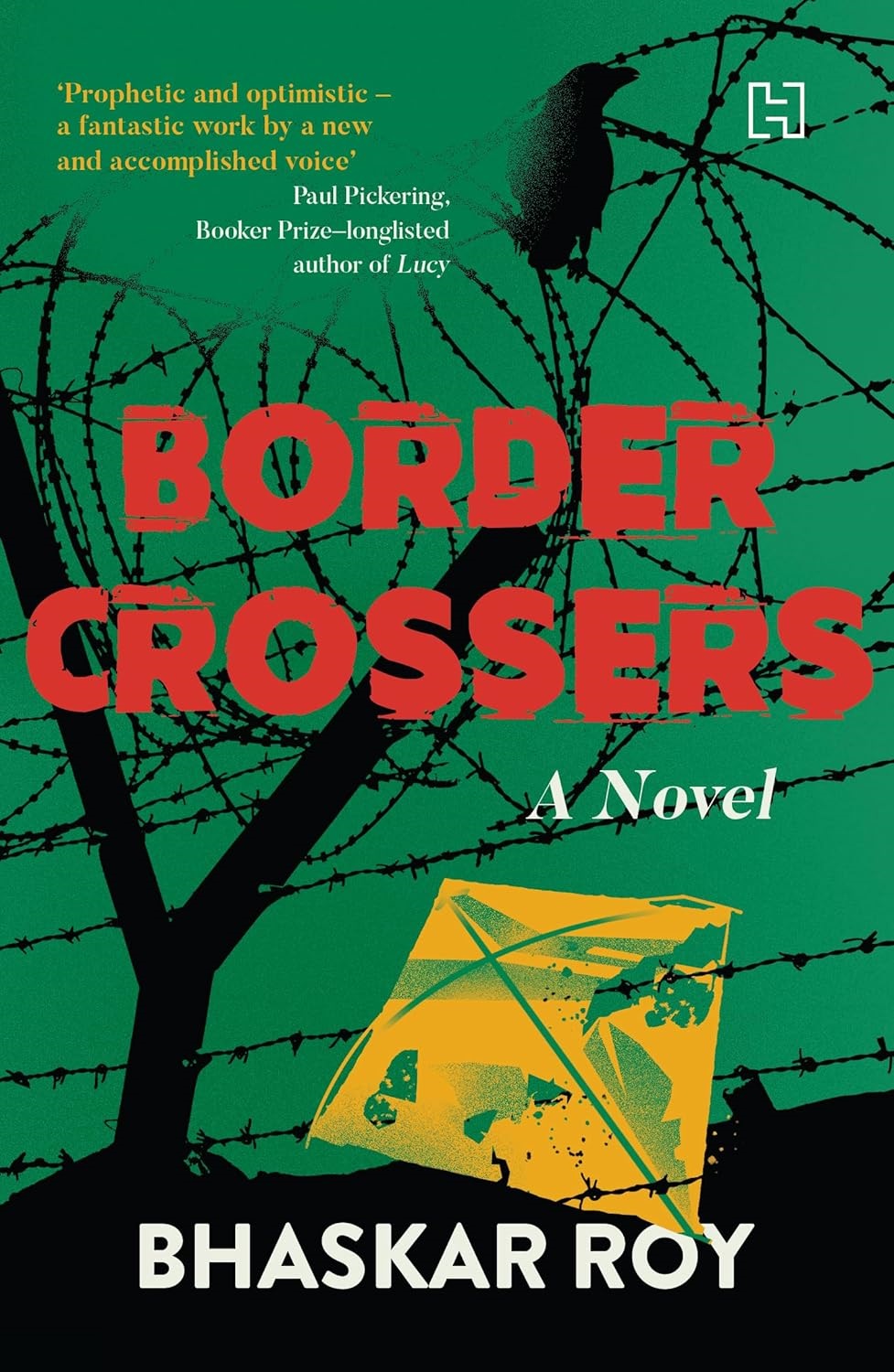
Multiple borders, spanning diverse geographies with their unique demographics and layers of intersectionality of class, caste and gender come to the fore in ‘Border Crossers’, a brilliantly evocative, lyrical offering of Bhaskar Roy. While the personal lives, hopes and aspirations of ex-diplomat Arijit Basu and his fiancée Nandita Kapoor are wrecked in their effort to rescue the undocumented migrant Rabeya, alias Rita, from Bangladesh, the Gurkha guard Ram Bahadur Chhetri is able to ‘manufacture a new identity’, and hopefully a new life for both of them.
The story line is both familiar and unique. Year on year, hundreds, if not thousands cross the India-Bangladesh border where women, who are more vulnerable than men, opt for an acceptable Hindu name and even apply a bindi or a vermillion mark (if the situation so demands). Even as getting the new identity card is more difficult, it is not an impossible paradigm as the new migrants often eke out an existence on the margins, with women preferring to be domestic helps. Thus, it is that Rita finds employment at Arjit Basu’s flat in the newly constructed Blue Lotus Grove beyond the interstate border across the river Hindon. Rita has been trained in the culinary art by her father who was employed by an American documentary filmmaker. She is wooed by Jamalan, another migrant from her own village, who is very good in his task in shaping iron grills: however, he is spotted and indoctrinated by Islamic hardliners and receives instructions from a Pakistani major who talks about ‘the spineless veggie Hindus’ with contempt. Jamal loves Rita to the core, but her feelings about him are ambivalent, especially as she fears the violent streak in him.
Meanwhile, although Arijit discovers the truth about her status, he feels protective towards her – almost like a father, and she too reciprocates by transiting in her relationship with him from Sir to uncle to the more affectionate and endearing Kaku. Arijit’s fiancée Nandita Kapoor too takes an immediate liking for her, and for at least some time in the middle of the book, it seems that the story could have a happy ending – with Arijit and Nandita settling in a farmhouse in the outskirts of the city, and Rita setting up home with Nandita’s driver Bharat. However, this was not to be, as just before Rita could move to the new EWS housing, the JJ cluster of these undocumented migrants is set on fire by the arsonists wanting to free Bharat of the foreign vermin. The fire brigade does not arrive, and the cops do what they are best at doing – sexually assaulting the vulnerable women and taking five thousand rupees to let them off for not registering the complaint about their illegal status on this land.
The shy and charming Rita is simply superb in her job – she has perfected both continental and Bangla cuisine, and manages the house to perfection, and even finds time to do her intricate needlework and embroidery which she learnt from her mother. Unlike her cousin Rekha, who becomes Mrs Varghese after her marriage, she is reticent in her approach to her suitors: and this makes her even more appealing – for Nandita’s driver Bharat, and of course Chettri, who has been her ‘protector’ from the very beginning of the story. It is he who has the earthy sense to give her a new look and whisk her away from the capital after the connection between her and Jamal – the terrorist – was likely to be tracked.
However, Jamal’s calls to Nandita – in connection with her house repairs are now exaggerated by the paparazzi to build a case against her – for she had been one of India’s most celebrated writers in Paris, and we get an insight into how top anchors can go to any length to increase their TRP ratings. She fights back and wins- but something has snapped, and she has no will to tie the nuptial knot with Arijit, not because she does not love him, but for his sake, and for their sanity and privacy.
Roy makes us traverse many different worlds: we absorb the conferencing, dialogue and diplomacy of Arijit Basu which seamlessly blends into the Bengali upper middleclass household of his sister in Kolkata, his niece in Dehradun and Mussoorie, and his daughter in the US. Then there is the world of Nandita Kapoor and her mother – the upper crust of the Punjabis, the Hindutva brigade of Neha Arora and the vigilantes, the Bauls and Fakirs of Chandni Bagh who talk of universal love – a sharp contrast to the venom spewing Maulana Saheb who wants to exterminate the Jews, Christians and Hindus, the spouse swapping upper crust of the new professionals, the street theatre activist Ranjana Mathur who is equally at home – both at the iconic Prithvi theatre as well as the squalid slums, besides of course the world of realtors who flaunt state power to oust peasants from lands which they have farmed for generations.
The vulnerability, identity crisis, desperation and likely sexual assault of the domestic staff has been a recurrent theme in contemporary fiction writing in India. From Aravind Adiga’s The White Tiger to Mahasweta Devi’s Truth/Untruth (translated by Anjum Katyal) and No Way In by Udayan Mukherjee, the asymmetry in the relationship between the Saheb and Madam vis a vis the driver and the maid is quite explicit: the latter being more vulnerable, and often at the receiving end. In Border Crossings, there is equal agency with those at the margins – they make their choices, shape their destinies, build their dreams and make intelligent compromises to survive. Perhaps Roy can do a sequel on the lives of the feisty Gurkha and the damsel from Rupda (Bangladesh) as they settle in Down Under – perhaps under another non de plume.
Finally, there are questions? Have border fences ever worked in history? Well, they have at best been able to arrest the tide, because the inexorable laws of the market will often drive people from starvation wage levels to greener pastures. What happens when demographics change to a point when the original inhabitants fear becoming an electoral minority? Is their vulnerability real, imagined or exaggerated, or a mix of all of these? To get a nuanced view on these issues, as well as the drivers and motivations behind the many shades of terror and religious intolerance that shape the Indian sub-continent, do yourself a favour by picking up a copy of this eminently readable book by Bhaskar Roy, whose writing has been described as ‘rich and sensual with an extremely good evocation of the sights, sounds and smells of India and Bangladesh’.
Sanjeev Chopra (born 3 March, 1961) is a retired IAS officer of the 1985 batch, from Kapurthala, Punjab. He is a resident of Dehradun. He is a former Director of the Lal Bahadur Shastri National Academy of Administration and has written a book, “We, the People of the States of Bharat: The Making and Remaking of India’s Internal Boundaries”, published in 2022. He is now the patron and honorary consultant to a literary festival, the Valley of Words International Literary Festival, held annually in Dehradun. Chopra has held the Hubert H Humphrey Fellowship (Cornell), the Robert S McNamara Fellowship (World Bank) and positions at Royal Asiatic Society, London, the Lakshmi Mittal and Family South Asia Institute (Harvard).