 By: Ganesh Saili
Life has taught me that once the genie is out, you can’t put it back into the lamp. Ours is the bandstand in Library Chowk. Gifted to the hill station a hundred years ago by H.H. Jagatjit Singh, Maharaja of Kapurthala, it never found a permanent spot. After being repeatedly pushed around, a few feet at a time, it was finally shifted southwards to ease the way for today’s traffic. The music went the way of the Raj, and when I last went past it, it hung on to the very tip of the Library. If pushed any further, I’m afraid it would slide down the hill, coming to rest in Dehradun.
Mussoorie’s affair with the royals or ex-rulers of princely states began in the nineteenth century, as the royals were discouraged from settling in Shimla. Imagine their delight in finding the perfect place to ‘chill out’- where everyone could ‘Tune in! Drop out! And paddle their own canoe’.
Among those who chose to settle here were the rulers of Patiala, Rajpipala, Nabha, Panna, Baroda, Jind. Tikari, Cooch Behar, Palanpur, Kasmanda, Kateswar, Rampur and Indore. They fell in love with these hills and built or rented splendid homes.
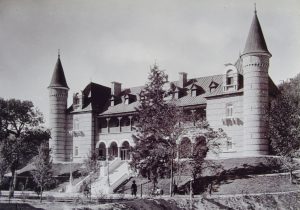
After a frenetic search, Kapurthala’s royals homed in on St. Helen’s Estate, a 22-acre property. Acquired in 1895, work began with the levelling of a vast hillside. The French influence on the fairy-tale castle is evident in the entire structure
Pic courtesy: Pramode Sawhney’s Art Press Collection
The District Gazetteer found: ‘It is the only building with any pretensions to architectural beauty in the hill station.’ The foundation was laid on 20th October 1896 for a solidly built, French-style chateau with four turrets piercing the Himalayan skies, adorned by a pair of stately winged lions, many fountains, statuary of classical goddesses, gargoyles and sprawling tennis courts.
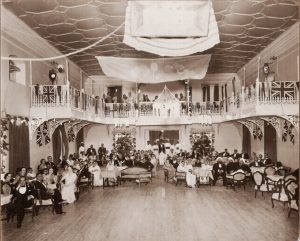
The fun and frolic at the Chateau de Kapurthala was legendary. Opened in 1899, it had Fancy Dress Balls with alcohol aplenty, and the tables creaked with copious amounts of food. In those days of wine and song, permissiveness pervaded these hills, making it a place of gaiety. Guests gleefully abandoned their scruples, except for the occasional odd-bod or Peeping Tom who complained: ‘Some bold women did not hesitate to take their lovers to their houses to share their bed.’
In 1941, a typical week in Mussoorie for the Maharaja meant two or three lunches at the Chateau, weekend dinners at the Savoy, and Sunday lunches at the Charleville. Mussoorie was always a ‘retreat’ for the Maharaja, but he never forgot his official duties or affairs of the State. His discipline was legendary, and he excused himself from his guests at 11 p.m. no matter what was happening.
He fell in love with Stella Mudge, a ballet and ballroom dancer, whom he took as a wife and built Stella Cottage for her as their love nest. At one time there were seventy-two gardeners to tend the garden and extensive lawns. Today it is home to advocate Aaloke Malhotra.
Pic courtesy: Kaputhala family achives
In May of 1949, Jagatjit Singh made his last visit to the Chateau, aware that the world had changed. The sun had set on the British Empire. Up until now, his evenings had been packed back to back with four or five engagements, but now he was a lonely old man who could only murmur: ‘The whole world once dined at my table, and here I am now, alone, listening to my radio.’ Two years later, aged seventy-six, he passed away in Bombay.
I met Brigadier Sukhjit Singh, presently the current owner of the Chateau, and paused for a chitchat. He reminisced about his time at the army camp in Germany after World War II. Walking through the Black Forest, an eerie silence had reigned. ‘It was as if even the birds avoided the horrors of the concentration camp of nearby Auschwitz.’
If you were to carry on beyond the Chateau’s wrought iron gates, you would go past St. Helen’s, home to Princess Sita and Prince Karam of Kapurthala. Stray further to Wycliffe (built long before the Chateau) for a glimpse of Tikka Brijendra Singh and his wife, Dawn. They are from Himachal’s Dada Siba. But that tale waits for another day.
Ganesh Saili, born and home-grown in the hills, belongs to those select few whose words are illustrated by their pictures. Author of two dozen books, some translated into twenty languages, his work has found recognition worldwide.