20 proposals cleared; tribute paid to Armed Forces
By Our Staff Reporter
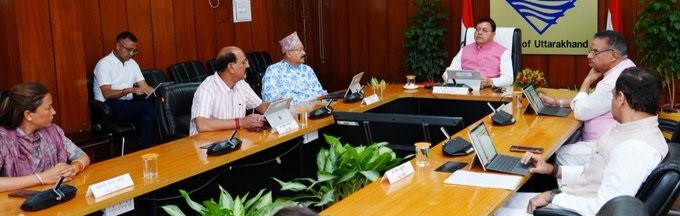
Dehradun, 16 May: The Uttarakhand Cabinet led by Chief Minister Pushkar Singh Dhami, held its meeting at the Secretariat here today and approved 20 key proposals. Among them was a significant decision aimed at improving the operational efficiency of Uttar Pradesh Power Corporation Limited (UPCL). Before commencing official discussions, the cabinet paid tribute to the valour of the Indian Armed Forces for their success in Operation Sindoor, expressing gratitude to the brave soldiers and Prime Minister Narendra Modi.
Following the cabinet meeting, Home Secretary Shailesh Bagoli briefed the media on the approved proposals. The proposals approved include revised guidelines for the Chief Minister’s Disaster Relief Fund, ensuring that funds are deposited only with the banks offering higher interest rates.
A policy for large poultry farms has also been sanctioned, which aims to benefit 3,000 families with a subsidy of 40 percent in the hills and with a subsidy of 30 percent in the plains. Additionally, a policy for housing destitute cattle in cow shelters was approved by the Cabinet today. This policy grants the District Magistrates (DMs) the authority to construct gaushalas with 60 percent government funding.
The cabinet also approved service rules for promotions in the Finance Department, specifically for Joint Commissioner Grade 1 and Grade 2 positions. The Uttarakhand Juvenile Justice Policy 2025, aligned with the Juvenile Justice Act 2015, also received approval of the Dhami cabinet along with a State Children Policy.
In a major step towards women’s empowerment, the Chief Minister’s Single Women Self-Employment Scheme was sanctioned, which is aimed to benefit 2,000 women in its first year with a Rs 30 crores budget and subsidies of up to Rs 1.5 lakhs.
Other significant decisions include declaring the Chief Retirement Officer of the Programme Implementation Department as the Head of Department and approving the Chief Minister’s Self-Employment Scheme 2.0, merging existing employment schemes. A new policy for the Tapovan to Gunjapuri, Narendra Nagar Ropeway Project was also given a go ahead by the cabinet, marking a major advancement in Uttarakhand’s ropeway network development. It may be pertinent to remind here that currently feasibility studies for 50 proposed ropeway projects are underway, with the Chief Minister authorised to decide on profit-sharing percentages for viable projects.
The cabinet also approved separate Fire NOC standards for industries based on height parameters and approved the continuation of employment under the Sajal Scheme until 2026. A regulation for virtual land deed registration was also sanctioned, while clarifications on the New Pension Scheme and Old Pension Scheme were provided, along with a cut-off date for the New Pension Scheme. Amendments to service rules for librarians under the Technical Education Department were also approved.
Not only this, the cabinet also approved the formation of the Dharmaswa and Pilgrimage Council. Another important decision entailed an increase of 28 percent to 30 percent in the green cess rate for vehicles entering Uttarakhand from other states, under the 2017 Motor Vehicle Taxation Reform Act 2003.
UPCL set to be transformed as per recommendations of McKinsey India
By Our Staff Reporter
Dehradun, 16 May: The Uttarakhand Cabinet today approved an action plan submitted by the Department to reform Uttarakhand Power Corporation Ltd (UPCL), based on suggestions provided by McKinsey India. This transformation plan aims to strengthen UPCL’s financial and operational efficiency, ensuring its stability and profitability through strategic reforms.
The plan focuses on four key objectives. First, stabilising and strengthening UPCL’s financial position by reducing its outstanding dues of approximately Rs 5,000 crore and eliminating the persistent losses incurred over the past six years. Secondly, reducing distribution and transmission losses, which remain significantly high in districts such as Haridwar and Udham Singh Nagar. Special emphasis will be placed on enhancing energy efficiency and upgrading infrastructure to curb these losses.
The third objective is to improve consumer experience, aiming to boost consumer satisfaction and enhance collection efficiency. Lastly, the plan seeks to promote green energy solutions, enabling cost-effective and environmentally friendly power distribution. These strategic reforms will establish UPCL as a reliable and efficient pillar of the state’s energy sector.
So far, most of the past moves and measures to reduce distribution and transmission losses have not been very successful. It will have to be seen if the recommendations made in this respect by McKinsey India can make any significant changes.
More cowsheds to deal with stray cattle
The Cabinet today also approved a structured policy for the construction and upkeep of Gaushalas meant for destitute cattle. As per the decision of the Cabinet, all the construction activities related to the establishment and facilities of Gaushalas will be managed under a District Level Committee, chaired by the respective District Magistrate. The budget for this initiative will be integrated within the relevant standard items of the Animal Husbandry Department.
Under the prevailing system, funds for the maintenance of destitute cattle in these Gaushalas will also be allocated through the Animal Husbandry Department and placed at the disposal of the concerned District Magistrate. The department will act as the nodal authority for grants related to cattle care and Gaushala funding.
Additionally, the Cabinet clarified that the Animal Husbandry Department’s role in Kanji Houses, operated by municipal bodies, will remain limited to providing medical treatment for destitute cattle. The operation and related expenses of Kanji Houses will continue under the respective municipal authorities.
The Cabinet has also authorised the District Magistrate to grant financial and administrative approval for the construction of Gaushalas costing up to Rs 1 crore, ensuring streamlined implementation of the policy across all districts.