
 By Alok Joshi
There has been a lot of media attention and buzz around India-China relations in the wake of the recently held SCO Summit in Tianjin. You might have heard a lot of analysts, party spokespersons and scholars passing judgements from their air-conditioned media studios. You might have also come across many arm-chair philosophers who voice their half-baked opinions from their cozy living rooms as if they are the last word on the subject.
While everyone has a right to voice their opinion, I think many such arguments are based on limited readings or media reports.
I am not an authority on the subject but do have firsthand experience of working and living in China for over 12 years (2007-2019). During this time, I worked for five companies with Chinese employees, travelled to over 20 cities and villages, lived in Chinese communities and interacted with thousands of locals from different walks of life. I guess that qualifies me to offer my two cents.

In December 2020, my first book, a memoir titled “12 Sweet & Sour Years in China” was published, wherein I shared my experiential journey and perspectives on Chinese culture. I not only happily survived in China but enjoyed most of my time. I always kept my eyes and ears open to new, even bizarre sights and situations. In this book, I have openly shared my humble opinion that there is a lot of potential in India-China cooperation and friendship. To the diehard pessimists, I always say that “you can love China, or you can hate China, but you cannot ignore China”.
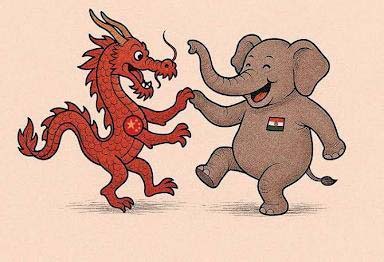
India and China account for about 37 percent of the world’s population. If the elephant and the dragon dance together, it can impact and alter the turbulent global geopolitics emerging from Trump’s tariff war. India has been unfairly hit and has the right to make strategic choices in national interest. These moves have hurt years of carefully nurtured Indo-US ties, which Washington had hoped would act as a regional counterweight to China. Both India and China are attempting to reset their relationship, which is indeed a promising step forward. Both countries recognise that they are development partners, not rivals. Additionally, Russia siding with the two most populous economies makes for a powerful bloc in itself.
To me, it is currently more economic than political reasons for this warming-up of relations. PM Modi has reportedly discussed reducing India’s burgeoning trade deficit of $99.2 billion. India will need Chinese investments to achieve its GDP growth rate aspirations. At the same time, China sees India as a huge market considering its consumer population. There is a common interest to resist this bullying from the West.
I totally get it when analysts reiterate trust-deficit between the two countries. We have had border issues with China for a long time. I was very much in Beijing during the 2017 Doklam stand-off. But I can vouch, it did not in any way affect the way my Chinese colleagues and friends perceived me as an Indian. No doubt 2020 Galwan clashes and China’s support to Pakistan during Operation Sindoor cannot be forgotten. We have had border issues for several decades and I don’t think these can ever be sorted out completely.
However, Chinese President Xi Jinping is reported to have said that border issues should not define India-China relationship. The 2014 Patrolling Agreement is a result of a series of bilateral discussions and negotiations. It has definitely set off a tentative thaw in our ties.
I had also mentioned in my book the need for people-to-people contact to overcome gross misconceptions on both sides. Many Chinese still think India is a poor country of ‘Slumdog Millionaire’ fame, that all Indians are dark skinned, only Buddhists, and everyone here can have four wives. The older Chinese generations know so little about their neighbouring country. I also noticed that both countries published only negative news for local consumption thereby influencing their perceptions negatively. Similarly, China is not only about fake products. I for one am deeply impressed by their infrastructural development, discipline, hard work, health-consciousness and respect for elders. Similarly, the Chinese generally consider Indians as smart and intelligent people having IT supremacy and good English language skills. They are big fans of Bollywood movies and yoga.
India needs to be always vigilant and tread cautiously in its approach towards China. Defence related talks must continue to iron out differences. Until then, more tourism, cultural exchanges and people to people contact should be encouraged. Also, we need to retain our strategic autonomy without falling into any one particular camp just to escape bullying.
To sum up, we should and need to “dance”, but the dance will involve complicated choreography.
(Alok Joshi is former Director (HR & Marketing) PetroChina (CNPC); Head, HRD, GNPOC, Sudan; Head HR, Mumbai High Asset, ONGC; Civil Services probationer; motivational speaker, author of three books and has over a hundred published articles to his credit.)


