 By: Ganesh Saili
‘Khushi take, khushi no take, otherwise dusri dukan dekh!’ (which meant either buy or don’t buy! Otherwise, look at another shop!) grumbled the first generation of businessmen from the plains, struggling with their mix of English and Hindi to communicate with the troopers from the nearby army cantonment depot.
I can still hear the chuckles of the labour leader Gopal Dutt Dimri and my father. Having left school, they arrived in Mussoorie, seeking employment. Edgar and Willie Chowfin, of Mesmore Inter College, Pauri-Garhwal, had made sure the two had a smattering of English, enough to secure employment as salesboys at Fitch & Company, below the General Post Office along the Mall. Mussoorie’s bazaars were well stocked with all kinds of things: in the early 1900s, it is said that ‘the Landour Bazaar has shops, petty dealers, cloth merchants, mahajans (usually moneylenders) and native bankers. In its heydays, it was one of the best supplied bazaars in India, with merchants, traders and merchants of all shapes and sizes (in fruit and vegetables: the majority of the larger dealers are direct importers from European manufacturers in their particular lines, and one can get almost anything one requires).’
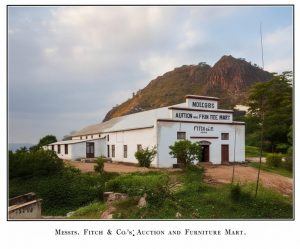
Pic courtesy: the Internet.
Fitch & Company and Joliffe had a store with showrooms and wine godowns for their local staff, as well as owning a smaller store in Dehradun. It was smaller than the one up here.
I too set out hunting for a job, many years later. The summer of 1969 saw me fishing around for my first employment at the Language School, where I met the venerable Rev. Caldwell Smith, who had the rare ability to connect intonation with the place the speaker came from. Barely had I opened my mouth, he delivered a coup de grace: ‘You’re a Garhwali from Chamoli district!” Fifty years later, the ‘Hari Kitab’ (pub:1971) is the basic book every teacher swears by to this day. The green rexin-covered book remains the standard manual for students from universities flocking from Berkley, California, Arizona, Stanford, and Chicago universities to learn the ropes of Hindi, Hindustani and Punjabi.
Pic courtesy: Bruce Skillicorn.
In a lifetime spent in the hill station, I have bumped into a handful of unforgettable characters. There was Professor Zimmerman, who found solace in the drawings of Ahoi, from Saharanpur district; Arthur Lopatin from Columbia University sought solace in the politics of Eastern Uttar Pradesh; the balding Paul Keupfele’s took to Adwaith philosophy; and believe-it-or-not, I even met a linguist logging the whistle calls of the shepherds of the higher meadows, and then another listing the clucks of the muleteers egging on the charges.
‘Teach me some bazaar slang, please!’ pleaded young Jack Dayal. I succumbed in a moment of youthful camaraderie, believing that truly happy are those who can help others become happy. A few days later, I taught him the best ABCs of bazaar slang that I had heard bandied about in the bazaar.
Afterwards, as we were going for our usual lunchbreak at Char Dukan, with the other teachers. John hailed me like an old friend, well-met with a shower of words that I had recently helped add to his vocabulary.
I must say that Mr Dhingra, a teacher who helped Gerald Berryman write his tome on the Hindus of the Himalaya, rose to my defence, saying, ‘Never try teaching a monkey how to use a razor!’
I thought I had seen it all until I met pretty Pauline, a summer student on a scholarship, who was spending a year studying the effects of marijuana on the mind.
‘How’s the Hindi coming along?’ I made conversation.
‘Fine! It’s the folks in the Landour bazaar who don’t seem to know what I’m saying!’
I don’t think that was the least of the problems. Trouble knocked, I discovered, when a plump busybody living in the neighbourhood made baseless complaints against the school for violating visa regulations.
At times like these, I am constrained to agree with those who believe Landour’s altitude is to blame: lack of does play havoc, especially with those whom God has blessed with a feeble mind.
Ganesh Saili, born and raised in the hills, is one of the select few whose words are illustrated by their pictures. As the author of two dozen books, some of which have been translated into twenty languages, his work has gained renown worldwide.