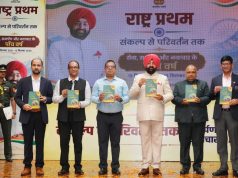
Garhwal Post Bureau
Haridwar, 22 Jan: Union Home Minister and Minister of Cooperation, Amit Shah, today addressed the “Centenary Year Ceremony – 2026” organised by the Gayatri Parivar here on the occasion of the birth centenary of Mata Bhagwati Devi Sharma and the centenary year of the Akhand Deep. On this occasion, several distinguished dignitaries, including Chief Minister Pushkar Singh Dhami, were present.
Union Home Minister Amit Shah said on the occasion that Haridwar is a confluence of faith, spirituality, and culture. He said, “By coming to the ‘Akhand Jyoti’ Conference today, I am experiencing unbroken energy and consciousness. Revered Pandit Shriram Sharma chose the path of individual transformation to revive faith, spirituality, and culture. He worked to awaken and energise the divine soul residing within every individual. Those who know Sanatan Dharma, understand Indian culture, and are familiar with India’s history have a firm belief that, if solutions to all problems of the world exist in one place, it is within the Indian tradition itself.”
Shah added that the spiritual reconstruction of India will be beneficial not only for India but for the entire world. Great visionaries such as Swami Vivekananda, Maharshi Aurobindo, and Pandit Shriram Sharma have all expressed, through their powerful words, the belief that when India awakens with its full radiance, it will illuminate the entire world and the whole universe. Shah added that the words of such great souls and visionaries never fail. We must move forward by accepting the truthful words spoken by them as the word of Brahma. He further said that Pandit Sharma, through the Gayatri Mantra, brought devotion out of the sanctum of the temple and carried it to the lips and souls of the common people.
Shah recalled that Pandit Shriram Sharma Acharya and the revered Mata Bhagwati Devi, during their very lifetimes, accomplished the work of many eras. They created a banyan tree whose shade today guides more than 15 crore followers in over 100 countries along the path of spirituality, helping them advance on the path of the welfare of their souls. He said that moving along a single path with a single goal from 1925–26 to 2026—carrying not just one individual and one idea, but millions of people together—proves the immense energy inherent in Pandit Ji’s life, thoughts, and actions. Shah said that even so many years after Pandit Ji’s passing, the Akhand Jyoti has not only continued to burn but has also taken a permanent place as a lamp in the hearts of millions of people.
Shah recalled that 1925–26 was a year of national resurgence. In that very year, the Rashtriya Swayamsevak Sangh (RSS) was founded and it too is celebrating its centenary. Gita Press, Gorakhpur, is also marking 100 years since its establishment, and this year is likewise the birth centenary of the revered Mata Ji. He said that the convergence of all these in the same year signifies that God must have created that year specifically for the resurgence of India.
He said that for an individual, a lifespan of 100 years is considered a form of completeness, but for institutions that work for individual transformation and national resurgence, it represents a formative stage, in which they move forward with renewed energy. Shah added that Pandit Shriram Sharma connected millions of people with the Gayatri Mantra, Gayatri worship, and Gayatri spiritual practice. India will never be free of the debt it owes to him. He connected millions of people with the movement of individual transformation and devotion, guided them on the path of spirituality, and revitalised the Gayatri Mantra. Without discrimination of caste, community, or gender, he showed every soul, through the Gayatri Mantra, the path to welfare and upliftment. Shah added that Pandit Shriram Sharma received guidance from Mahamana Madan Mohan Malaviya to take the knowledge of the Gayatri Mantra to the masses and made it the guiding mantra of his life. In 1971, the divine light manifested on this sacred land, Shantikunj was established, and crores of people began to walk on the path shown by Gurudev. He said that no religion, religious leader, or philosophy can change an era. Pandit ji gave the maxim, “Hum Badlenge, Yug Badlega” (We will change, the era will change) and this principle showed the way to the entire nation. He said that until the individual, the nation, and the times change, the question of changing an era does not arise.
Union Home Minister and Minister of Cooperation said that Pandit Shri Ram Sharma Ji linked the slogan “Hum Badlenge, Yug Badlega” (We will change, the era will change) with the Gayatri Mantra. He said that by giving the message “We will change, the era will change,” Pandit Acharya Sharma provided the entire nation with a new direction and renewed resolve. He said that the Gayatri Mantra was originally composed for the welfare of all humanity on Earth, but over time it had gradually reduced to a mere ritualistic practice.
Shah pointed out that the magazine ‘Akhand Jyoti’ reaches crores of people in more than 100 languages without any advertisements or external support. This is the direct result of the austere spiritual practice of Pandit Shriram Sharma and revered Mata Ji. The Home Minister said from the freedom movement to social reforms, Pt Shriram Sharma Ji played a significant role in nation-building. He participated in the Salt Satyagraha, endured the lathi blows of the British, and after independence, launched a movement against the prevailing social evils in society. He broke the shackles of caste discrimination, showed society the path of equality, and granted women the right to chant the Gayatri Mantra. He called for the adoption of dowry-free marriages. With a creative vision, he removed social evils. Along with campaigns for freedom from addiction and the cleaning of the Ganga, he also undertook the work of tree plantation.
The Home Minister also inaugurated the Patanjali Emergency and Critical Care Hospital in Haridwar.