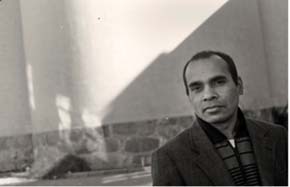
In conversation with Anisur Rahman, Bangladeshi-Swedish writer
 By Ashish Singh
Bangladesh today stands at the edge of a precipice—politically fractured, ideologically torn, and staring at the possibility of democratic collapse. The interim government, led by Nobel Laureate Muhammad Yunus has taken an unprecedented step by banning all political activities of the Awami League, the country’s oldest and most influential party. This is not just a bureaucratic measure or a legal maneuver—it is a direct assault on the legacy of 1971, on the secular, progressive spirit that defined the country’s liberation struggle.
The ban, imposed under the guise of national security, masks a more sinister agenda: the return of reactionary, anti-liberation forces to the helm of power. It is not only a betrayal of the democratic aspirations of millions of Bangladeshis but also an exposure of the deeply compromised politics of an interim regime increasingly aligned with Islamist hardliners and their long-standing collaborators. As the world watches, the image of Muhammad Yunus—a once-revered development icon—is being redefined, not by Western accolades, but by his actions at home.
This article explores the decision in detail, its political motivations, and the long-term implications for Bangladesh’s democracy, civil liberties, and historical legacy.
What is this new decision on the former ruling party, the Awami League?
Anisur Rahman: On the night of May 8, the interim government in Bangladesh, led by Muhammad Yunus, imposed a ban on all political activities of the Awami League, the party led by former Prime Minister Sheikh Hasina. The decision came nearly a year after Hasina was ousted amid mass protests. Following the ban, the Election Commission on May 12 officially de-registered the party.
The party—which led the country’s 1971 Liberation War—was banned under the country’s Anti-Terrorism Act. The restriction will remain in place until a special tribunal completes its trial into the party’s alleged role in the deaths of protesters during the July-August anti-government movement last year. The protests were largely led by a new political coalition and members of Jamaat-e-Islami’s student wing, the same group that had opposed Bangladesh’s independence and collaborated with the Pakistani army in 1971.
- Why was this decision brought in?
Anisur Rahman: This decision is the latest in a string of anti-democratic and pro-extremist actions taken by the Yunus administration. The government and its supporting political factions are largely dominated by Islamist forces who long to return Bangladesh to a pre-1971 ideological framework. In contrast, the Awami League represents secular, progressive, and liberal politics.
In addition to the Islamist groups, the Bangladesh Nationalist Party (BNP) has also supported the decision. It is likely that the interim authorities held informal talks with BNP leadership before moving forward. These stakeholders view the Awami League as a formidable obstacle to their authoritarian and regressive agendas.
What we see now is a coordinated effort to eliminate the Awami League from the political arena out of fear that it might return to power through an inclusive election. The method adopted is unmistakably ultra-fascist.
- What justification is the interim government offering?
Anisur Rahman: The government claims that the ban is necessary to safeguard national security and sovereignty and to protect activists from the July movement, along with plaintiffs and witnesses involved in tribunal proceedings.
The authorities have expanded the scope of the International Crimes Tribunal to include any political party accused of killings or inciting violence during the anti-Hasina protests. This is a deliberate move to criminalise a party that has been central to Bangladesh’s democratic evolution.
- How do you see its impact?
Anisur Rahman: The consequences of this decision will be grave and ultimately self-destructive for the Yunus regime. The ban infringes not only on the political rights of Awami League supporters but also on the broader rights to free expression and media freedom in Bangladesh.
According to the directive, no one will be allowed to speak, write, or even post online in support of the Awami League. This represents an Orwellian descent into censorship and authoritarianism. In taking this step, Yunus and his backers have betrayed the democratic aspirations of the country and exposed themselves to the global community.
The world is slowly beginning to recognise the darker truth behind the polished image of a Nobel Laureate—an image crafted by years of propaganda and Western imperial agendas. The reality on the ground is far bleaker.
- What can Sheikh Hasina’s Awami League do at this stage?
Anisur Rahman: On May 11, the Awami League issued a statement accusing the interim government of “stoking division” and trampling on “democratic norms” by banning all of its activities. The party, which has withstood decades of repression—from the Pakistani era to the brutal assassination of its founding leader Bangabandhu Sheikh Mujibur Rahman—is no stranger to authoritarian attacks.
Today, many of its leaders are in jail, on the run, or in hiding. And yet, the party remains united, grounded in deep grassroots support across the country. However, it must now re-evaluate its strategy with a clear-eyed assessment of its strengths and weaknesses.
At this critical juncture, the Awami League must intensify its international campaign. The party should treat this as a wartime scenario. Exiled leaders must consider a coordinated return to Bangladesh. They must also engage influential international lobbyists and build global solidarity.
The party can help launch Citizen’s Forums or National Unity Committees—non-partisan platforms calling for democracy and national survival. Awami League’s overseas chapters can support these initiatives not as party organs but as democratic citizens’ efforts.
This is not just a political fight. It is a battle between the ideals of 1971 and the forces that betrayed them. The people must be mobilised around this binary: pro-1971 versus anti-1971. It must be clearly defined and firmly communicated. Only then can Bangladesh’s democratic soul be preserved against the creeping authoritarianism of the Yunus regime and the “Hercules gang” that now threatens to erase history.
(Ashish Singh is a social and political scientist.)