The Books from My Shelves
By Kulbhushan Kain
I have spent a lifetime in schools, as a student, a teacher, a Principal, and a Director. If there is one thing that classroom, staffroom, and a Principal’s office taught me, it is that a book read at the right age never really leaves you. It moves in, quietly, and rearranges the furniture of your mind.
“Rebecca” by Daphne du Maurier was not my discovery but my inheritance. My father loved it, and he pressed it into my hands when I was still a boy, too young, perhaps, to understand everything in it. But I understood the mystique- the unseen first wife whose presence filled every room of Manderley, the haunting beauty of a house that seemed to breathe its own secrets. Ironically, whenever I see an old estate, it always reminds me of Manderley. Rebecca remains, without contest, my favourite book.
If Rebecca speaks to the mysteries of the human heart, Mitch Albom’s “Tuesdays with Morrie” speaks directly to its wisdom. It is a slender, deeply moving account of a former student reconnecting with his old college professor, Morrie Schwartz, during the final months of the older man’s life. Structured as one last “class” meeting every Tuesday, Morrie shares simple, profound truths on love, forgiveness, family, and what truly matters before time runs out. As an educator who has spent a lifetime in classrooms, it resonates with me at a deeply personal level. It is not a book about death, but a quiet, beautiful masterclass on how to truly live life.
My father also presented me “Of Human Bondage” by W Somerset Maugham, and it sits close behind Rebecca in my affections. Its title comes from Spinoza and from his idea that human beings are enslaved by emotions they cannot master, and the novel traces this bondage through the long, painful education of Philip Carey and his idealised notions of love and art, his self-destructive obsession with the callous Mildred, his shame over his clubfoot. But the single image that has stayed with me longest is when the bohemian philosopher hands Philip a Persian rug and tells him the meaning of life is woven into its pattern. Years later Philip understands. The pattern has no meaning beyond itself, and the weaver’s freedom lies in shaping triumph and sorrow alike into something whole. It taught me, at an impressionable age, that true freedom is not the absence of limitation but the acceptance of it.
Arnold J Toynbee’s monumental ten-volume “A Study of History” provided my first fundamental understanding of how civilisations rise, flourish, and decay. I turned to its formidable pages during a six-month period when I was drifting in life, unemployed, and it kept me firmly anchored. Whether one agrees or disagrees with his grand sweep of historical cycles, it remains a magnificent, indispensable work that shaped how I view the human civilisational journey.
“One Day in The Life of Ivan Denisovich” by Alexander Solzhenitsyn was a different kind of education altogether- an education in suffering, and in the strange dignity that can survive it. Through one ordinary day in a Soviet labour camp, Solzhenitsyn laid bare a system that reduced men to their hunger for a scrap of bread, and yet somehow, within that bleakness, showed what endurance looks like. It is not a comfortable book. It was never meant to be. But it taught me something about the extremities of the human condition that no history lesson ever could.
Hemingway’s “The Old Man and The Sea” taught a gentler, though no less demanding, lesson: that persistence has its own nobility, win or lose. An old fisherman going out, day after day, against an indifferent sea. There is a simplicity to it that conceals enormous depth, and I have returned to it more than once whenever life required a reminder that showing up matters more than the catch.
As a schoolmaster, the whole of my working life, I cannot leave out “Goodbye, Mr Chips” by James Hilton. Written in the early 1930s, it is the portrait of a teacher’s life that every teacher secretly hopes might be written about him one day: unspectacular, devoted, quietly loved by generations of boys, who did not always say so at the time. I have read it more times than I can count, watched the film adaptations more than once, and it has never once failed to move me.
“Julius Caesar” gave me, at school, my first taste of Shakespeare’s understanding of ambition and betrayal — Brutus’s tragedy is doing the “right” thing at the wrong moment.
“The Fountainhead” by Ayn Rand introduced me to the idea that integrity is worth defending even at the cost of everything else. Howard Roark’s refusal to compromise his architectural vision, whatever it cost him, is one of the fiercest arguments for individual conviction I have ever read.
The first Agatha Christie novel I read was “The Murder of Roger Ackroyd”, and it was responsible for every Christie novel I read subsequently. My elder brother was the one who put it in my hands. He gave me one instruction: read it all the way to the end, and let him (my brother) be the one to read me the final pages aloud. I still remember that moment. The novel is narrated throughout in the first person, and it is only in its closing pages that the narrator Dr James Sheppard -the very voice that has been telling us the whole story, gaining our trust chapter by chapter -reveals himself to be the murderer. My brother read those lines out to me with unmistakable relish, and as I write, I am getting goosebumps. It remains, for me, the finest proof that fiction can achieve greatness through sheer ingenuity of design.
I adore “Animal Farm”. Only George Orwell could have taken something as simple as a farmyard rebellion and shown with such precision, how hierarchy creeps back into even the most idealistic of revolutions, and how “all animals are equal” quietly becomes “some are more equal than others”. I have read it as a student, taught it as a teacher, and it grows more relevant, not less, with every passing year.
To balance the weight of history and mystery, I must reserve a place for pure, unadulterated joy – and no one delivers that better than PG Wodehouse. “The Code of The Woosters” is arguably his crowning achievement, a masterclass in comic timing, high farce, and incomparable linguistic wit. A perfect sanctuary of sunshine and laughter for any reader.
Looking at my bookshelf, I notice something: these are not books I chose for their fame or their prizes, though several carry both. They are books that arrived at particular moments – a father’s recommendation, a six-month period of drifting, a part of my school syllabus, a classroom I once stood in front of – and they simply stayed. That, I have come to believe, is the only test that matters. Not whether a book is celebrated, but whether it is still there, on the shelf of your mind, years after you first opened it. And let me confess this – books have shaped the way I think more than human beings.
That is because I trust them more!
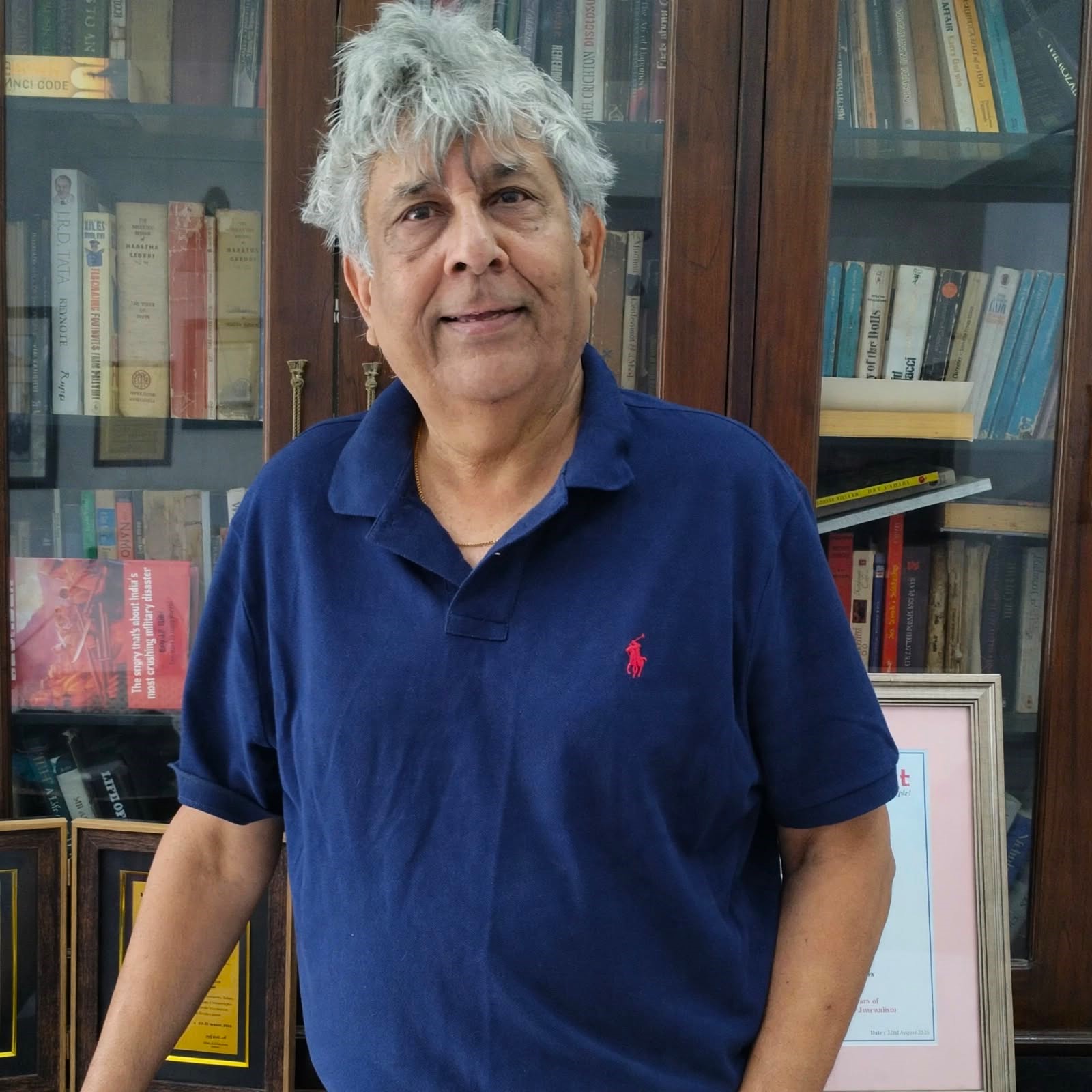
(Kulbhushan Kain is an award winning educationist with more than 4 decades of working in schools in India and abroad. He is a prolific writer who loves cricket, travelling and cooking. He can be reached at kulbhushan.kain@gmail.com)