 By Radhika Nagrath
The scriptures say that the ‘purv sanskars’ (impressions from the past birth) and environment at home have a lot many roles in shaping a personality. The early formative influences and childhood adversities moulded the child Bal Krishna into an accomplished man of today.
Birth and Relocation:
Born to Jai Vallabh Suvedi and Sumitra Devi, Balkrishna’s life started in the Suvedi family that lived in district Syangja, some 200 kilometres away from Kathmandu, the capital city of Nepal. There was extreme scarcity of jobs in Nepal in those days and people often migrated to India in search of employment. His parents also moved to India, travelling to various cities, the father tried his hands at different jobs. Finally, arriving in the holy city of Haridwar, they decided to settle and started living in a small rented house in Dadu Bagh Colony in Kankhal, Haridwar. Bal Krishna was born on 25 July, 1972 on 10th day of the month, Dashmi tithi as per lunar calendar. The moon was in the Rohini Nakshatra as per astrological calculations. To raise their son surrounded by the love and affection of grandparents, they moved back to their native village Bharuwa in Nepal after three months.
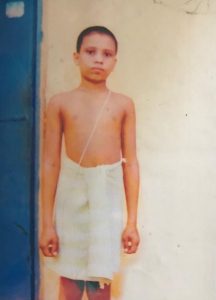
A braveheart:
At the age of two-and- a-half, child Bal Krishna suffered burns to a large part of his body. But that did not change his behaviour. He was severely burnt but never cried in pain or showed any distress. “He rarely cried, not even when I changed his dressings and applied ointments,” says his mother Sumitra Devi. The child even smiled at the villagers saying he would be alright soon.
Bal Krishna shared, “It was around the harvest time in winters. Grains were piled up in the courtyard in ‘Chattas’ (piles). My grandparents were helping the labourers. I was toddling around, half naked. My mother had just given me a bath in the courtyard and was cleaning up afterwards. A little while ago, she cooked breakfast for the labourers in the Allav-Chullah (earthen oven). The logs had burned down to ashes and there were none visible. I went and sat near the ‘Allav’. The fire wanted to test my endurance. I was wearing a polyester shirt that caught a light from a flying ember and turned me into a ball of fire. Everybody rushed to my help. My grandfather put out the fire with bare hands and burnt himself. My stomach was severely burnt as the shirt was stuck to my skin. There were no doctors in our village. My mother went running to a local Vaidya who hastily prepared an ointment and asked her to apply it on the burnt skin, frequently. I believe I was saved by this ointment. I remember that I had stopped crying in a day and started sermonising instead.” His not crying was taken as a saintly life in previous birth by some villagers and possession of a malevolent spirit by others. Nonetheless, how effective are those herbs in treating ailments and burns, the child had realized.
Determination of Dhruv attracted him:
Bal Krishna’s mother worked in the farms during the day and did all household chores in the evening. Like all mothers in India, she would tell him stories from the Hindu scriptures at bed time. Once she narrated the story of Dhruva Bhagat which the child Balkrishna liked so much that he would want to hear it night after night. He was so enthralled by the determination of Dhruva that he decided to become Dhruva himself. If Dhruva, who was barely five years old, could overcome all hostilities and force God to come and meet him, why could not he, he pondered. Acharya says “I would dodge to the cattle shed and sit there for hours with eyes closed. This was a much safer place than the corners of the house, where mother would find me out quickly and jolt me to open my eyes. The story of Dhruva Bhagat had stirred my innocent horizons”. Entering into meditative moods even continues till today whenever he gets bored from routine tasks, he runs away to unknown places and mountains to meditate and get solace in nature.
Bearing grief alone:
Balkrishna lost his grandmother at the age of four and his three year old younger sister, at the age of nine. When his sister was buried, Balkrishna was not taken to the burial ground. He desperately wanted to know the place of her burial and would frequently ask his mother about this. Tired of his questions, his mother one day pointed to a nearby hill where she was buried. Balkrishna often visited that hill to cry his heart out. He had learnt to bear his grief alone.
Childhood sans facilities:
Balkrishna’s childhood was spent barefoot. The only time he had new clothes was when his father came home from India. He would bring him a pair of half pants and shirt on every visit. Due to the shortage of clothes, Balkrishna had learnt to mend his old clothes and tie the buttons quite early in childhood. His primary school was Tej Pragati Primary School in Kafaldanda located nearly four kilometres away from his home, on another hill. The way to school was through the hilly terrains and farms. Walking through the farmlands he reached school but his feet were weak and ached upon walking. Shaligram, an elderly boy, took him to school.” They did not have a clock to know the time. Acharya says, “The sun was first seen on the hills and then in the village. We calculated time by its movements. The spot of sunshine changed with the seasons, but we were never late for school.”
Bullying by peer group:
Balkrishna’s father had always wanted a girl when he was born, so he was never given a haircut till he was five or six years of age. His parents would send him to school dressed up like a girl, wearing earrings. Once his classmates brewed some fun and made him cry. He came home sobbing and reported the matter to his father. After that he never confided anything with his father. After class three, he was sent to another school in a nearby town Bhukunde. The town students considered themselves superior to the village students. They bullied Balkrishna, considering him a village boy.
Fascination for plants:
In adversities, he had no attraction for toys, liked productive tasks instead. He was fascinated by plants and trees. He liked to look at the flowers and leaves, touch and taste them. The flowers with a strong fragrance were his favourite. “I wanted to do something useful for my mother. I brought wood and made a fence around the house and decorated it with leaves and flowers” quips Acharya. Neighbours always spoke highly of him and asked their children to be like him.
Learnings from mother:
Acharya’s mother learnt the use of herbs and other traditional medicines from her father. Medicinal herbs grow in abundance in Nepal and she knew how to use them for different ailments. The villagers used to come to her, seeking remedies for their illnesses and she would readily offer them herbal solutions. Acharya says, “She was my first teacher of Ayurveda. She would use ‘Vasa’ (Malabar nut) for cough and ‘Chitramulak’ herb for fever. During seasonal changes, she would boil the leaves of ‘Chati-van’ (saptparni) and make us drink it for a couple of days. It used to be very bitter.”
(Excerpts from his biography written by Soma Nair).