Garhwal Post Bureau
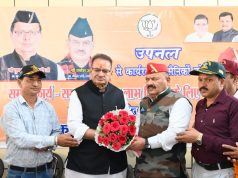
Dehradun, 14 Aug: Col Ajay Kothiyal (Retd), who played a leading role in the post-2013 Kedarnath reconstruction, has been entrusted by the Dhami government with the critical task of rebuilding the flood-affected Dharali-Harsil Valley. The region, situated along the Bhagirathi and its tributaries, has recently witnessed severe and widespread devastation, resulting in significant loss of life and property. The rescue operations are still underway.
Kothiyal is an accomplished Everest summiteer and is a former principal of the Nehru Institute of Mountaineering (NIM). He is widely respected for his expertise in disaster response and rehabilitation in high-altitude and geologically sensitive terrains. After his retirement from NIM, Kothiyal joined politics and, to begin with, had joined the Aam Aadmi Party (AAP) as its state president. But he lost the elections and then joined BJP. Currently, he holds a Lal Batti post as Chairman of the Uttarakhand Ex-Servicemen Welfare Advisory Committee.
His appointment to lead the reconstruction works in Harsil and Dharali indicates the government’s intent to undertake a technically sound and resilient reconstruction effort in the valley. In a parallel initiative, a multidisciplinary team of experts constituted by the state government has arrived in Dharali to conduct a detailed site inspection and probe the underlying causes of the disaster. The team comprises Shantonu Sarkar, Director of the Uttarakhand Landslide Mitigation and Management Centre (ULMMC); Dr DP Kanungo, Chief Scientist at the Central Building Research Institute (CBRI), Roorkee; Ravi Negi, Director of the Geological Survey of India (GSI); Dr Amit Kumar, scientist at the Wadia Institute of Himalayan Geology; and Mohit Kumar, Principal Advisor at ULMMC.
The expert delegation has already undertaken an extensive field visit, covering multiple locations across the affected zone. Their investigation focused on assessing the magnitude and nature of the damage, collecting debris samples, and analysing the flow dynamics and dispersion of debris in the Khirgad area. The team also interacted with local residents to gather firsthand accounts and contextual information regarding the incident.