 By Kulbhushan Kain
A few years ago, I stood in Fairview Lawn Cemetery in Halifax, Canada, among the graves of those who had died in the Titanic disaster.
It is a strange place to visit. There are rows upon rows of names, some familiar, many forgotten, and some that carry no name at all. More than 120 victims of the Titanic are buried there, victims whose bodies were recovered from the icy waters of the North Atlantic and brought back to Halifax. Roughly one third of these belong to victims who were never identified. Their graves carries a date and a number – but no name.
One grave, in particular, has always stayed with me.
It belongs to the “Unknown Child”.
The grave is that of a little boy only 19 months old. When his tiny body was recovered by the ship, Mackay-Bennett, the crew were so moved that they took up a collection among themselves to pay for his burial. They became his pallbearers and buried him in Fairview Lawn on May 4, 1912.
For decades, nobody knew who he was.
Then, almost ninety years later, DNA testing began to unravel the mystery and eventually established that the little boy was Sidney Leslie Goodwin, an English child whose entire family—his parents and five siblings—had perished aboard the Titanic.
I remember seeing his tiny shoes at the Maritime Museum of the Atlantic in Halifax.
There was something profoundly affecting about looking at the shoes. They were not merely an exhibit connected with a famous shipwreck. They were the shoes of a real child who had once walked, played and been held by his parents—and whose little body had been carried from the Atlantic by sailors who could not bear to leave him nameless.
I remember walking away from the cemetery wondering about the other side of the Titanic story: the people who had survived.
Among them, I discovered, was a girl whose story took me somewhere I could never have expected.
Guntur.
Today, Guntur in Andhra Pradesh is best known for its agriculture, its tobacco and its enormous chilli market. To many people in northern India, it may seem like an unlikely place from which to begin a Titanic story.
Yet one of the most remarkable survivors of the disaster was born there.
Her name was Ruth Elizabeth Becker.
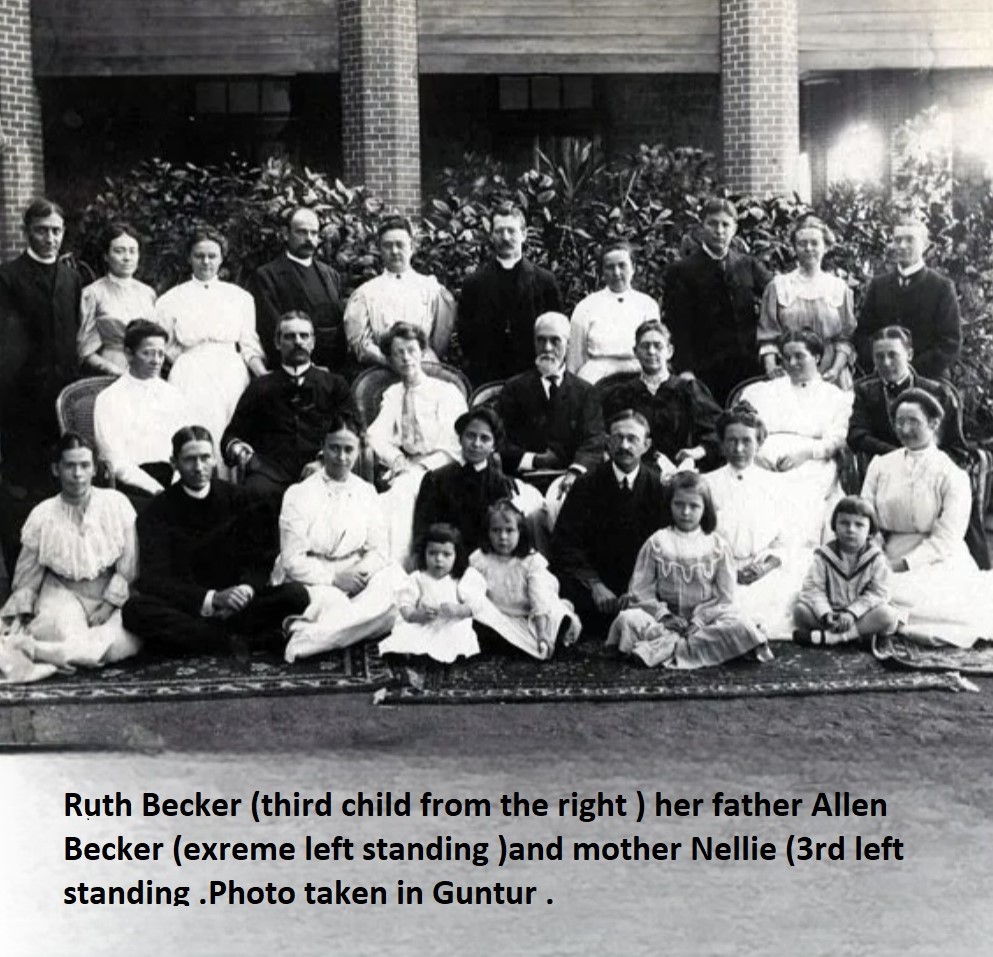
She was born in Guntur on 28 October 1899, the daughter of American missionaries -Allen Oliver Becker and Nellie Elizabeth Baumgardner.
And that is where this extraordinary story begins.
At the turn of the twentieth century, the Beckers were living and working in India as missionaries. Guntur was their home. Their children grew up in India, surrounded by a world utterly different from the America to which their parents ultimately intended to return.
Ruth (the first of their children) and Marion were born in Guntur, and their youngest child, Richard, was born at Kodaikanal. A son, Luther, born during a visit to America died tragically, as a child in Guntur. India, however, was proving increasingly difficult for the family, particularly for Nellie. The heat, the illnesses and the difficult conditions of missionary life took their toll. When the youngest child, Richard, became seriously ill, the family finally decided that Nellie should take the children back to America.
It was a decision that would change their lives.
Nellie and the three children travelled from India to England.
Allen remained behind, intending to follow them later.
That separation would turn out to be an extraordinary stroke of fortune.
On 10 April 1912, Nellie, with her three kids – Ruth, Marion and Richard – boarded the newest and most celebrated ship in the world at Southampton.
The name of the ship was “Titanic”.
Five days later, on the night of 14 April, the Titanic struck an iceberg.
The rest is history but for the Beckers it became a story of survival.
When the alarm for evacuation came, Nellie hurried to get the children ready. In the confusion of the evacuation, her children were separated from her. The younger children were placed in one lifeboat, while Ruth, then only twelve years old, found herself separated from her mother.
Eventually, Ruth was placed aboard another lifeboat.
All four survived.
The Titanic did not.
As the ship disappeared beneath the Atlantic in the early hours of April 15, more than 1,500 people died.
The Beckers were among the fortunate ones who were rescued by the Carpathia.
And there is an extraordinary twist to their story.
Allen Becker was still in India.
Had he accompanied his family aboard the Titanic, he would have been travelling as an adult male at a time when women and children were given priority for the lifeboats. His decision—or necessity—to remain behind in India may well have saved his life. Out of the total men on board (passengers and crew combined), roughly 80% of all men on the ship perished. By comparison about 26% of the women lost their lives.
Eight months later, he was reunited with his family.
Ruth eventually became a teacher and lived a long life. She rarely sought the limelight because of her connection with the Titanic, although in later years she did speak about that terrible night and recorded her memories.
She died in 1990, aged 90.
And there was one final, extraordinary journey.
Ruth’s ashes were eventually scattered over the Titanic wreck site in the North Atlantic, fulfilling her wish to return, in some way, to the place where her life had been changed forever.
So when I think back to that cemetery in Halifax, I now see two very different stories.
There is the tiny grave of the Unknown Child—the little boy whose identity was lost for nearly a century, whose shoes I saw in the museum, and whose burial moved a crew of sailors to compassion.
And there is Ruth Becker, the little girl who survived.
Between them lies the entire tragedy of the Titanic: those who were lost, those who were saved, and the extraordinary lives that continued afterwards.
But what makes the Becker story particularly fascinating for us in India is that before Ruth became a Titanic survivor, she was something else.
She was a child of Guntur.
A little girl born in a missionary household in a town in Andhra Pradesh, thousands of miles from the North Atlantic.
Her journey from Guntur to the Titanic is one of those improbable threads that history occasionally throws across continents and generations.
And it reminds us that great historical events are very rarely as distant from us as they first appear.
Sometimes, the Titanic is not merely a ship that sank somewhere in the Atlantic.
Sometimes, its story begins in Guntur.
(Kulbhushan Kain is an award winning educationist with more than 4 decades of working in schools in India and abroad. He is a prolific writer who loves cricket, travelling and
cooking. He can be reached at kulbhushan.kain@gmail.com)