By Radhika Nagrath
After a five year long hiatus, the Kailash Mansarovar yatra resumed this year. It was suspended during the Covid period and, every following year, efforts were made at the government level but it took five years for us Indians to be allowed to visit our holy sanctum sanctorum – Kailash Mansarovar. The last date of application announced by the Kumaon Mandal Vikas Nigam was 13 June. I had applied four days before the deadline and received the status “waiting” from Nathu La pass, Sikkim route. Seeing the obscurity and medical clearance limitation, I made up my mind to go via the Nepal route through a private agency.
When the first batch of pilgrims left for pilgrimage via the Lipulekh pass – Pithoragarh route organised by KMVN, I received a phone call from MEA that I could be given a chance in the pilgrimage in 9th batch if I gave consent via Nathu La route. My mentors guided me to opt for the Nepal route instead since it was less expensive and less time consuming. The thirteen-day trip via Nepal seemed to me more alluring than the 21-day Sikkim route trip but, as destiny had it, even our Nepal route trip got extended to 19 days due to natural exigencies. Each day was strenuous, painstaking but rewarding, turning my faith in the divine into conviction.
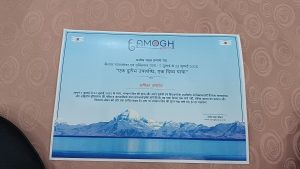
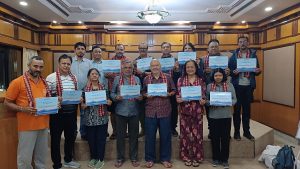
A batch of seventeen pilgrims started from Indira Gandhi International Airport with chants to Lord Shiva on 7 July. After a nearly one-and-a-half-hour flight, we were welcomed at Tribhuvan International Airport in Kathmandu, Nepal. The Amogh travel group welcomed us with Rudraksh rosaries and we stayed in Le Himalaya hotel in Lazimpat. It is a tradition that, before starting a pilgrimage, blessings from Pashupatinath Temple are sought and we did the same.
The First Hurdle
The second day morning we spent seeking blessings from Lord Pashupatinath and came back to do travel shopping for hiking stuff like sticks, shoes, rain covers and money exchange. By the time we reached the hotel in the evening, we were called in the hotel conference room for a meeting. It came as a bombshell to us when we were told that the Kyirong bridge was washed away in a flash flood due to incessant rains so our pilgrimage could not go on. High in the Himalayas, just across the border from Nepal into China, lies this small village Kyirong, one of the border crossing points in China. We were told that the meeting in Beijing is on by the government officials but it is definite that it will take two to three years to make a bridge so some alternative route would have to be chosen. We thanked God that we were not stuck halfway.
It was decided that, for three days, another small pilgrimage to Muktinath, the world’s highest Vishnu temple, could be undertaken until the routes became clear. This shrine is dedicated to Lord Vishnu and without His consent how could we go to Lord Shiva’s abode? The new journey was enchanting with a lot of fresh water falls enroute and finally a 300 stepped trail to Muktinath. The journey along Gandaki River was thrilling but my mind was still stuck at Kailash.
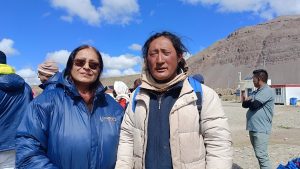
While staying in Pokhara, enroute, we came to know that one batch of pilgrims had been allowed to enter into China through Kodari border. A ray of hope had arisen and we continued our journey to Kathmandu. The fifth day we started at the Kodari border and halted at night at Tatopani. Next day, after getting clearance from the immigration centre, we entered China-Tibet territory. Throughout the journey, landslides had occurred and continuously JCB machines were clearing the debris from the road and Chinese men were working on repairing roads. Bridges were under construction. And intermittent showers of rain marked our hill journey.
After nearly 14 hours of driving we reached Saga at night. Our spirits were down, everyone felt dizzy and I even had a bout of vomiting as soon as the bus stopped. Reaching the hotel room, my body oxygen level was checked which had come down from 97 to 75.
The Second Test
“You cannot go as your oxygen level has dipped to 65”, said Astrologer Dhananjey Dubey who had done Kailash yatra five times earlier. When I shared my problem with four other female pilgrims at the next day’s breakfast table, even they expressed the same difficulty. Thankfully, seven hours’ rest made us wake up again and we could eat food in a Tibetan restaurant consisting of vegetable soup and rice and cooked potatoes.
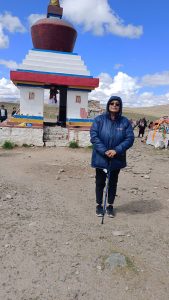
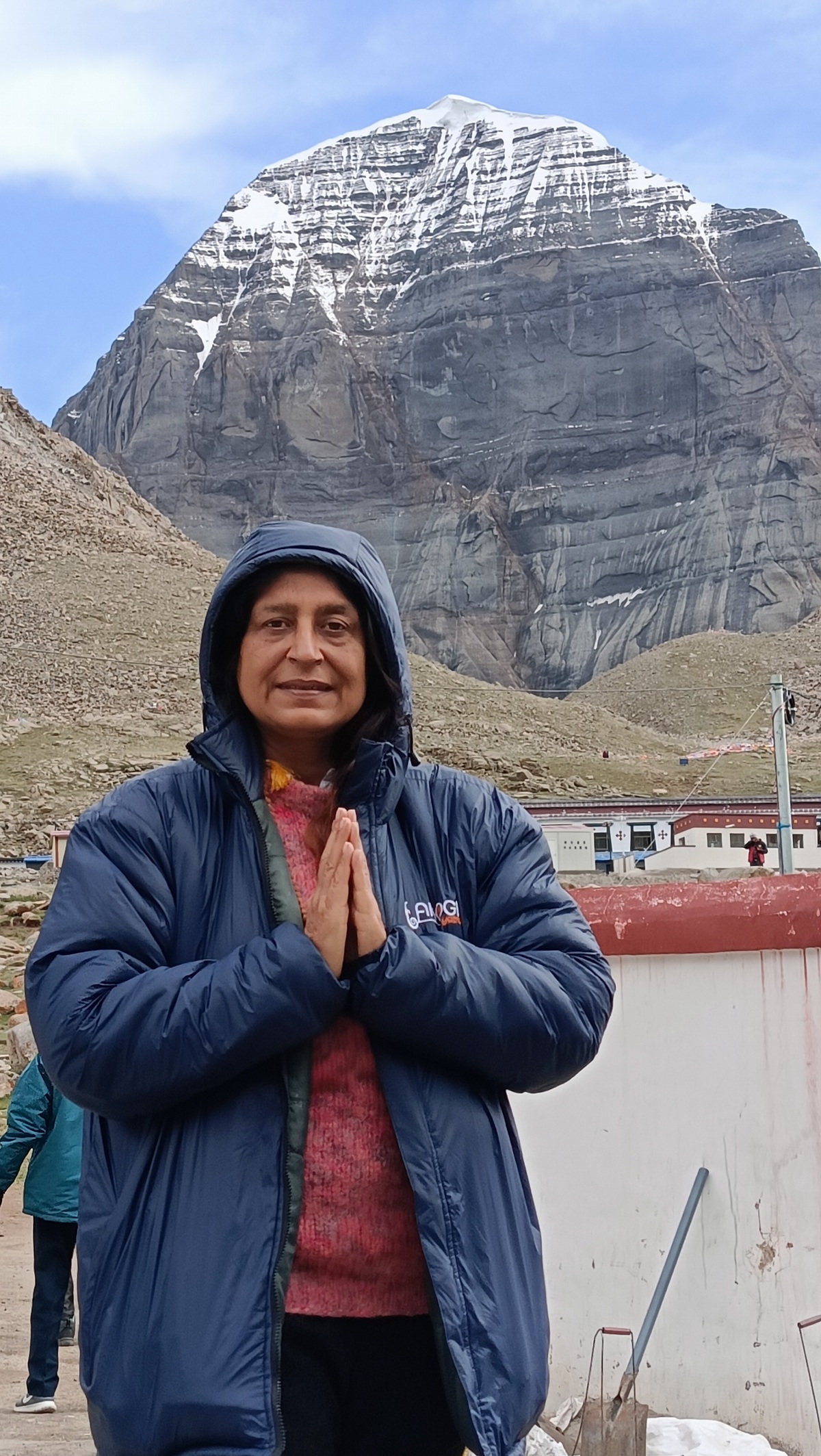
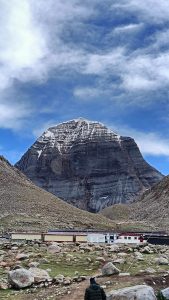
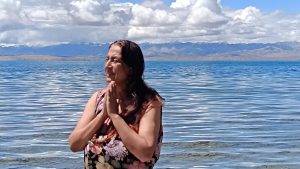
Next morning, on the seventh day, we started from Mansarovar Lake which was a dream come true. Around noon, when we reached Mansarovar Lake, the bright sun greeted us and its rays touched Mount Kailash located across the lake, miles away. The first darshan of Kailash rejuvenated us and everyone sat with rosary in hand doing japa. “We are so fortunate to have our first glimpse of Kailashpati,” exclaimed every member of our group. Although bathing is not allowed in Mansarovar Lake, yet we had a splash and filled bottles with the holy water from Mansarovar.
Circumambulation of Kailash
We started for Darchen by bus, a Chinese town from where the south face of Kailash is seen. After spending the night at Darchen, we started for Yam Dwar after breakfast. After an hour’s journey we reached Yam Dwar from where the Parikrama or circumambulation begins. It is said that one leaves behind the Sanchit karmas (clears karmic account) and one is free from all bondage when we cross this Yama Dwar. Even the bondage of cleanliness goes away since one cannot have a wash for three days during Parikrama or change clothes. It is so cold and the body is so tired that no energy is left for any such body cleansing. I was told that a porter and pony should be booked for all three days, though it is for the second day that one needs them while crossing the Dolma pass, the toughest trek. Total trek of three days amounted to 52 kms with the biggest challenge of lowest oxygen level at Dolma pass. It seemed an unending array of stones and cliffs when we crossed this mountain pass. Dolma Pass is a high mountain pass at 18,514 feet located on the outer Kailash Kora (Parikrama). It is the highest point of the trek. The horse takes us up but one has to descend on one’s own as it is risky to ride the horse. With Lord Shiva’s grace, after a long 8-hour trek, I reached Derapurk with our co-pilgrims from where Kailash Mount is clearly visible from the north side. Clear skies added to our fortune of having good darshan from our place of stay.
Connected at Spirit Level
I realised that we all were connected at spirit level. My pony’s owner was a Tibetan whose help I needed for the second day. He could not understand my language, only with gestures we talked. From Yam Dwar where we were allotted the horses, I was made to pick a handwritten slip. The name which I picked was chosen for my journey by our guide Lawang. I still cannot spell that pony owner’s name and I clicked one photo with him as the only identity of my porter and that helped me in searching for him wherever I needed him.
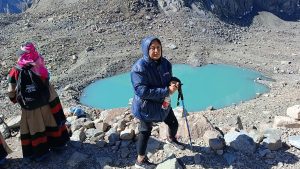
On the second day of circumambulation, enroute, is the turquoise green coloured Gauri Kund for which the porters ask for 100 Yuan to fill the bottle from the holy water body. Every step I felt was impossible to take but the power of japa ‘Om Namah Shivay’ pulled me through. On a glacier lake when I was about to slip, a man behind me held me from my upper arm and I was saved. Innumerable times there were instances when it seemed I would faint but the sound ‘Om Namah Shivay’ raised me up. The pony porter did not let me sleep on the way although I tried to lean against a stone to have a rest. He cautioned, “If you stop, you will never be able to make it.” The second night was spent in Zuzulpuk and the third day trek was much easier and shorter by just three hours. With a sense of gratitude, satisfaction and ecstasy surrounding me, we completed our never-ending soulful journey of Kailash Mansarovar.
(Radhika Nagrath is Manager at Divya Pharmacy and is Joint Secretary with Chinmaya
Education Society. She is a social activist.)