 By Atul Rawat
India is blessed with all the seasons, yet the monsoon stands apart as nature’s greatest gift. It arrives like a cool balm on a body scorched by the relentless summer sun. Year after year, we wait for those dark clouds to gather, for the cool breeze to blow, and for the first drops of rain to touch the earth. There is something about the monsoon that lifts us above the daily grind of life.
It also brings out the child within us and revives memories of carefree days when the rains meant nothing but unrestrained joy. There was a time when the monsoon was more than a season; it was an entire ecosystem—emotional, social, and magical. The first shower transformed every neighbourhood. Children appeared outdoors within seconds, marveling at nature’s spectacle. No one cared about getting wet; that was merely incidental. The real excitement lay in discovering everything that arrived with the rain. Mothers shouted warnings about fever, cough and pneumonia from balconies while children hopped around jumping in the rain.
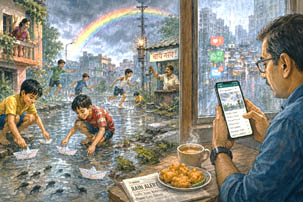
Soon the roads filled with puddles and water gushed through the drains. Within minutes, paper boats appeared by the dozen. Every child suddenly became an engineer, a naval architect and an explorer. The last few pages of old notebooks were gladly sacrificed for this grand maritime ambition.
These tiny vessels carried the dreams of every child. Every fold was crisp and every crease perfect. There were little ones and giant ones. Some fortunate children even had plastic boats.
Some sailed majestically. Others sank within seconds.
Yet every child launched the next boat with renewed optimism.
In the friendly neighbourhood, little tadpoles appeared as if by magic. These tiny black wriggly tadpoles in the roadside puddles fascinated an entire generation. Children observed them with the curiosity of young scientists.
“This one will become a frog tomorrow,” declared the eldest child of the colony.
It was gospel. No one fact-checked.
Nearby, full-grown frogs croaked in perfect rhythm, as though an orchestra had assembled for the occasion.
Entire afternoons disappeared while nature quietly performed miracles in muddy water. There were no curated YouTube videos. Life itself unfolded on a giant 70-mm screen.
The soundtrack was equally enchanting—the rhythmic tapping of rain on tin roofs, pressure cookers whistling in kitchens, waft of pakoras being fried, distant thunder rolling across the sky, the neighbourhood chaiwala calling out through the downpour, and somewhere, almost inevitably, the electricity transformer exploding.
Power cuts during the rains were accepted with remarkable philosophical calm.
Families gathered near windows to watch the rain instead of scrolling through social media. Conversations happened. Pakoras arrived. Tea circulated endlessly.
Then came the rainbow, bringing collective delight to everyone. It was nothing short of a miracle. How did seven colours appear suddenly in a perfect arc? Nobody worried about the science; everyone simply enjoyed the experience.
“Rainbow! Rainbow!”
Children ran outside. Adults pointed skywards. Everyone admired it together as though God Himself had launched a limited-edition colour scheme.
No photographs.
No filters.
No hashtags.
Just pure awe.
Cut to today.
Almost everything in the urban maze has disappeared. No one has time for any of it anymore. Paper boats are gone.
Tadpoles struggle to survive because the puddle has become a parking lot. The monsoon is now discussed in terms of traffic jams, network disruptions, waterlogging and delayed deliveries.
Even rainbows must compete with notification alerts.
Simple happiness has been replaced by Reel Mania and Insta Mania. Emotions themselves have become digitised.
The old monsoon slowed life down.
The new monsoon irritates people because it interferes with office schedules and food timelines.
The old monsoon connected people to nature.
The new monsoon connects people to the digital world. Google has already given me all the updates. There is no mystery anymore.
And perhaps that is the real loss—the disappearance of wonder itself.
How can anyone spend time with nature without checking a device every ten seconds? We even have wearable ones now.
God help us.
Yet the monsoon arrives faithfully every year.
The clouds still gather.
The frogs still sing.
The rain still carries the fragrance of wet earth and forgotten memories.
Alas, it is raining again.
Let me quickly send a picture to my daughter and the countless WhatsApp groups I belong to—before sentiment overtakes habit.