
 By Roli Shukla
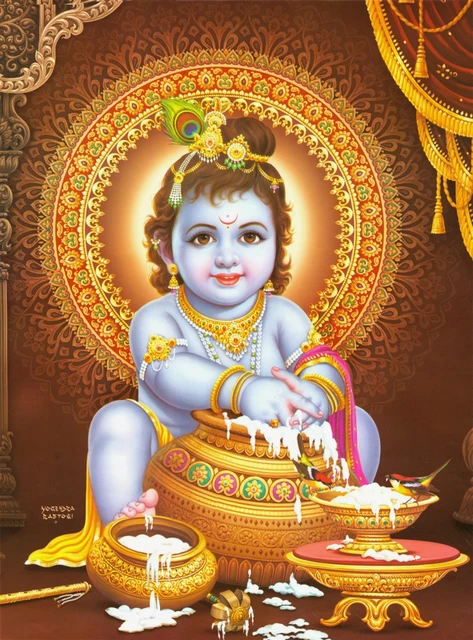
Saviour? Nay. Protector? No. Preacher? Never. At least, that is not how Krishna first entered my life. My first Krishna was a tiny, adorable idol with a ‘laddu’ in his hand, placed among countless other pictures and statues of Deities on my maternal grandmother’s pooja altar. I was a little girl then. Whenever I pointed my finger towards him and asked who he was, my grandmother would look at him with an expression of pure affection and say, “Laddu Gopal”. Then, almost as naturally, she would place whatever prasad was available at that moment in my outstretched palm and say, “You are my Laddu Gopal too. Enjoy the prasad.” That was my first Krishna.
Not a distant God. Not an almighty being sitting somewhere beyond the skies. Not a figure I was expected to fear or worship without understanding. He was simply Laddu Gopal—someone close enough to be loved, teased, remembered and spoken about. And, in my childish mind, if Krishna could be Laddu Gopal, so could I.
I did not know then that this simple introduction had quietly given me one of the most profound ways of understanding Krishna. Before I learnt about his divinity, I encountered his humanity. Before I heard about his philosophy, I experienced his intimacy. Before I knew the stories of his greatness, I knew his smile.
Only much later did I discover that this little Krishna was the Krishna worshipped by millions across Bharat and around the world; the Krishna whose message to the world reverberates through the Bhagavad Gita; the Krishna whose life has inspired scriptures, poetry, music, dance, painting, philosophy and devotion for centuries. I learned about Vishnu and his avatars. I learnt about the Mahabharata. I encountered the philosopher Krishna, the politician Krishna, the strategist Krishna, the warrior Krishna, the friend Krishna and the mysterious divine Krishna.
Yet, somehow, my grandmother’s Laddu Gopal never disappeared from my heart. Perhaps that is the secret of Krishna. He does not remain confined to one definition.
For some, he is God. For others, he is the supreme teacher. To some, he is the mischievous child stealing butter; to others, the enchanting flute player of Vrindavan. He is the friend of Arjuna, the counsellor of the Pandavas, the statesman of Dwarka, the strategist of the Kurukshetra war, the voice of the Gita, still sometimes, the mischievous Krishna of Yashoda outshines them all! He is playful and profound, affectionate, and formidable, compassionate, and uncompromising. Sometimes all at the same time!
He can hold a flute in one hand and the destiny of a civilisation called Bharat in the other. This extraordinary multiplicity fascinates me.
When I look at Rama, I see an ideal. Rama stands before society as Maryada Purushottama—the embodiment of dignity, discipline, duty and moral conduct. He is the ideal son, brother, husband, warrior and king. His greatness lies partly in the perfection of his conduct.
But Krishna is different. Krishna does not always fit neatly into the mold of an ideal. He enters complicated situations and makes us think. He does not merely tell us what is right; he makes us confront the difficulty of deciding what is right when life itself is complicated. He understands human weakness, political reality, moral ambiguity, and the consequences of action. He knows that ‘dharma’ is not always a simple road marked with signposts.
Perhaps that is why Krishna feels so alive and so real.
My grandmother, whose childhood was spent in Mathura, seemed to understand this without ever explaining it philosophically. Krishna was her companion, guide, and friend. She would speak of Krishna, Balarama, Yashoda and the people of Vrindavan as though they were not characters from a distant past but members of a living world and her own family. That, I now realise, is one of the most remarkable features of Krishna in the Bharatiya imagination. He belongs to everyone.
The intellectual can find philosophy in him. The poet finds beauty. The child finds mischief. The devotee finds God. The artist finds a form. The musician finds a melody. The dancer finds movement. The warrior finds courage. The statesman finds strategy. The seeker finds wisdom. The ordinary person finds companionship. And perhaps that is why Krishna travelled so effortlessly through the centuries.
There came a time in the ancient history of Bharat when devotion became a powerful language of literature and spiritual expression. In difficult political and social circumstances, perhaps the common person needed something more intimate than an abstract philosophy. Bhakti offered a direct relationship with the divine. One could sing, remember, surrender, question, cry, dance and even quarrel with one’s God. And Krishna welcomed all these relationships.
Surdas saw the child Krishna. Meera saw Krishna as her beloved. Others saw the friend, the lover, the master, the playful boy of the neighbourhood or the supreme consciousness. Their Krishna was deeply human even while remaining divine and unreachable. This is what makes the Krishna phenomenon so extraordinary to me.
The Bhagavata tradition gave people Krishna worship; the poets gave them a Krishna experience. And Bharat did not choose between the two. It embraced both. Krishna became a bridge between the sacred and the ordinary.
He could live in a temple and in a poem, in a philosophical and intellectual discourse and in a folk song, in a classical dance and in a child’s story. He could be invoked in the most profound discussions of consciousness and remembered through the simplest lullaby. This is Krishna I see in the soul of Bharat. Not merely a God who descended to earth, but a phenomenon that entered the consciousness of a civilisation and refused to leave.
The Bhagavad Gita perhaps represents the highest expression of this phenomenon.
Standing on the battlefield, Krishna does not offer Arjuna an escape from life. He does not tell him that the world is too complicated and therefore he should withdraw from it. Instead, he teaches him how to act without being enslaved by the fruits of action; how to find steadiness amid turmoil; how to perform one’s duty with awareness; how knowledge, devotion and action can become paths towards freedom.
To me, this message is extraordinarily relevant to the Bharat of the future.
Because the Bharat I dream of should not be a civilisation that merely remembers Krishna. It should be a civilisation that thinks along with Krishna.
A future Bharat through Krishna’s eyes would not be frightened of complexity. It would not confuse tradition with stagnation or modernity with imitation. It would possess the courage to engage with the world without losing its centre because Krishna never taught Arjuna helplessness. He taught him clarity. The future Bharat will inherit not merely the stories of Krishna, but his questions.
Can you remain calm when the world around you is confused?
Can you act without becoming a slave to reward?
Can you distinguish ambition from purpose?
Can you use knowledge without arrogance?
Can you be powerful without becoming cruel?
Can you enter the world without allowing the world to possess you?
Can you fight injustice without becoming unjust yourself?
These questions seem more important to me than simply memorising verses about Krishna.
Krishna’s Bharat would not be afraid of science. It would not reject technology. It would not run away from the modern world. But neither would it surrender its conscience to technology, wealth or power. The Krishna I imagine looking at future Bharat would perhaps smile at our extraordinary achievements—and then ask us a very uncomfortable question: “For what purpose?”
Krishna’s message, therefore, is not confined to a battlefield thousands of years ago. It belongs to every generation standing before its own Kurukshetra. Our Kurukshetra may be different. Yet the essential question remains the same: How shall I act? That is why Krishna continues to matter.
For centuries, Bharat has absorbed, questioned, debated, and reinvented itself. Its civilisation has survived not because it remained frozen, but because it possessed the capacity to renew itself while returning again and again to deeper principles. Krishna represents that living principle of renewal for me. He is ancient, yet never old. He belongs to history yet refuses to remain historical. He is a legend yet feels intensely alive.
He is divine, yet extraordinarily human.
He belongs to temples, but also to streets, homes, books, music, theatre, dance and childhood memories. And somewhere within all these manifestations remains my grandmother’s little Laddu Gopal. That is the Krishna I carry within me.
When I look back, I realise that perhaps my grandmother gave me something far more valuable than an introduction to a deity. She gave me permission to approach Krishna without fear. She allowed me to see him first as someone close to me. Only later did I discover his majesty. Because Krishna becomes truly magnificent when we do not reduce him to a single image.
For the people of Bharat, his leelas, his teachings, his discourses, his music and his presence in almost every dimension of our cultural life are like a celestial song without an ending. Perhaps that song has lasted because every generation hears a different note.
My generation heard one Krishna. The next generation will discover another. And the generations after that will continue to find themselves in him.
That is a miracle. That is mesmerism. That is the legend.
And that is why, when I think of the future Bharat, I do not imagine Krishna standing behind us as merely a glorious figure from our past.
I imagine him standing before us. Smiling. Holding the flute in one hand. Wisdom in the other. And asking us to step onto our own Kurukshetra—not with fear, not with hatred, not with blind ambition, but with courage, clarity, compassion and dharma.
Perhaps he would remind us that Bharat’s greatness will not be measured merely by how powerful it becomes, how wealthy it grows, or how advanced its technology becomes. It will be measured by what kind of human beings it creates.
And perhaps, looking at the Bharat of tomorrow, Krishna would ask only this: “You have inherited a great civilisation. What will you do with it?” Perhaps our answers should be simple.
We will remember.
We will learn.
We will act.
And above all, we will try to become worthy of the civilisation that gave the world Krishna—not merely as a God to worship, but as an eternal teacher of how to live. For as long as Bharat continues to sing, Krishna will continue to play. And as long as Krishna’s song continues, I believe, the soul of Bharat will never fall silent. Happy Janmashtami to all.
(Roli Shukla is an Author & Educator based in Thane, Maharashtra.)


