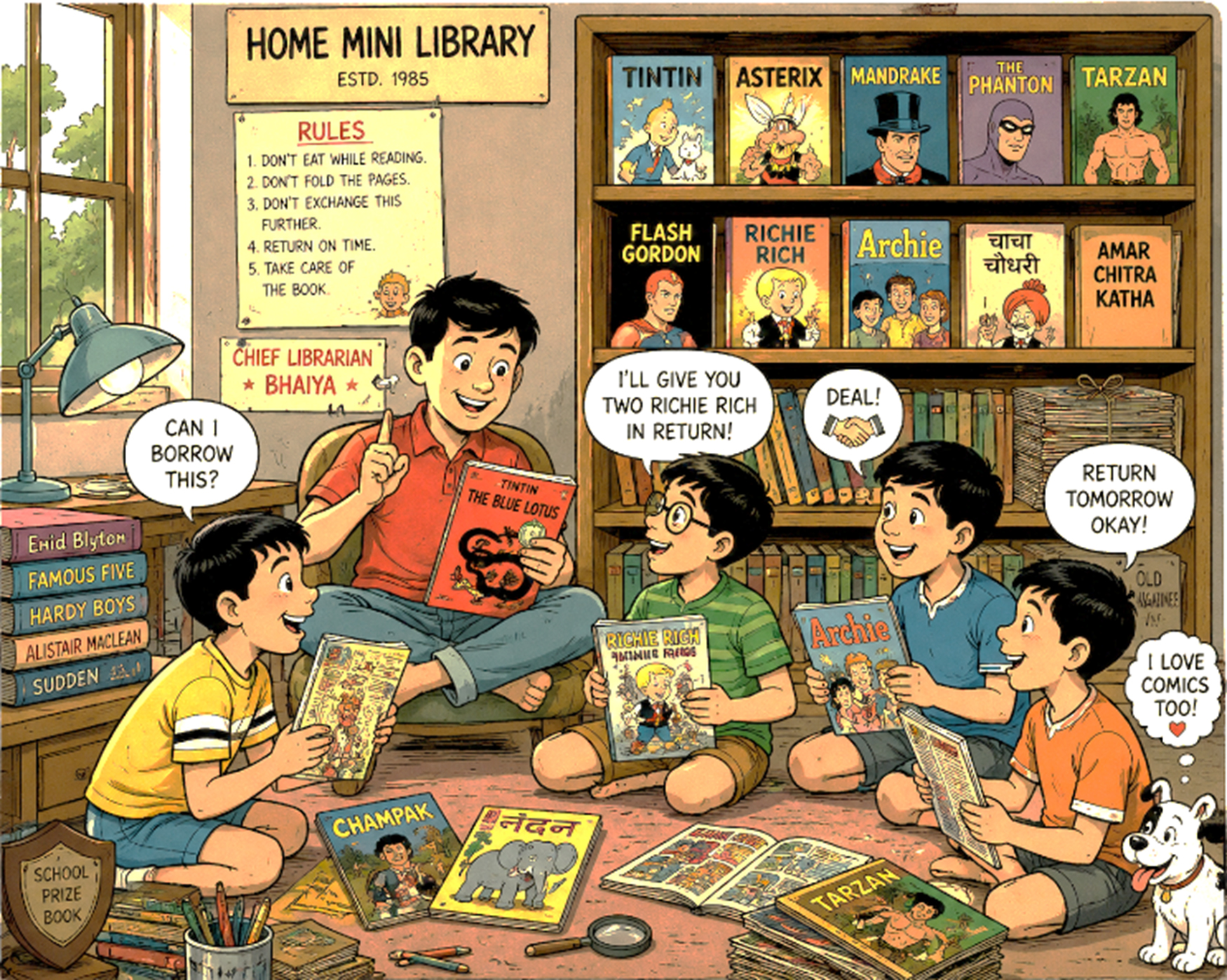
Some memories are not preserved in photographs; they survive in the pages we once borrowed and never truly returned
 By Atul Rawat
Growing up, every home in the colony had a mini- library, and every child knew exactly where it was.
It usually occupied the elder sibling’s room and was treated with reverence. It was a prized possession, guarded with greater zeal than the gold in Fort Knox and accounted for more carefully than the reserves of the Reserve Bank itself.
Nothing left its shelves without permission.
The collection grew with the family. Every birthday, every school prize, every visiting uncle from abroad added another treasure.
The shelves held everything imaginable.
Tintin, Asterix, Mandrake, Phantom, Tarzan, Flash Gordon, Richie Rich, Archie and countless others.
Champak, Nandan, Chacha Chaudhary, Amar Chitra Katha, Diamond Comics and others.
Enid Blyton’s Famous Five, Hardy Boys mysteries, Alistair MacLean thrillers, Sudden westerns, Hindi detective pocket books full of ingenious scams and mysterious villains.
There were encyclopedias, school prize books displayed proudly, and old magazines tied neatly with string, waiting for their next reader.
It was the glorious age of comics and novels.
Our childhood was built upon the adventures of superheroes, detectives, pranksters and jungle kings.
Comics were never the “content.” They were social currency.
The neighbourhood operated a highly sophisticated informal exchange economy long before economists invented complicated theories.
One Tintin could fetch two Richie Rich comics. A bound volume of Asterix carried a trading value equivalent to national gold reserves.
Comic exchanges were negotiated with the seriousness of international diplomacy.
“You folded the corner last time,” the lender grumbled.
“You stained the cover,” the lender complained.
“My Mama brought this from London,” the lender moaned.
“Return it tomorrow or there will be no exchange in future,” were the strict instructions.
Trust was everything.
Anyone who failed to return a comic or damaged it risked immediate social isolation. Reputations could collapse over a missing issue of Phantom.
The library also reflected the personality of every household.
One specialised in mythology, another in medicine, another in detective fiction. Some homes had shelves full of Amar Chitra Katha, while others possessed foreign comics that everybody wanted to borrow.
The news of the arrival of a new comic spread through the colony like breaking news. A borrowing queue instantly formed, following a strict hierarchy known only to children.
Every colony had one legendary figure—the big brother who served as the unofficial Chief Librarian. Being in his good books had enormous benefits.
He always batted first in gully cricket. He was allowed to win board games.
Everyone wanted to be on his team. His instructions accompanied every loan.
“Don’t exchange this further.” “Bring it back tomorrow.”
Needless to say, these rules were honoured more in principle than in practice.
Many comics returned carrying unmistakable evidence of national integration—oil stains and folded corners.
Yet nobody minded much.
Books were meant to circulate. Stories were meant to travel.
Today, children possess tablets containing thousands of digital titles. Yet nobody exchanges anything anymore except reels and likes.
Homes have larger televisions but smaller bookshelves.
The comic exchange economy has collapsed completely. Earlier, friendships deepened through borrowed books.
Now friendships survive through forwarded emojis.
The accidental joy of discovering a forgotten comic on someone else’s shelf has quietly disappeared.
Today a child enters a friend’s house and asks, “What’s the Wi-Fi password?”
We used to ask, “Anything new to read?”
The books usually passed from hand to hand and the stories travelled across homes.
Imagination belonged to everyone. Perhaps that is why those old comics remain unforgettable. The skull-shaped cave of Phantom, the Ghost Who Walks, or the thunderous jungle cry of Tarzan swinging from one tree to another took us to the deep jungles. The adventures of Tintin along with Snowy, Captain Haddock and Mr Thomson and Thomson took us to varied parts of the world. Astrix and his loyal friend Obelix taking on entire platoons of the Roman soldiers always excited us no end. Closer to home, we marveled at the razor sharp intellect of Chacha Chaudhary and the timeless wit of Birbal.
Between faded pages and dog-eared covers lived an entire neighbourhood that laughed at the same jokes, waited for the same heroes and dreamt the same dreams—one borrowed book at a time.
And whenever life slows down and memory opens one of those invisible shelves, a familiar sigh escapes effortlessly— “Bachpan ke din bhi kya din thhe.”