By Col Sudhir Rana (Retd)
If someone is a Malyali no matter what is their caste or religion, they are bound to celebrate this beautiful annual festival of Onam with great gusto.
Onam is traditionally associated with the legend of the benevolent Asura King, Mahabali, who once ruled Kerala, returning each year to visit his people. Onam falls in the month of Chingam, which is the first month according to the Malayalam Calendar. The celebrations mark the Malayalam New Year, are spread over ten days, and conclude with Thiruvonam. The ten days are sequentially known as Atham, Chithira, Chodhi, Vishakam, Anizham, Thriketa, Moolam, Pooradam, Uthradam and Thiruvonam. The first and the last days are particularly important. Though the festival is basically a Hindu festival associated with the harvest season in Kerala, but since 1961 it is celebrated as a State festival. The Atham day is marked with the start of festivities at Thrikkakara Vamanamoorthy Temple, Kochi. This Vishnu temple is considered as the focal centre of Onam and the abode of Mahabali.
Onam starts here with the raising of the festival flag. It is followed by a colourful parade called Athachamayam, which is colourful and depicts the elements of Kerala culture with decorated elephants, floats, tableaux, and matching drums. The procession path historically has been from Tripunithura to the Vamanamoorthy Temple in Thrikkakara, Ernakulam district. In Thrissur, festivities include a procession consisting of caparisoned elephants surrounded by Kummatikali dancers. Statues or figurines of Mahabali and Vamana are also installed at the entrance of each house on this day.
Lots of events like boat races, sports and cultural activities, dances, martial art demonstrations and Pokkalam (flower carpets) are designed and displayed.
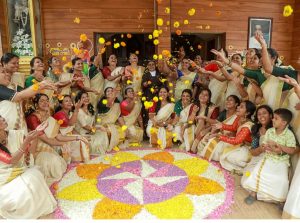
Pookkalam is a flower carpet, generally circular, with several delicate patterns made of colourful flowers on the floor by girls and women. It is adorned with lamps. When completed, a miniature pandal hung with little festoons may be erected over it.
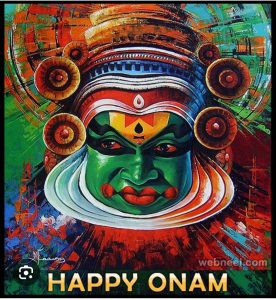
Several forms of dances are also performed during the festival, e.g., Thiruvathira, Kummattikali, Pulikali, Thumbi Thullal, Onam Kali and others. Kathakali performances are a part of Onam tradition, with dancers enacting characters from the various ancient Indian legends like Ramayana and Mahabharata. Pulikali, also known as Kaduvakali, is a common sight during the Onam season. This dance showcases performers painted like tigers in bright yellow, red and black, who dance to the beats of instruments like Chenda and Thakil. Performances of the ritual worship dance, Theyyam, are given during the Onam season in which the lore of Mahabali is enacted.
It is also the time of prayers, donations and charities. The families gather over feasts, where both men and women wear traditional dresses like Kasavu saris and mundu by men.
Most cities in Kerala, e.g., Thiruvananthapuram, Kochi and Thrissur, are lit up with lights and fabulous displays of fireworks.
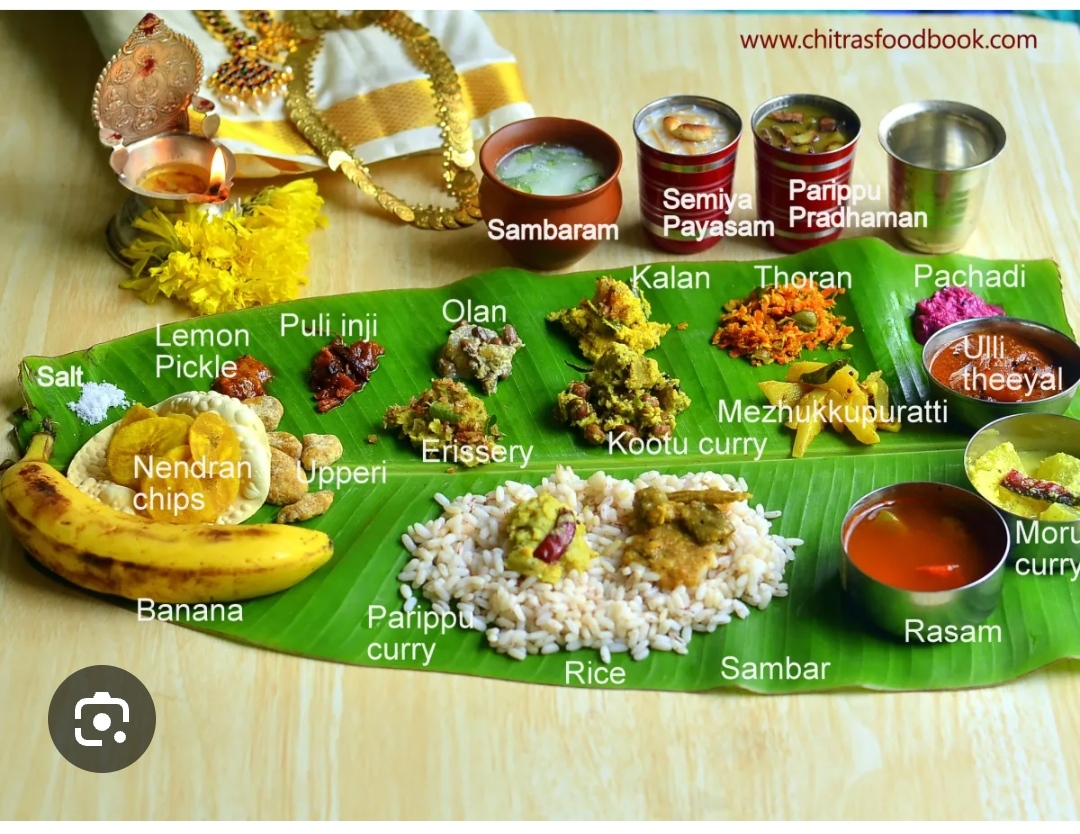
Sumptuous Onam Sadya feasts are prepared. In Thrikkakara temple, a mega-feast is conducted, which is open to the public and is attended by more than twenty thousand people.
In Dehradun, too, several thousand Malayalis live, so it is natural that Onam is also celebrated here with great fervour. Cultural activities and feasts are arranged in homes and common places like ONGC grounds.
I am lucky to be the husband of a beautiful Malyali lady and we have some celebrations of Onam at home, too.
Here is wishing all a very happy Onam.