The Books from My Shelves
By Stephen Alter
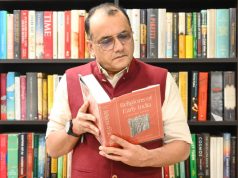
In my study are four bookcases, as well as a couple of shelves built into the walls that contain an assortment of hardbound and paperback volumes. None of these are arranged in any particular order, though one of the bookcases, which I keep locked, contains the more valuable or cherished titles in my collection. Other rooms in the house also have shelves full of books that our family has accumulated over the years – mysteries and thrillers left behind by guests, memoirs by friends and neighbours, children’s storybooks our son and daughter enjoyed years ago, and a set of venerable encyclopedias long out of date.
Predictably, books about the Himalaya dominate my personal library, especially mountaineering literature and natural history. This includes everything from Swami Pranavananda’s Kailas Manasarovar to Hermann Buhl’s Nanga Parbat Pilgrimage. One of the titles I always recommend is Into the Silence by Wade Davis, a detailed and fascinating account of early British expeditions to Mt. Everest in the 1920s. More than just a record of failed attempts to reach the summit, it explores how alpine adventure provided solace and redemption for traumatized veterans of WWI.
Bill Aitken’s The Nanda Devi Affair sits close at hand, in the centre of a middle shelf to the right of my desk. It is an inspiring account of the author’s spiritual and physical fascination for Uttarakhand’s highest and most sacred mountain. Aitken’s arduous ascent into the Nanda Devi Sanctuary, retracing the footsteps of Eric Shipton and Bill Tilman, is vivid enough to give even the most stoic reader an exhilarating sense of vertigo.
Undoubtedly, the rarest and most valuable book I own is Jim Corbett’s Jungle Stories, a slim volume that he self-published in Nainital in 1935, well before his later wildlife chronicles became bestsellers. In fact, this thin paperbound book is essentially a first draft of Man-Eaters of Kumaon. Brushing your fingers over the text, you can still feel where the letterpress type left impressions on the page, almost like braille.
Another book that I value, as much for its beautiful illustrations and luminous text as its informative facts, is Salim Ali’s Indian Hill Birds. Though a scientific publication, it is also a work of art, with stunning colour plates by G.M. Henry. Many more recent and updated bird books are now available but they can never match Salim Ali’s precise yet lyrical descriptions. His field guides as well as his memoir, The Fall of a Sparrow, form the cornerstone of my collection.
Poetry occupies the top shelves of two bookcases. While I don’t write verse myself, I try to read at least one poem a day. Arvind Krishna Mehrotra’s fine translation, Songs of Kabir, is a book I often reach for instinctively, or Mehrotra’s own Collected Poems. These keep good company with Eunice De Souza’s Necklace of Skulls and Manohar Shetty’s Full Disclosure. Tucked away nearby is Adil Jussawalla’s seminal anthology, New Writing in India, first published in 1974, a book that opened my mind to modern Indian literature.
Many of the books I own have some sort of personal significance. Among these is Diana Athill’s memoir, Stet, recounting her career as senior editor at Andre Deutsch publishers. It is an entertaining and utterly frank account of her professional and personal encounters with some of the famous authors she nurtured, including V.S. Naipaul. As she explains, he was a brilliant writer but also an extremely disagreeable personality. By coincidence, Diana Athill happened to be Ruskin Bond’s first editor and mine, though neither of us feature in her memoir.
Fiction takes up a good deal of space on my bookshelves. I still possess the first novel I ever read, The Old Man and the Sea by Ernest Hemingway. An early American edition that my parents owned, and I can distinctly recall taking it off the shelf as a young boy and being immediately hooked by this fishing tale.
Among the more recent publications that stand shoulder to shoulder on my shelves are some of the works of John Banville. His murder mysteries featuring the irascible Dr. Quirke, are as good, if not better than his Booker Prize-winning, The Sea. Browsing through my library, I also find Navtej Sarna’s Crimson Spring. A compelling novel about the Jallianwala Bagh massacre and its aftermath, this carefully researched work of historical fiction brings alive one of the most horrific episodes of colonial rule.
A very different novel that sits on the same shelf is Anuradha Roy’s The Folded Earth. Set mostly in Ranikhet, it is a perfect example of how universal themes can play out within the confines of an isolated hill station. In one scene, Roy’s narrator impulsively decides to reorganize her books. As she explains, “I began to pull books out of the shelves and pile them on the floor. Silverfish scuttled out from between their pages. The books needed dusting and sunning. I pulled out shelf after shelf of books, possessed with energy and purpose. I would arrange them alphabetically – or maybe by genre… In a while, I was exhausted. I sat on the floor and looked in despair at the tumbling heaps of books around me. I would never get them back on their shelves now.”
Like Anuradha Roy’s character, I often feel an urge to reorganize the books on my shelves. This isn’t because of a fastidious need to put disorderly volumes into logical categories. Instead, I feel a desire to shuffle them about so that familiar authors and titles end up in new and unexpected places, where I can discover them all over again.
(Stephen Alter lives in Landour, where he reads and writes.)