Book Review
 By Dr Satish C Aikant
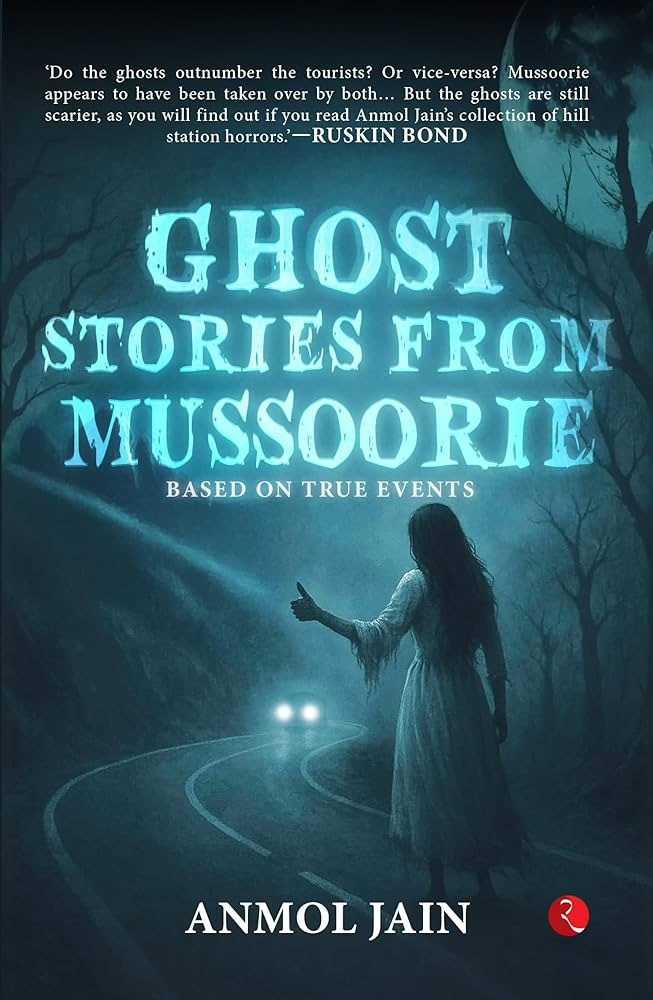
Ghost Stories from Mussoorie

By Anmol Jain

Rupa Publications, New Delhi, 2025, Pages xiii+ 192, Rs 295
During my school days in Mussoorie one often heard about a ‘Bhoot Ki Kothi’ (a haunted house) near the Clock Tower which remained deserted for a number of years as no one would go near it or summon courage to enter its premises believing that the ghosts had occupied it. It was after several years that it saw human presence when a daring soul bought it. It is now a hotel doing brisk business. The resident ghosts having apparently exhausted their potential for mischief must have departed for other places or seduced by the rich aroma from the hotel’s multicuisine kitchen have ceased to meddle in human affairs. Yet, stories are rife about ghostly apparitions, haunted mansions, and inexplicable happenings that have become an integral part of Mussoorie’s folklore. Anmol Jain presents a charming collection of his tales of the supernatural in his book Ghost Stories from Mussoorie stringing together fascinating, if chilling, narratives of close encounters with ghosts, mainly from personal experiences.
Ghosts and sundry spirits have played vital roles in oral and written narratives throughout history and across cultures, ranging from mere figments of the imagination to avowed testimonies of divine messengers, benign or malignant ancestral spirits and pesky alien creatures, to disturbing figures returned from the dead bent on exacting revenge or revealing hidden crimes.
The mist-shrouded hills of Mussoorie with whispering trees amidst eerie silence of the mountains, particularly amenable to ghostly visitations, enact a theatre for restless spirits, vengeful phantoms, and inexplicable occurrences transporting us to a world of mystery and enchantment where the boundaries between the real and the supernatural are blurred.
Why should the spirits populate a hill station in particular? It is perhaps because a hill station is a liminal space, a threshold between the sweltering plains and the cool and rugged mountains, that makes it susceptible to the intrusion of the supernatural. The haunted mansions or bungalows with abandoned or decaying structures serve as hotbeds for supernatural activity. The hybrid and polyvalent genre of the ghost story defying the opposition between realism and fantasy underlines the power of the narrative in representing the real and the imaginary limits of the human situation. It refuses to fit into a neat categorisation contesting the commonly perceived nature of reality.
In the story ‘The Hitchhiking Chudail’ the ghost comes back, repeatedly reappearing as the residue of some traumatic event that has not been dealt with and therefore the apparition returns, the way trauma always does. The narrative sounds contemporary, and I am sure the readers, many of them frequent commuters from Mussoorie to Dehradun and back, the feeling that the next time they take this shortcut from Jharipani- Barlowganj and pass Chunakhala the spot where the Chudail was sighted- they will be wary of it. When confronted by the demonic vision, recitation of Hanuman Chalisa as the talisman might save the day, as the author believes it did for him.
‘The Silent Sentinel’ is the tragic tale of one Mr Benedict, a legendary school teacher who met his untimely demise in the hills, only to return as a ghostly apparition, haunting the same roads he once strolled. The guardian spirit of Mr Benedict kept protecting children whenever they needed to be kept out of harm’s way.
‘The Human Oil Extractors’ takes the readers to the underbelly of the British colonial rule when under the cover of darkness ghastly acts of extracting human oil were carried out. The victims were captured and taken to a distant cavern where they were hung upside down over a burning fire, so their body fat melted, and the oil processed from the extract was used for medicinal purposes. Old-timers of Mussoorie still allude to this nefarious practice.
Townsfolk, in particular the migrant labourers, venturing out after dark simply vanished without a trace. Despite official denials, Dr G with help from a couple of friends decides to unearth the truth behind the disappearances. The author comes across a travelogue by Lady Constance Frederica Gordon Cumming who visited Mussoorie in the 1870s which recounts the incidence of disappearing coolies but dismisses any suggestion that there were Telis (oil extractors) at work behind their disappearance. She was perhaps being only a mouthpiece for the British. Such stories can be seen as a commentary on the British Raj as an era of darkness, subverting the British ‘civilising mission’ narrative. British colonial rule characterised by exploitation, violence, and cultural erasure, actually contradicts the notion of benign governance. It exposes the hypocrisy and brutality that lay beneath the surface of colonialism.
The location of ‘Old Mines’ is regarded as one of the most haunted sites in Mussoorie that saw the tragic demise of 38 miners entombed alive in a landslide caused by an accidental explosion followed by several incidents of fatalities. The place had been abandoned, and occasional visitors get spooky feelings there.
‘The Whistling Intruder’ recounts the saga of Miss L, a former teacher at the Hampton Court School, who was under the uneasy impression that a stalker constantly chased her to her cottage on the Camel’s Back Road (where the Christian Cemetery is located). As it later turns out, it was a ‘whistling ghost’, the spectre of an English gentleman who spoke Queen’s English with impeccable Victorian accent. Miss L regrets having inadvertently rebuffed the spirit which had been offering her bunches of daisies at her doorstep.
‘Pari Tibba’ is about a forlorn hillock opposite the Woodstock School which was the habitation of a group of the ‘paris’ or fairies, their sanctum sanctorum being a small mound of stones which was jealously guarded by them. Trespassers into their space could do so only at their peril.
In ‘Hooves at Midnight’ we learn about Richmond Hotel, a haunted property, frequently visited by the ghost of a white man attired in a hunter’s dress riding a horse. The apparition had scared away the hotel staff and the customers.
‘Cobbler and the Yaksh’ is a story about a family of cobblers that had migrated from the Itawah-Mainpuri region in Uttar Pradesh to Mussoorie. Kundan the pivotal figure in the story is a skilful cobbler who had set up his shop in Mullingar in Landour and was running a flourishing business through the grace of a benevolent spirit Jaakh, a Yaksh, who asks him never to deviate from the straight path in life. However, he goes astray when he gains affluence. He squanders all his wealth on liquor, gambling and nautch girls. Soon nemesis catches up with him and plunges him to a catastrophic reversal of fortune. It is too late when he regains his senses. The author meets the wizened and chastened Kundan, then a nonagenarian, preparing to meet his maker.
What is interesting about the stories in this collection is that the author does not present them as coming from the hoary past but from recent and remembered history, albeit coloured with supernatural colour. They have a contemporary feel and appeal to modern sensibilities.
As you turn the pages of this book, you’ll find yourself immersed in the spine-chilling tales of Mussoorie’s ghostly encounters. The stories are not just about apparitions and ghostly figures; they are also about the people who inhabit these regions. They are about the fragility of human life, and the overwhelming power of nature, and the mysteries that lie beyond our understanding. Ghost stories tap into fundamental human emotions like fear, curiosity, and the desire for connection with something beyond the mundane. Many today would approach such stories with a healthy dose of scepticism, seeking rational explanations for seemingly paranormal phenomena. But even if they aren’t taken literally, they can still evoke powerful emotional responses. The curious readers will be led to explore further from what is said and what is tantalisingly left unsaid.
What is the moral of the ghost stories, if any? Just as the unconscious supplements the conscious to complete the human persona, the uncanny can be projected as the other side of the visible reality.
‘There are more things in heaven and earth, Horatio, than are dreamt of in our philosophy,’ says Hamlet in the Shakespearean play.
(The reviewer is former Professor and Head of the Department of English, HNB Garhwal University, and former Fellow of the Indian Institute of Advanced Study, Shimla)