 By Kulbhushan Kain
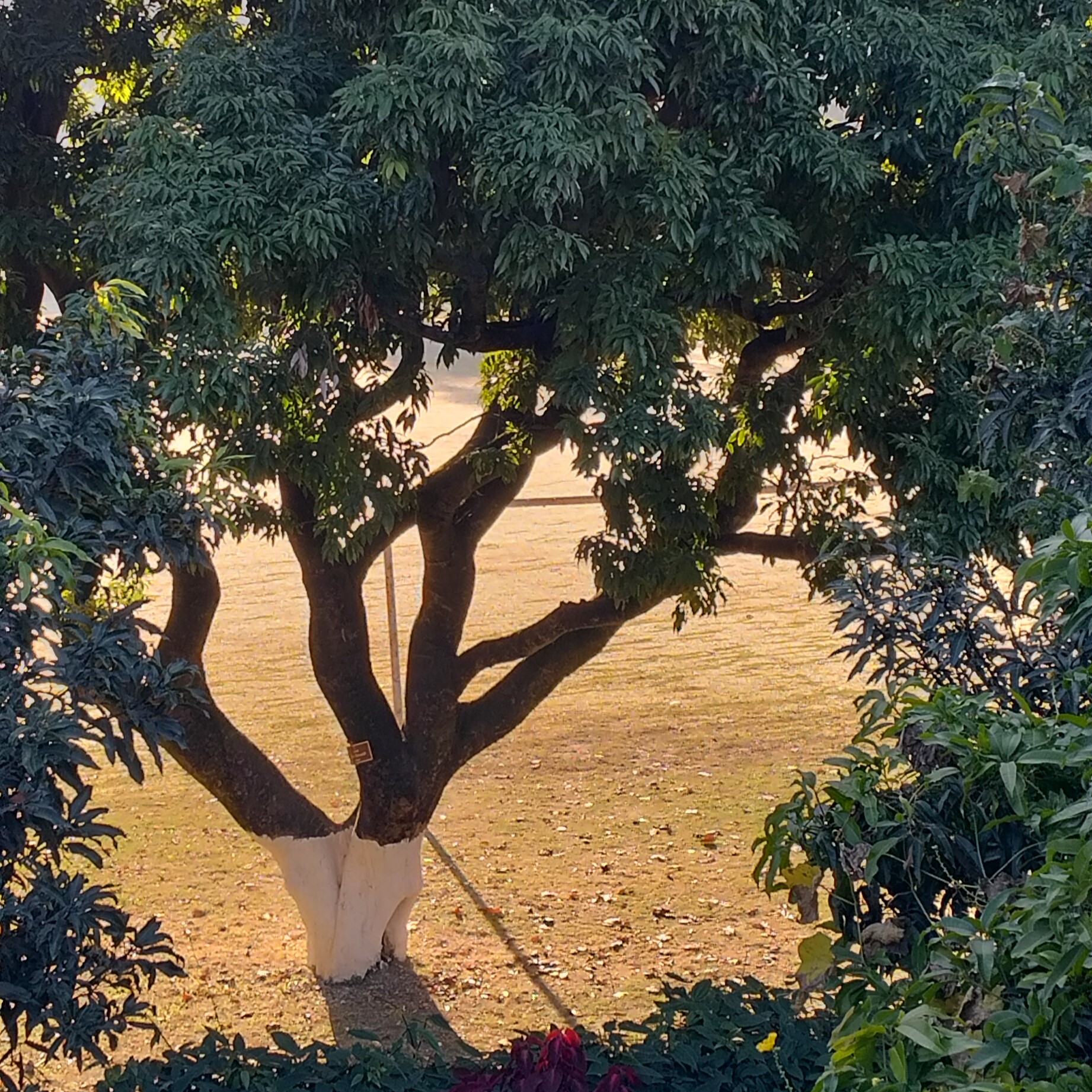
There is a particular morning light that arrives in Dehradun when autumn is just making up its mind to enter. The monsoon’s last green is still holding on, but the air has turned thin and clean, and the winter is standing quietly at the door. This morning I stood at my window and looked out at the lawns, the long shadows lying across the grass, the dry leaves scattered like loose change, and the old trees with their whitewashed trunks standing like sentries in white socks. And just like that, I was a boy in Dehradun again.
I do not know if it is the light, or the smell, but autumn does it to me every year. It carries me back to the 1960s and the 1970s, when Dehradun was a town of gardens with houses in them, and not the other way around. Almost every house then had a wide compound, a mango tree or two, a lychee tree heavy with fruit in spring, a lawn where three or four of us played cricket with the trunk of a tree as stumps, and a verandah where grandmother sat watching the world go by at its own unhurried pace. Our bungalow in Clement Town was like that. It was simply how people lived, and we assumed it would always be so.
It was not to be. Today, that Dehradun survives only in pockets, and I happen to live in one of them. I live in a bungalow of one of the old traditional public schools, Welham Boys’ School. The old public schools, though periodically scorned by people, have held on to what the rest of the town let go: the large playing fields, the open skies, and the great old trees. Some of these trees are nearly a hundred years old. They have watched generations of boys run past, cry, laugh, grow up and leave, and they have never once asked for anything in return.
In spring, the lychee trees put on their show. The fruit hang in clusters, first green, then blushing, then a deep rosy red, and the whole tree seems to glow with a kind of private happiness. I stand underneath and remember how we waited for the lychee season as other children wait for festivals. Then there are the mango trees, which remind me of my own bungalow. Their fruit is the kind no shop can match, because it ripens with the sun and the patience of a whole year behind it.
And then the butterflies come. They arrive in yellows, whites, blues and flashes of orange, drifting daintily over the lawn as if they have nowhere in the world to be. I have had a wooden bench made near one of the trees, and I sit there for hours, simply watching. My dogs, of course, have a different view of the matter. They leap and twist and chase, with all the seriousness of a cavalry charge, and not once in all these years have they caught a single butterfly. They return, tongues out, utterly defeated and utterly happy, and go off in search of the next one. A squirrel which they think is easier to hunt since it does not fly! There is a lesson there about chasing things one can never catch, and being content with the chase.
Just before the summer sets in, when the sweet peas are in bloom, a big, black bumblebee arrives, and it hums. It is a deep, round, contented sound, like a very small organ playing in a very large cathedral. I have taken to recording it, following it around the flowerbeds with my phone. In a world so loud with the wrong things, it is a joy to preserve a sound so entirely right.
And the birds! In the mornings the trees are full of them. Sometimes I sit under a tree with a cup of tea going cold beside me and listen to them for hours. I have stopped trying to name each one; listening is enough. A tree full of birds is a kind of conversation, and it asks nothing of me except that I be quiet and pay attention. How rarely we do that now.
On other days, I walk, with nowhere in particular to go. The grass is soft underfoot, the fallen leaves crackle in a way that takes me straight back to childhood, and the light falls through the branches in long golden pieces. I think of my own school days at St Joseph’s, of the playing fields and the old buildings, and I realise that the whole of my life has been spent in the company of trees and schools and children. I would not have chosen differently.
But there is a price to all of this, and I pay it every time I step out of the gate.
The moment I leave this pocket of green and enter the main town, I find a city I can scarcely recognise. The big bungalows with their wide gardens, the ones I grew up admiring, are being pulled down one by one and replaced with tall residential blocks and shopping complexes. The trees that once lined the roads have given way to hoardings and wires. The traffic is relentless, and the quiet that was once the signature of this town has been traded for something louder, faster and, I am afraid, a good deal poorer. I do not say this out of bitterness. Every generation has its own idea of progress. But I cannot help grieving a little for what has been lost.
And so I have come to say a strange thing, and I say it with a smile. I live in a jail. It is a jail of the past, a lovely, leafy, sun-dappled jail, with butterflies for wardens and bumblebees for company, and I am a very willing prisoner. For when I step out of this jail, I do not step into freedom, as prisoners are supposed to. I step into a big, wild, bustling city that has no use for my memories. The freedom is inside, and the confinement is outside. It is a topsy-turvy sort of arrangement, but it is mine.
Perhaps that is what nostalgia really is. It is not a longing to go back, for we all know that is impossible. It is rather a gratitude for the places that have let us keep a little of what we were. This campus has done that for me. It has kept a corner of old Dehradun alive, and, in doing so, it has kept a corner of me alive too.
So if you happen to be in Dehradun this season, and the air has that first thin chill in it, do me a favour. Find a tree. Sit under it. Let the leaves fall around you, and listen to the birds. Do not take out your phone, except perhaps to record a bumblebee. For an hour or so, you may slip quietly out of the present and into some gentler time, one that your grandparents might have recognised.
Then, when you must, step back out into the city. But carry a little of that green with you.
Dehradun will need it.
(Kulbhushan Kain is an award winning educationist with more than 4 decades of working in schools in India and abroad. He is a prolific writer who loves cricket, travelling and cooking. He can be reached at kulbhushan.kain@gmail.com)