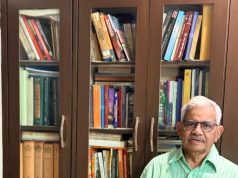
 By Dr. Satish C. Aikant
The Indian Civil Service and its postcolonial avatar, the Indian Administrative Service, created to manage and strengthen the administrative system of the country has obviously stood the test of time and its functioning has been extremely commendable so much so that casting doubts about its role and performance, and propose an alternative system of governance would be considered as nothing short of a heresy. However, there are sceptics questioning its relevance in the modern times when the country faces new challenges.
Speaking at a Global Leadership Summit recently Narayana Murthy, the co-founder of Infosys, and undoubtedly an esteemed leader of the business world, suggested that India’s Civil Services should be recruiting officers directly from Business Schools instead of relying solely on the Union Public Service Commission (UPSC). Murthy argued that India’s bureaucracy should shift from an ‘administrative mindset’ to a ‘management mindset.’ The current system of governance, he believed, was based on producing civil servants trained to maintain the status quo rather than to bring about innovation, and visions of policy formulations to meet the demands of public governance.
Murthy’s suggestion has triggered strong opposition from educationists and bureaucrats. Dr.Sanjeev Chopra, former Director of Lal Bahadur Shastri National Academy of Administration (LBSNAA) takes issue with Murthy, defending the existing merit-based process of recruiting civil servants, highlighting, in particular, its inclusivity and its role in balancing governance with democratic policy-making. This comes from both an insider’s and an outsider’s perspective. Chopra was an IAS officer for 36 years and has worked in two state governments (West Bengal and Uttarakhand) besides the Government of India, in senior administrative and academic positions. He has done exceptionally commendable work in the areas of agriculture, industry, and training institutions. That he is also a literature and culture aficionado is the classic icing on the cake.
True to his professional mindset Murthy counts the virtues of B-School training in terms of the outcome of formulating and implementing policies relating to cost effectiveness, innovation, and rapid execution of programmes as holding the key to the changing demands of governance. Murthy’s views are based on a false assumption about the role and responsibilities of civil servants committed, above all, to social welfare, constrained by working within limited resources.
Chopra’s contention is that the Business-schools are places of privilege. ‘The UPSC’s selection process incorporates merit, diversity and inclusion. It offers every young Indian the choice to appear for the exam in English or any of the 22 languages included in the Eighth Schedule. I am not aware of any B-school having such a provision. As such, there is an inherent bias in favour of students from elite English–medium institutions with a background in science and maths. India cannot become Viksit Bharat if those working toward achieving that goal come predominantly from the uppermost echelons of the English-speaking, urban middle class.’
The UPSC ensures that the candidates from diverse linguistic and regional backgrounds, especially those coming from the hinterland, most of whom and are poor and disempowered and are denied access to the premier service to serve the country.
As to the changing demands of governance Murthy talked about, Chopra asks, who would decide what these demands are? Public institutions responding to the demands of a welfare state cannot operate on corporate model focused predominantly on profit motive. We cannot compare the All India Institute of Medical Sciences (AIIMS) with Max, Apollo, or Medanta. Nor can state funded institutions of higher education like the JNU, Delhi University, the IITs and the IIMs be rated below the expensive private institutions where only the elite can take admission.
The Civil Services officers are trained to create an environment where the ease of doing business is balanced with the ease of living, both being the legitimate goals for human aspiration. The corporate sector spends more on advertisements than on corporate social responsibility. They are never transparent about their activities and shy away from adopting the RTI Act for their organisations. The salary differentials between the top executives and the workers down the line are startling, to say the least. They are never transparent about their inclusivity index.
Let us not forget that contrary to popular perception public institutions like UPSC and LBSNAA are not static institutions – they evolve with times adapting to the changing socio-political demands. Ideas such as digitisation, e-governance, and New Public Management, which draw inspiration from the private sector, are already part of governance today. IAS officers already undergo training at premier institutions like IIMs as part of their induction process. Interestingly, many IIM and IIT graduates themselves choose to join the civil services, recognizing their broader impact and challenges of governance. However, comparing civil services to the private sector overlooks fundamental differences in their nature of work. It’s essential to recognise that the public sector operates under a completely different set of principles – focused on equity, inclusion, and accountability rather than profit. The public institutions have to fulfil their obligations balancing diverse interests while working with limited resources.
The IAS provides a meritocratic framework for governance, where officers are selected based on their academic achievements and performance in the civil services examination regardless of social background or connections. This ensures that the best and the brightest minds are attracted to the service, and officers are promoted based on their merit and performance.
Graduates from business schools and the corporate world may excel in specific areas, such as finance, marketing, or management, but may lack the breadth of experience, public interest orientation, and commitment to public service that IAS officers possess.
The world of Business Schools is unavoidably a world interlinked by technology
The digital technologies including social media platforms, big data, mobile technology and artificial intelligence are increasingly dominating our economic, political and social life. It cannot be denied that these technologies have, on balance, made us more informed, richer and, in some ways, have contributed to human happiness making our lives more comfortable. After all, technology tends to expand human capabilities, produce new opportunities, and increase productivity. But that doesn’t necessarily mean that they are good for democracy. In exchange for the undeniable benefits of technological progress and greater personal freedom, we have allowed too many other fundamental components of a functioning political system to be undermined: parliamentary sovereignty, economic equality and a vibrant civil society and an informed citizenry. The high-tech revolution has only just got going. As is apparent, the coming years will see further dramatic improvements in AI enhanced digital technology. On the current pace of development, within a generation or two, the contradictions between democracy and technology will only get exacerbated.
While the latter-day utopians are busy dreaming up a society dictated by connectivity, networks, platforms and data one needs to realise that democracy (and indeed the world) does not run like this – it is slow, deliberative and grounded in the physical. Democracy is analogue rather than digital. Any vision of the future that runs contrary to the reality of people’s lives and wishes can only end in disaster. In fact, highly modernized societies are steadily moving in the direction of techno-oligarchies.
If we are not attentive to the demands of democratisation, neo-liberal capitalism will undermine our democracy by accentuating social inequality. There is a close link between the corporate world and the lure of technology. If technocrats have to acquire a human face they must operate under predominantly human watch. Man controlled by technology is constantly in danger of compromising his subjectivity and authority and is bound to be buffeted by forces beyond his control. Though technology can provide transformative solutions to some of the pressing problems we face today it must be used with caution to prevent its authoritarian impulse.
It is humanistic education and training that can endow a proper judicious outlook to those managing the affairs of the state. However, in the final reckoning we will have to rise above the either/or syndrome embracing both the professional technocrat and the humanist as indispensable to our democratic governance adhering to the values enshrined in our constitution, and follow in letter and spirit what is mandated by it.
The bedrock of the corporate world is market which promotes an overt consumer culture, the negative fallout of which can only be redressed by a humanist enterprise. Let us not be under the impression that in the tussle between man and technology human agency will be the inevitable winner and that the humans will remain firmly in control. Visionary leaders and civil servants like Sanjeev Chopra can however make sure that there is no corporate overreach to jeopardise the social domain where the welfare state thrives.
The Indian Civil Service by no means is redundant in the changing India. It has neither exhausted its potential nor withdrawn from its role in nation making. Let the steel frame acquire a new sheen.
(The author is former Professor and Head of the Department of English, H.N.B.Garhwal University and former Fellow of the Indian Institute of Advanced Study, Shimla)