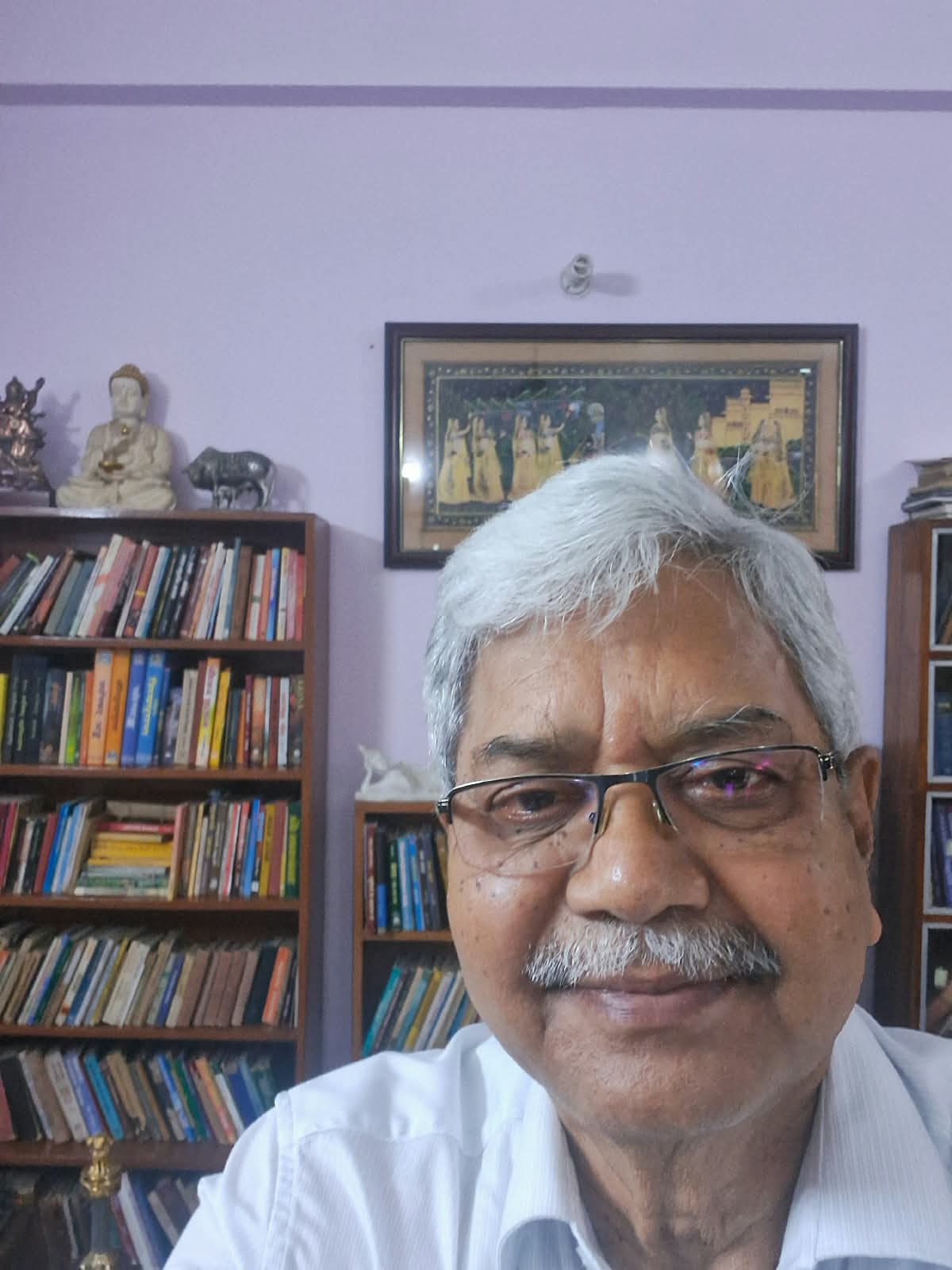
The Books from My Shelves-12
By VC Goel
I am grateful to NS Napalchyal for inviting me to introduce ten books which I have read in the last decade. Any ten books would have made the task easier but his advice not to include two books on the same subject made it slightly difficult. However, as my interests are multifarious I was somehow able to pick up ten such books from my collection. My interest to understand ‘Why we (Indians) are the way we are?’ takes me to our history, archaeology, philosophy, psychology, neuroscience, and scriptures various schools of thought and sects. Almost a herculean task. Whenever I feel a particular book may help me in unravelling a part of it, I get it and read.
I have photography as my hobby. Corona times gave me an opportunity to test my skills, whatever I had, to take photographs of birds from my first-floor terrace. I photographed more than 75 birds in and from my house. To understands birds seemed to be understanding humans and the ecosystem. A very satisfying adventure, an adventure without going out! In the process I collected more than a dozen books on birds and conservation and preservation of birds and the environment.
The books selected are not in any specific order, but may reflect my interests.
I am happy to share that the student woke up in me is still awake and demands to know more!
Why Buddhism Is True: The Science and Philosophy of Meditation and Enlightenment (Simon & Schuster 2017) by Robert Wright is a compelling, secular exploration of Buddhist meditation and philosophy through the lenses of modern evolutionary psychology and cognitive neuroscience. Natural selection designed our brains for reproductive success. It does not care for happiness or objective truth. We are trapped in a cycle of craving and aversive reactions. He argues that Buddhism’s core diagnosis of the human condition—specifically, that our natural mental states are full of delusion, dissatisfaction, and illusion—is scientifically accurate. Vipassana meditation is a secular, empirical, and practical toolkit to disengage from our daily selfish, knee-jerk emotional reactions to happenings around us. I agree with him because like him I am also a beneficiary of this meditation.
Tony Joseph’s Early Indians: The Story of Our Ancestors and Where We Came From (Juggernaut 2018) seems to re-emphasise the argument of David Reich in Who We Are and How We Got Here (OUP 2018) to Indian and South Asian ancestry in detail. Writing as a journalist rather than a lab scientist, Joseph has bridged the gap between the dense genetic research and the general reader. He shows that we are migrants and we are all mixed. Human populations were always on the move, and blended and re-blended over thousands of years. With hard scientific data the book has tried to systematically dismantle political and ideological myths regarding “indigenous” pure races or “out-of-India” linguistic origins. He uses the metaphor of multilayered pizza to describe the Indian population.
The Myth of the Holy Cow (Narayana, 2015) by Prof DN Jha, who on the basis of rigorous research and profound historical examination has argued that the absolute sacredness of the cow is a relatively late construct rather than an unchanging tenet of ancient Hindu tradition. He has copiously cited from early religious texts including the Vedas and Brahmanas, Buddhist and Jain scriptures which show that beef consumption and cattle sacrifice were common during the Vedic and post Vedic periods. Sacredness of the cow was introduced due to various socio-religious developments like the rise of Buddhism, Jainism, and changing agrarian economies.
Republic of Hindutva: How the Sangh is Reshaping Indian Democracy (Penguin 2021) is a book by social historian Badri Narayan who critically examines how the Rashtriya Swayamsevak Sangh (RSS) has evolved into a modern, socially inclusive political force from a traditional cultural organisation. Based on extensive field research in UP, Narayan observes that the RSS has adapted to contemporary democratic imperatives and finds the opposition’s perception of the Sangh largely obsolete. Shifting away from relying purely on communal polarisation, the Sangh is focusing on assimilation of Dalits, tribals, and marginalised communities into a broader Hindutva metanarrative. The Sangh is actively leveraging and validating the aspirations of the disadvantaged groups (rather than attempting to eradicate caste identities), and translating this recognition into electoral support for the Bhartiya Janata Party.
No Ten Commandments (Anugya, 2022) by ST Hollins was first published in 1954. Hollins was an IP officer who rose to become IGP of the United Provinces (today’s UP and UK). It is a fast-paced memoir of policing in pre-independence British India. One can find details of many crimes committed in those days like dacoity, honour killing, human sacrifice, sati, professional poisoning, and communal riots. It gives many historical insights into the independence movement and revolutionary activities. It gives first hand details of the death of Chandra Shekhar Azad in Allahabad clearing many an imaginary narrative surrounding his killing.
I have always been amazed by the interpretational versatility of the Gita. When I read Dorothy Figueira’s The Afterlives of the Bhagavad Gita: Readings in Translation (OUP 2023) I was further amazed to find that it was not only in India that the Gita has been received, interpreted, transformed differently, but it was so across different global eras and cultures, mostly in Europe and USA.
Translations of the Gita do not seek the same aims in all places and at all times. Even in India, in the Gita Gandhi found Anasakti Yoga and Ahimsa, Tilak Karma Yoga, Aurobindo Integral Yoga, Vivekananda Practical Vedanta, Radhakrishnan Universalist Philosophy and Prabhupada Bhakti Yoga. The author finds that translation theories and methodologies are not uniform across nations and eras. It was translated with very different agendas across nations and temporal periods. This volume looks at insolites (unusual, strange) readings of the Gita and how they seek to fill the hermeneutical gap between readings tied to its canonical and scriptural status and those that are distant from the text’s tradition.
The Dawn of Everything: A New History of Humanity (Allen Lane 2021) by David Graeber and David Wengrow is a re-examination of human history that challenges the traditional linear narratives of social evolution. They argue that mainstream anthropology and history were trapped in a pessimistic binary: either humans lived as innocent, egalitarian hunter-gatherers, or civilisation required sacrificing their freedoms to hierarchical states and markets. On the basis of new archeological data, they show that early humans consciously experimented with diverse, flexible forms of social organisation, seasonal governance, and large-scale horizontal structures without succumbing to permanent domination.
Ishtiaq Ahmed’s The Punjab: Bloodied, Partitioned and Cleansed (Rupa 2022) is a landmark comprehensive and scholarly masterpiece of oral history and archival verification into the catastrophic division of the Punjab in 1947. It presents the raw violence that accompanied the division. Through hundreds of first-person eyewitness evidence Ahmed captures the trauma of ordinary Hindus, Muslims, and Sikhs. Eyewitness depositions of mob violence and riots may sometimes be highly emotional and deeply harrowing, particularly in incidents when the Sikhs would kill their women and children before embarking on revenge, lest they fall in the hands of the Muslims. Views of both sides have been honestly documented. Ahmed estimates that 500,000 to 800,000 people perished in this ethnic cleansing pogrom
Geetanjali Shree’s Ret Samadhi (Raja Kamal Paperbacks 2022; published in English as Tomb of Sand, translated by Daisy Rockwell) made history by winning the International Booker Prize as the first for a Hindi language book to do so. The story is about an 80-year-old unnamed matriarch (Ma) who, following the death of her husband, sinks into profound depression, but soon rejects the mourning constraints placed upon a traditional widow. She gets up from bed with a renewed, youthful zest for life and embarks on a journey that defies expectations, crosses familial boundaries, which leads her across the border to Pakistan to confront the lingering trauma of her Partition-era youth. The narrative deconstructs man-made and conceptual borders—whether dividing nations, religions, genders, or generations.
Birds of the Photo Ark (National Geographic 2018) is a collection of studio portraits of birds in zoos, aquariums and wildlife sanctuaries by photographer Joel Sartore with an accessible text by expert birder Noah Strycker. Each bird is photographed against a clean black or white background, focusing solely on the bird’s unique features. The portraits are intimate and engaging. This book is part of the Photo Ark project started by Joel Sartore and created by National Geographic. This projects aims to inform the world about the plight of the earth’s animals and encourage efforts to save them.
(VC Goel is a retired DGP, UP, and former VC, CCSU, Meerut. He has published three books on policing and two coffee table books.)