 By Rajshekhar Pant
Since my arrival here last evening, I have been seeing many faces.
Some I noticed only in passing; others held my gaze for a moment.
But today—today I really looked at one, it stayed with me, long enough to follow me into thought.
I am in Shirdi… the Shirdi of Sai Baba.
Sai Baba—whose eyes, whose very face, seem steeped in compassion, kindness, and filial affection, as though these feelings had settled there for all eternity. The temple complex is impeccably maintained—spotless, orderly. It feels good to be here… to linger a while, to let the noise of the world stay outside for some time.
Yet outside the sanctum, life is less certain.
Misfortune, sorrow, and relentless adversity—beyond a certain limit, they make a supplicant out of any human being. Perhaps, in truth, supplication is a natural human instinct. God has given me everything… yet here I am, as a supplicant. Even when life is fairly smooth, the plea for God’s grace—His unbroken blessing—remains alive within us. But when misfortune becomes constant, when one’s strength to resist hostile circumstances is drained away, the very nature and focus of one’s appeal changes. It drifts away from God, towards human beings.
Perhaps this is because humans are not—like God or some higher power—distant, unfathomable, beyond words. In such moments, the chance of receiving immediate help born of human compassion feels stronger than any promise from the distant divine. A human hand can be warm now—not someday.
But… is that really so?
Since last evening, I have been watching little boys and girls, clutching the hands of some frail, helpless elder, begging for coins. Bent, skeletal old women sit along the clean temple lanes, imploring visitors to buy a picture of Baba, or a small bundle of red roses, or to let them smear sandalwood paste upon a forehead—for ten rupees, perhaps five.
A blind man, or one without legs, asks simply for a cup of tea—here it costs only two rupees.
One boy, carrying small black-and-white portraits of Baba, insists I buy just one. He says the money will get him a notebook for school. I meet him again the next morning, returning from the darshan.
“Buy one, uncle, just one…” His tone carries more irritation than pleading, as if to say, God has given you so much—can you not buy even a picture?
I take him to a bookshop and buy him two notebooks instead.
At once, several old, ragged women gather around, protesting that I gave the boy something but nothing to them. Chekhov’s The Beggar comes to mind—the character Lushkov, whose life was transformed by the kindness of Sergei and Olga. And perhaps, in my own search for a reflection of Sergei and Olga within myself, I am trying to fashion myself into some sort of benefactor. But then, believing Lushkov to be a scoundrel, a drunkard, a cheat—wasn’t that the first condition for Sergei and Olga to feel like better human beings, a redeemer…?
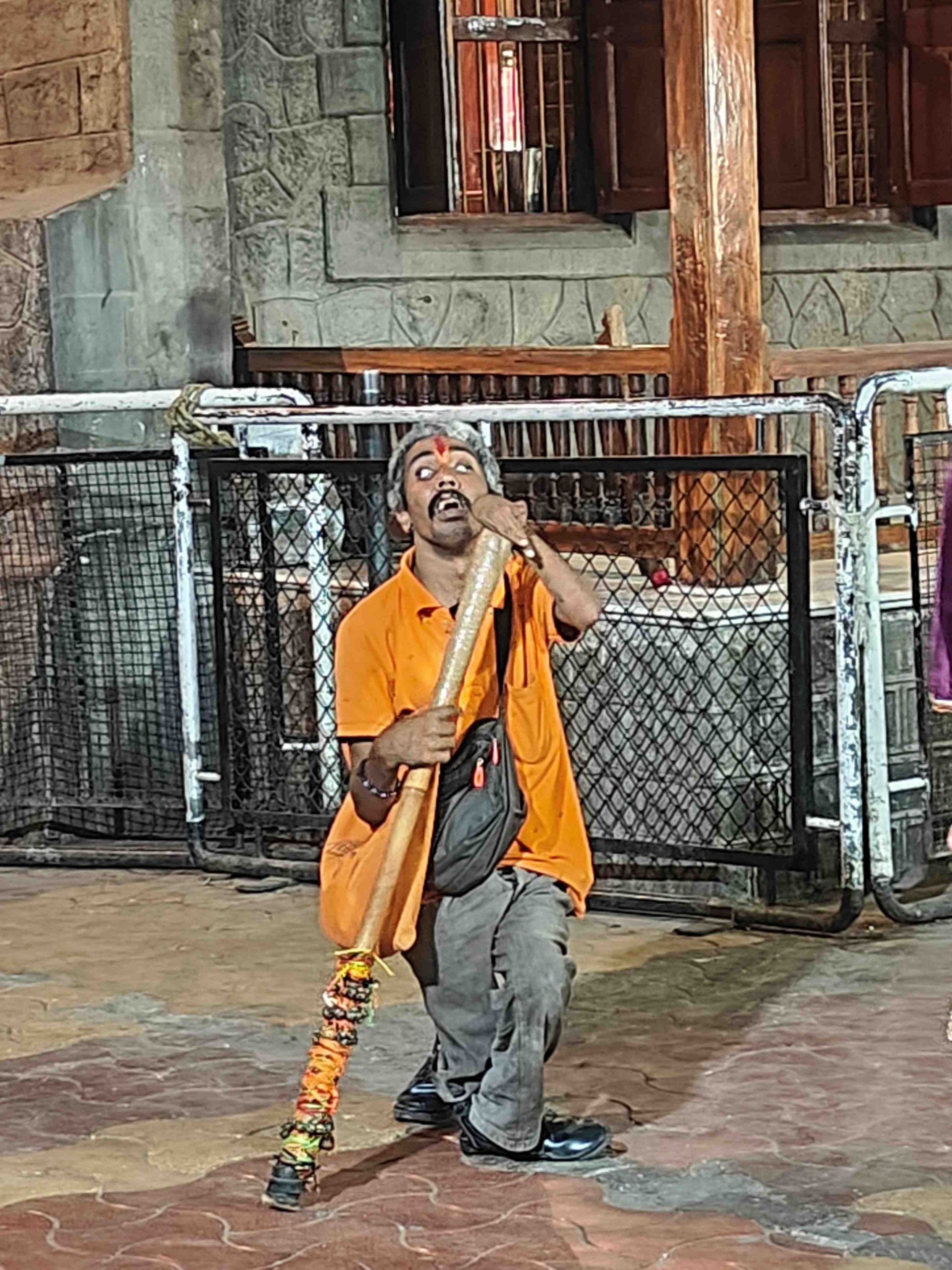
And then this evening …. I am looking at him.
Dragging himself along with the help of a bamboo stick—crippled (or perhaps, as they say these days, “differently abled”)—outside Dwarkamai. He asks nothing from anyone. His eyes held a pain that pierces straight through.
Geeta, my wife, has gone inside Dwarkamai—the place where Sai Baba had lived, had eased the suffering of countless souls. I stand outside, holding her handbag and mobile, waiting.
I check my pockets: three notes of five hundred rupees each.
I fail to bring myself to hand over five hundred as “alms”. Geeta, too, has no smaller notes.
“How many will you give money to? There are too many here…” she says with irritation, walking towards a shop. We have to buy a beautiful Kashmiri shawl—so we may have it “blessed” by Baba at the morning aarti.
She is right.
There are too many here.
Too many there.
Too many—everywhere.
(The author is an amateur filmmaker, a photographer, and a writer, who has written over a thousand write-ups, reports, etc., published in the leading newspapers and magazines of the country. He can be reached at pant.rajshekhar@gmail.com)