 By Atul Rawat
Formal education in schools and colleges is the crucible of national intellect, character building, learning from the past and preparing for the future. The first 20 to 25 years of life of a young person are spent in acquiring the nuances of this formal education tenets with a hope that it will be good enough to make a life out of it for the next 50 years.
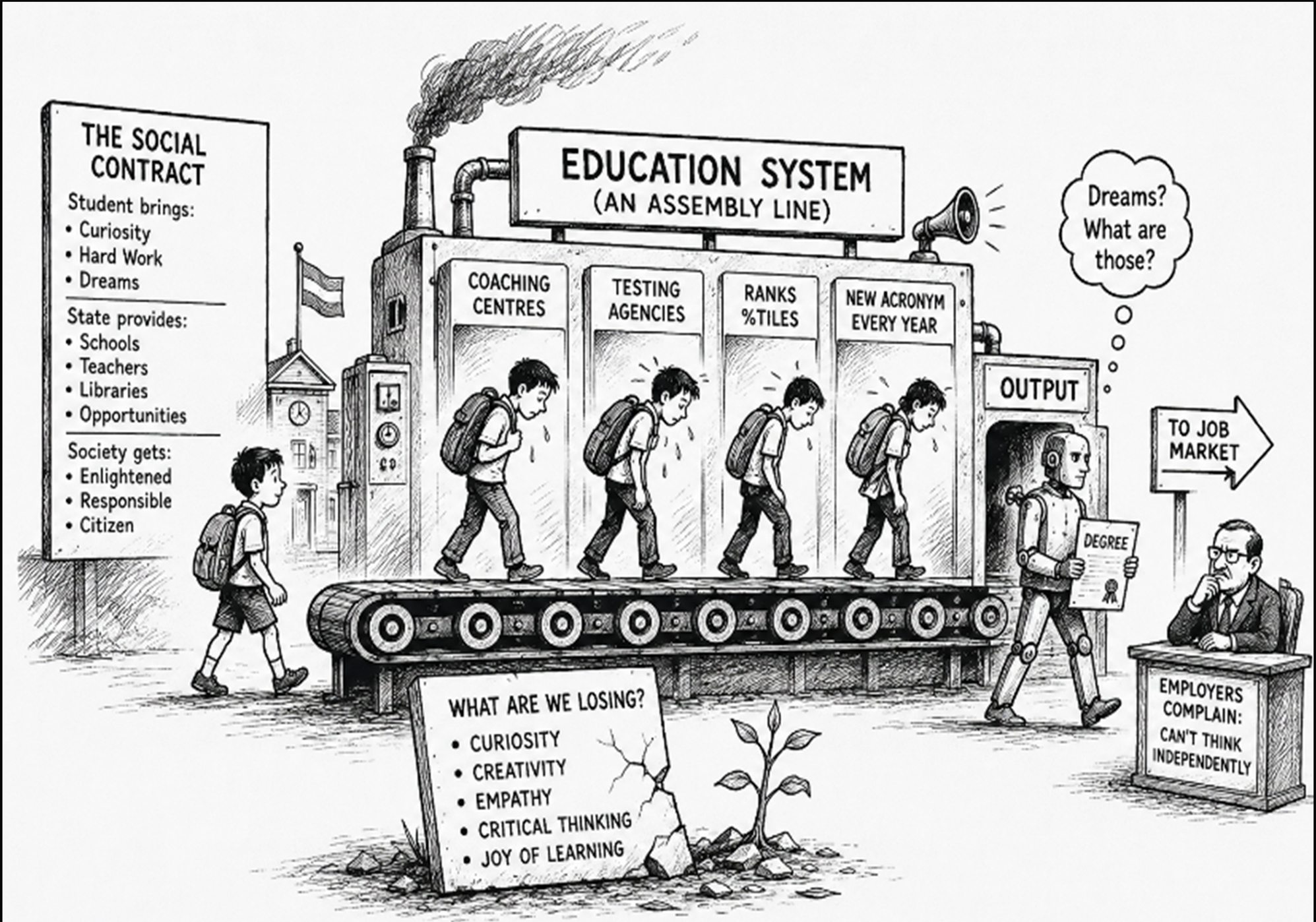
This arrangement between the Student and the State was envisaged as a sacred social contract. The arrangement was simple. It was expected that the student would come to the premises and bring along curiosity, hard work and dreams; and the state would provide the building blocks – buildings, teachers, libraries and opportunities. And in the end, it was expected that society would get a citizen who is enlightened, has enough intellectual rigour, respect for all and join the mainstream for the next five decades.
No one could fault such a system.
In today’s world it appears that the arrangement has been modified and is now at the hands of coaching centres and testing agencies.
Monetisation of education and the ever-increasing competitiveness to get a good enough job has in the process eaten away the human aspect of education.
Schools, increasingly resemble an assembly line with security gates, endless announcements and innocent faces carrying bags not only heavy with books and assignments but also with uncertainties and expectations.
The child who steps into a nursery classroom and passes through Class XII and college often emerges as little more than a highly efficient multiple-choice answering machine.
We graduate to a new acronym every year from smart classroom to digital learning, from AI-powered assessment to skill integration, from holistic development to experiential learning. The change is so fast that the essence of change is lost in just managing the change.
In the percentages, learning disappears.
The expectations are endless.
“Sharmaji’s son got into IIT.”
“Very unfortunate.”
“What happened?”
“He only got Computer Science.”
In this great national obsession, learning itself has become an accidental by-product.
Everyone appears to be under stress – the student suffers the constant weight of expectations and load of books and assignments, parents are financially exhausted, teachers are overworked, and employers complain that graduates cannot think independently. The system is slowly metamorphosing into one in which degrees are produced on an industrial scale but wisdom remains in short supply.
The state just manages another education cycle. The student gets lost in the entire exercise. Between the percentage and the percentile, they lurch from one event to another hoping that some unseen face somewhere is doing it right.
If the by-product is expected to evolve, can the state remain static? The onus is on the state. The job and the responsibility are onerous and sacred. The state must have a high emotional quotient and must maintain an umbilical cord with the student. Good education is not about producing obedient examinees; it is about producing thinking citizens. A classroom is where a republic quietly shapes its future.
A broken relationship, sets into motion tectonic events which for ever affect the social and emotional fabric. Along with it arrives poor leadership, shallow public discourse, intolerance towards ideas, scientific illiteracy and citizens unable to distinguish between evidence and WhatsApp forwards.
No country has ever become truly prosperous by neglecting its schools while decorating only its shopping malls. Roads and airports may build infrastructure, but education builds civilisation itself.
Yet, humans are eternal optimists. We cannot give up.
Hope alone is not enough. We know that, the engagement of a curious student with an evolved teacher and a responsive state have the capacity to unleash the true potential of the youth.
A country as diverse as India in terms of geography, culture, language and per capita income must continuously evolve the social covenant to ensure that it meets the requirements of the times.
Because, education is not charity. It is the foundation upon which every modern nation stands.
And if the social contract between the student and the state collapses, no number of smart boards, rankings or motivational hashtags will save us.
After all, a nation ultimately becomes what it teaches its children.