 By Atul Rawat
The other day, I was walking towards Pacific Mall. The afternoon sun was beating down mercilessly, and I was sweating profusely.
“Thank God for the trees,” I thought.
As I walked along the footpath, I came across a group of workers digging it up.
“Kya kar rahe ho, Bhula?” I asked innocently.
One of them looked at me and pointed towards another gentleman busy on his phone. I waited patiently for him to finish his conversation and repeated my question.
“Kya kar rahe ho, Bhula?”
Perhaps my grey hair earned me some respect. He grunted: “Jo tile neeche chali gayi, usko nikal kar phir se laga rahe hain.”
I looked around. He was right.
Tiles lay scattered everywhere. Pedestrians were negotiating the obstacle course with remarkable agility, trying to get on with their lives while pretending this was perfectly normal.
Welcome to a normal day in Doon on the roads.
Well, that was merely the trailer.
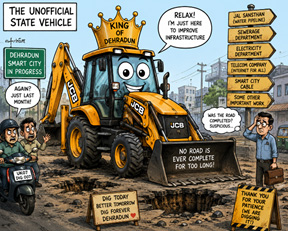
The star of the show—the ubiquitous JCB—was conspicuous by its absence.
Given its contribution to public life, perhaps it is time we officially declare the JCB the State Vehicle of Uttarakhand and erect a grand monument in its honour.
Development and JCB are synonymous on the streets of Doon. It must leave an imprint on every completed project in the city.
We love Doon—the city where roads are not infrastructure; they are a renewable resource for digging enthusiasts.
It often seems that the moment one project is completed, another project is sanctioned specifically to undo it.
A few days ago, I had come across a nicely tarred road. Very smooth. Silently, I complimented the administration and admonished myself for doubting them.
Not to be left behind, I promptly uploaded a pic on social media to the envy of my friends living in metros.
Well, it turned out to be a proverbial case of counting my chickens before they hatch.
A few weeks later, one department arrives to repair a pipeline. Soon after is the turn of the sewerage line. Then appears the power department because all overhead cables must now be placed underground. Not to be left behind, the telecom company suddenly remembers that high-speed internet must reach all Doonites. Then someone discovers a Smart City cable requirement.
Aggghhhh!
We all let out a collective sigh.
Traffic crawls. Honking reaches symphonic levels. Dust rises. And then the monsoon arrives to add its own quality assurance process.
The inter-departmental symphony of excavation will beat the best of the Mozartian orchestra.
By the end of the season, the road resembles the lunar surface which Neil Armstrong would have been proud to negotiate.
In many cases, it is left considerably worse than when the entire exercise began.
Yet we remain optimistic citizens.
Whenever we see a newly completed stretch of smooth road, our hearts swell with pride.
And panic. Because deep down we know that somewhere, in some office, a file is already moving. Someone is peering over a blueprint and whispering:
“This road looks suspiciously complete.”
Coordination between departments in Dehradun remains one of modern science’s greatest unsolved mysteries.
Each department functions like an independent kingdom discovering the city for the first time.
One digs. The second re-digs. The third widens the dig. The fourth studies the previous dig.
The fifth installs barricades and leaves them behind as a protected heritage structure.
If Dehradun were to update its civic symbols, the list might look something like this:
City Bird: The Hornbill.
City Flower: Dust.
City Festival: Excavation Season.
State Vehicle: The JCB Excavator.
And our civic motto?
“Why build once when you can dig forever?”