 By Rajat Aikant Sharma
Hill towns have always had a peculiar relationship with silence. Unlike the plains, where space is negotiated loudly and endlessly, the mountains prefer ambiguity. A bend in the road hides a shrine. A cluster of trees shelters a memory. A broken stone survives not because it is certified, but because no one ever felt threatened by it.
In the hills, silence was never suspicious. It simply was.
Trouble begins only when silence is asked to explain itself.
In recent weeks, a small, long-ignored prayer space in Mussoorie—quiet, disputed, largely invisible for decades—suddenly became very visible. What followed was not contemplation but acceleration. Questions arrived in quick succession: Who built it? When? With whose permission? Who rests there, if anyone? Was it legal? Was it authentic?
All fair questions. In a modern civic society, such questions are not only inevitable but necessary.
Yet the manner in which questions are asked often reveals more than the answers they seek.
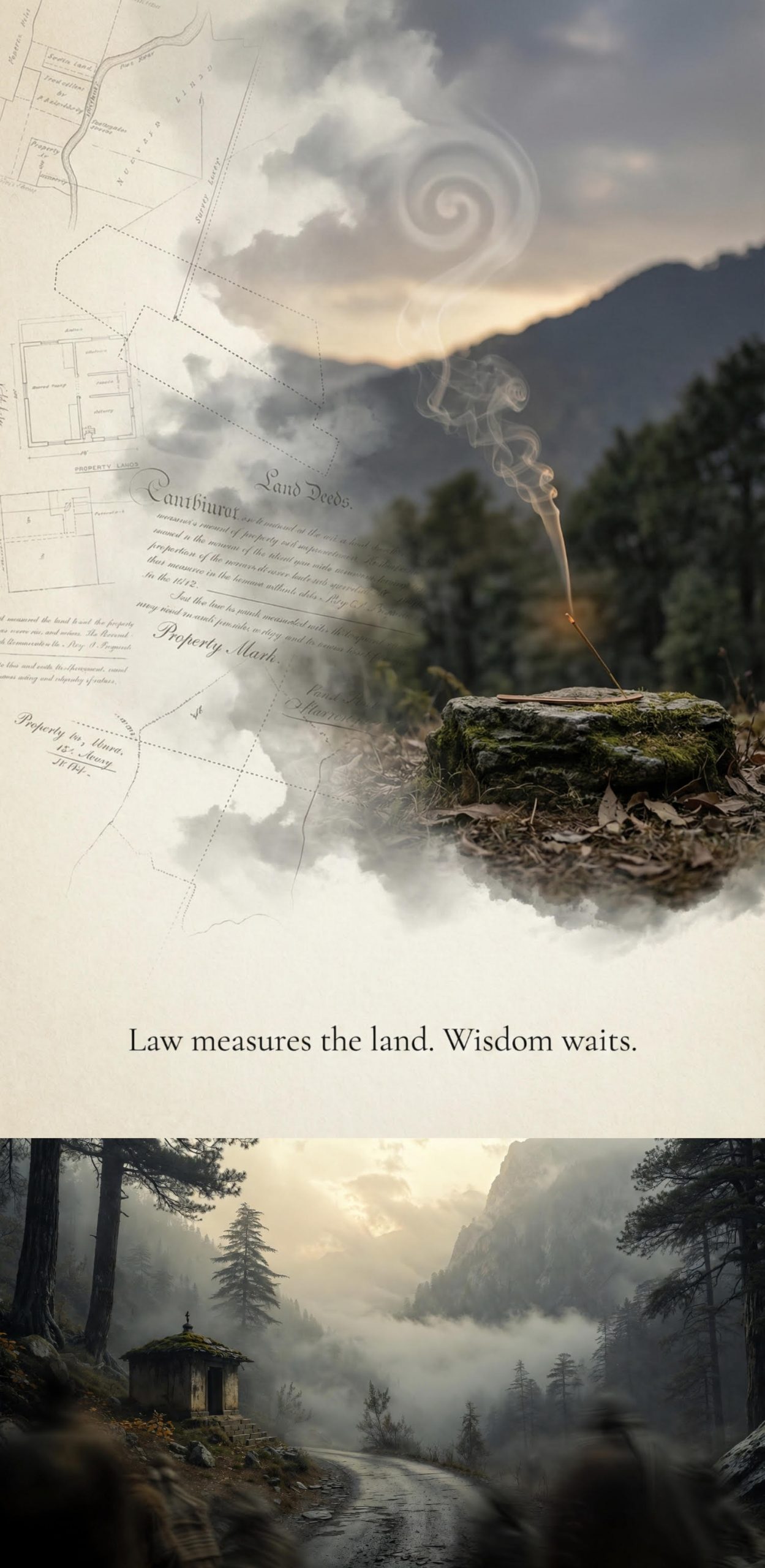
India has always lived with two kinds of sacred spaces. One kind is institutional—registered, documented, architected, audited. Its legitimacy flows from paperwork, permissions, and committees. The other is older and less orderly. These spaces emerge slowly: a stone placed, incense lit, silence respected. No inauguration, no signage, no ambition. They survive simply because they do not interrupt life.
Hill towns are full of the second kind. They exist not because something was proven, but because nothing was harmed.
Confusion arises when the language of one is suddenly forced upon the other—without patience, and without proportion.
The law, understandably, asks a precise question: was permission taken? Memory asks a quieter one: was anyone disturbed? Both questions matter. Both are incomplete on their own. A structure can fail legal tests and still carry decades of social acceptance. Another may pass every regulation and yet unsettle the land it stands on.
What has unsettled Mussoorie is not merely a question of legality, but the speed with which a marginal space was pulled into the centre of attention. Investigations, counter-claims, political statements, and warnings about what may or may not be rebuilt have entered the conversation. What once existed at the edge of notice is now amplified, interpreted, and claimed.
Old wisdom would remind us that reality is layered. Trouble begins when one layer is mistaken for the whole.
Much of the debate has revolved around bodies—whether anyone was actually buried there, whether the name associated with the site aligns with history, whether belief has outpaced fact. These are legitimate historical and legal questions. But philosophy asks something else entirely: why does absence make us uneasy?
Indian civilisation has never required physical remains to experience the sacred. Empty caves, footprints without owners, places of long-forgotten tapasya—these have always been revered, not because something lay there, but because something once became still there.
In the Garhwal and Himachal hills, this understanding is woven quietly into daily life. Along sharp bends and deep curves—places where accidents once occurred—one often finds small stones, modest structures, or simple mandirs. They do not celebrate death, nor do they sanctify the body. They exist as gestures of pause. They ask the traveller to slow down, to fold hands, to light incense, to acknowledge that a life ended here.
No one asks who lies there. No one demands proof. Silence itself is the offering.
When meaning is made dependent only on bones, silence becomes suspicious. Hill culture has long known otherwise: respect does not require remains—only awareness.
That said, silence too has its limits. A single, unobtrusive marker is one thing. Its gradual transformation into multiple structures, auxiliary graves, or permanent enclosures is quite another. Hill societies have always understood this distinction instinctively. A lone resting place—respected, contained, unobtrusive—could exist as part of the land’s layered memory. Expansion, however, invites scrutiny, not because of faith, but because of scale and intent.
It is reasonable to ask why a quiet marker should begin to resemble a burial ground, why additional graves or rooms should appear without transparency, why a space meant for pause should start looking like possession. These questions are not hostile. They are protective—of land, forest, and trust.
Across traditions, spirituality weakens the moment it seeks to occupy rather than withdraw. Any attempt—by anyone—to use belief as a means to permanently acquire land or multiply structures deserves firm civic and legal correction. If a place once carried meaning, it was precisely because it did not grow, advertise, or assert itself.
What needs constant addition is rarely sacred. What is complete does not seek expansion.
There is, however, a reasonable middle path. A society that values both law and memory must be capable of restraint. It is possible—and necessary—to say: let the single, original marker, if historically attested and harmless, be treated with dignity. Let later additions that suggest land capture be removed or prohibited. Let clarity come from authorities and landowners, not from haste, threats, or spectacle.
This is not erasure. It is containment. And containment is often the highest form of respect.
Lost amid debates over legality, belief, and identity is the one presence that predates all claims: the forest. Forests have always sheltered wanderers, ascetics, caretakers, servants, and the unnamed. They do not recognise registration numbers. They respond only to restraint. When forests become arenas for proving belief, the land quietly withdraws. Erosion, instability, exhaustion follow. Nature does not argue; it recedes.
It must be said clearly: questioning is not violence. Seeking legality is not hostility. Demanding clarity is not intolerance. The problem begins when questioning forgets proportion—when inquiry becomes performative, when correction arrives without patience, when silence itself is treated as provocation.
Civilisations endure not by avoiding questions, but by asking them without humiliation.
Once, hill cultures allowed overlap—unnamed shrines, shared silences, spaces that were neither claimed nor defended. They understood something we are rapidly forgetting: not every quiet place is a challenge, not every ambiguity a threat, not every undocumented space an enemy. Sometimes it is simply a pause left behind by earlier generations—imperfect, unofficial, and harmless.
Perhaps the real discomfort is not about permission or proof. Perhaps it comes from something deeper: that in an age of declarations, silence feels subversive; that in an age of certainty, ambiguity feels unsafe.
Old wisdom would gently suggest that when identity grows loud, consciousness grows small.
And the hills, as they always have, will wait—patient, unmoved—for us to remember how to lower our voices.
(Rajat Aikant Sharma is a writer and photojournalist exploring culture, history, and human stories. Beyond print, he creates digital content, posters, and social campaigns that extend his editorial voice into the world of influencer engagement and brand storytelling.)