 By Ganesh Saili
‘Lights?’
‘Sound rolling?
‘Camera? ’
‘ACTION’
We have not strayed onto a film set. It is a very old hotel, where the room boys, waiters, cooks and bellboys are cleaning out the rooms, calling to each other in the manner of the Director, Honey Irani. She had long since gone, having wrapped up the shooting of Armaan with the Big B the week before. In her wake, she has left behind a legacy stuck like the hill mist that lingers on. Having packed up, she was back in Mumbai.
Wiry Lashkari, a waiter with a quick smile, tosses a threadbare carpet across the passage. Mohan, the kitchen boy, grabs one end and lets out a whoop. At the same time, Chatter Singh Negi, who had known this place for half a century, calls a firm ‘Cut!’ As if on cue, a sleepy shrew, curled up and hidden in the folds of the carpet, awakes from its slumber with a squeak. In protest, it darts across the veranda, bounding across the tennis court, and enters one of the shops still shuttered in the bazaar below.
Those shops have been there for years. They have watched these hills provide shelter to actors, both big and small. In the 1950s, Prem Nath and his wife Bina Roy bought a cottage on Oak Road that shared a wall with the neighbouring Rama Devi School. If they looked down upon the Doon Valley, it was spread out like a green quilt. It was their quiet escape, if you ignored the noise from the school next door. If only you waited until dark, the valley below looked like a quilt made from the purest gems.
In the sixties, I saw Dev Anand and Kalpana Kartik in a rickshaw with Dev Anand helping push a rickshaw up the steep incline of Mullingar hill, tired but happy. They liked the old Nurses’ Barracks at Sister Bazaar and sent their children, Sunil and Devina, off to school. Kalpana Kartik, now in her nineties, often returns to the scene of her youthful escapades, hoping to catch a whiff of the old magic again.
Tip Top Tea Shop 1970s.
Pic courtesy: Norman van Rooy.
The seventies brought Rajesh Khanna or Kaka, who was, arguably, our first superstar. He was filming Ghar Ka Chirag at Allen School. He liked the place so much that he came back in 1989 to shoot Karm, at Hampton Court and the Convent of Jesus and Mary.
Of course, there is Victor Banerjee, who later became the lead of David Lean’s A Passage to India. He came in the nineteen-eighties, starring in Lekh Tandon’s Dusri Dulhan. Shooting with him were Sharmila Tagore and Shabana Azmi. The theme of the picture was surrogate children. I feel it was way ahead of its time; naturally, it bombed at the box office. A happy byproduct, though, was that Victor and Maya fell in love with Landour, a love that endures to this day. They put their two daughters into school and stayed on at the top of the hill in their storybook cottage called the Parsonage.
Tom Alter was born and schooled in these part and went on to achieve fame and fortune on the silver screen. Sadly, Tom left us way before his time
Newer entrants in the neighbourhood are Vishal and Rekha Bhardwaj. They are still finding their feet in a place the locals already call Mohalla Ruskin Bond.
Elsewhere, a film producer ran out of cash. Unable to settle his hotel bill, he left behind the cans of his exposed film as collateral. A fair bargain, or so he thought,
For thirty years, the film canisters lay forgotten in a storeroom next to the kitchen, gathering damp and mould, mouse droppings, and worse: dust and rust. I suggested cutting them up to make bookmarks that could be sold alongside the ‘I Love Mussoorie’ T-shirts at the Cambridge Book Depot during the forthcoming Winterline Carnival.
No one laughed. My dear friend, the hotelier was certainly not amused, though he did muster a wan smile at my suggestion.
Ah well. Who can please everybody? Some dreams turn to dust, others become stardust. Yesterday only shows that another day has dawned.
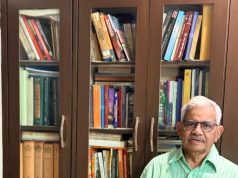
Ganesh Saili, born and home-grown in the hills, belongs to those select few whose words are illustrated by their own pictures. Author of two dozen books, some translated into twenty languages, his work has found renown worldwide.