By Himanshu Dhuliya
(Indian Navy veteran and
editor of
karmabhoomi.org.in)
The 6th edition of the Dr Shekhar Pathak led ‘Askot to Arakot’ expedition commenced on 25 May 2024 at ‘Paangu’ in Pithoragarh district and shall culminate at Arakot (Uttarkashi) on 8 July 2024. The first expedition in 1974 comprised students of the newly established Garhwal and Kumaon Universities. The expedition was launched under the guidance and motivation of the late Sunderlal Bahuguna. The purpose of this ‘Abhiyaan’ of 1150 kilometres was to know the villages and the people, to understand the hills and their ecology. After the success of the first Yatra, the same was repeated after every decade, adding new routes to make it broader. Numerous other organisations, institutions, university students from all over India and some researchers from foreign countries participated. In 2014, the expedition was ‘Flagged-off’ by Shri Chandi Prasad Bhatt another great leader of the ‘Chipko movement’ on 25 May, the birth anniversary of Sridev Suman the legendary freedom fighter. Chandi Prasad Bhatt named the abhiyan, ‘Jangam Vishwavidyalaya’.
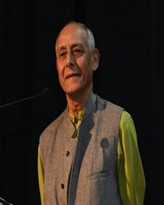
Dr Shekhar Pathak is a historian, writer, environmentalist, founding editor of ‘Pahad’, the annual magazine, since 1983. He also runs an NGO, ‘Pahar’, under whose banner the expedition is being organised. Pathak is a frontline thinker and writer and is following in the footsteps of Gaura Devi, Sunderlal Bahuguna and Chandi Prasad Bhatt. He walks the talk and his book on the Chipko movement recently won the ‘Kamla Devi Chattopadhyay’Award’. He has also written numerous research papers highlighting the ecological issues of UK. His book, titled ‘Asia ki Peeth Par’, co-authored with his writer wife, Uma Bhatt, narrates the explorations in the Himalayas of the famous explorer, Pandit Nain Singh Rawat. For years, the couple worked on the various diaries of the explorer to bring out this seminal work. He is a Padma Shri awardee and Nehru Fellowship scholar and, at the age of 74, is an inspiring leader of the team.
The team has been divided into various groups to venture on various routes. Some routes of the famous travels have been added such as that of ‘Hiuen Tsang’; the Andrade Jesuit’s travel of 1624 from Haridwar to Mana to Chaprang; that of the Daniels, uncle and nephew, in 1789 from Najibabad to Garhwal; Thomas Hardwick’s 1796 journey from Kotdwar to Srinagar; Bishop Heber’s 1824 travels in Kumaon hills, etc.
The expedition shall cover more than 300 villages, numerous ‘bugyals’ (alpine pastures), earthquake affected areas, Chipko movement areas, various deserted ‘chattis’(night stays), many valleys, therefore the journey shall be very fruitful and enlightening. The groups shall also study the impact of various ‘internationally funded’ schemes, the progress of the state since formation as it reaches 25 years of existence.
Some interesting stories emerge from the accounts of senior journalist Ashutosh Upadhyay who did the initial 10-day journey in Pithoragarh district. He states that some villages are still very distant from the main roadhead. He recounted his experience in such a village, which was 17 miles from the road, where he met a young wife who had met her husband on ‘Facebook’; the old parents were at home and all the young ones had gone up to the ‘bugyals’ for work. He recalls that a young man from the village suffered urinary infection and was unable to urinate; he could not be carried in time to the distant hospital and died on the way. In yet another village, the people greeted the group with much excitement. They dressed up in their traditional attire and sang and danced for them ‘impromptu’ as if they were expecting them, as if they were their near and dear. Such is the large heartedness of the people who live in tough conditions but celebrate life.
A group reached ‘Boodha Kedar’ in Tehri district, which has a famous Shiv temple, last week. The people were aware of the expedition as it had traversed these routes earlier. The locals welcomed them and were excited to host them. Arun Kuksal has reported the story in ‘Avikal Uttarakhand’ on 28 June. This is a story of three friends belonging to three different castes – ‘Brahmin, Kshatriya and Shilpkar’, who had studied in the same school. They decided to live together under one roof, share a common kitchen. They were together for 12 years and parted way amicably once their families expanded. Their names were – Dharmananad Nautiyal, Bahadur Singh Rana and Bharpuru Nagvan. They were influenced by the ‘Sarvodaya’ movement and wanted to set an example to eliminate the caste system. They stayed together from 1950 to 1962. The house still stands there as proof of their experiment. Nautiyal took the initiative first to send a signal; there was custom to keep three ‘hukkas’ in his shop for each caste. He removed two ‘hukkas’ and just kept one. The people did not support them openly but were appreciative of them in subdued voices. Reflecting on this bold ‘experiment’, I felt so proud of my state as I knew that, in other states, the three friends would have been debarred from the village.
As the expedition marches toward its culmination one ponders the critical environmental issues that have engulfed the Uttarakhand state in recent times. On 24 June, about 3000 citizens of Dehradun converged near the New Cantonment Road to voice their opposition to an administrative order to fell about 250 trees in order to widen the road. Is it a mark of another Chipko movement? There is much written about the construction of a highway between Dehradun and Delhi, which would reduce road travel to only two and a half hours. But, one wonders who asked for it? It is being trumpeted as an achievement! But, at what cost? Thousand of trees have been cut for this; many ‘Saal’ trees for which the famous saying is: “Sau saal khada hua; sau saal pada hua; sau saal sara hua” (100 years standing;100 years lying; 100 years rotting).
The temperatures in Dehradun touched 40 degrees this summer. There was an article dated 2 July by Dr S Ganguli, titled Why Dehradun is on the brink of disaster’ lamenting its present state.
Team 2 at Dodital Lake
Now what does this ongoing ‘Abhiyaan’ convey to us? It should motivate us to rise and conduct this 10-year expedition every year on the same dates -25 May to 8 July. Young students should take over, trek the 1150 km distance in batches so that it is not burdensome, and many should participate. The young would know the people. The people would know them. They would witness the village life first hand, a spirit of adventure, a spirit of social service may arise in them. The ‘Chardham’ yatra could also be revived on foot so that the roads and hotels are not clogged. Years ago, sincere pilgrims would walk from Rishikesh to Kedar-Badri, they would halt at the various ‘chattis’ (shelters) and ‘Prayags’ (confluence of rivers/holy places) on the way, listen to the sermons of sages and the slow and enriching journey would rejuvenate them.
The last lines of the poem by Ramdhari Singh Dinkar, titled ‘Himalaya’, comes to mind: “Tu Maun Tyaag, Kar Singhnaad,
Re Tapi! Aaj Tap Ka na Kaal.
Nav -Yug – Shankhdhvani jaga rahi,
Tu Jaag, Jaag, mere Vishal!
(You let go your ‘silence’, Roar like a lion,
You Ascetic; this is no time for meditation;
The call of the new age is waking us,
You rise, you rise my Mighty)