A View from the Valley:
Grounded in Dehradun for recovery, the country’s most beloved storyteller reflects on home, the geometry of happiness and looking up at his beloved hills.
 By ALOK JOSHI
For thirty years, Garhwal Post has chronicled the shifting mists, the rising concrete and the enduring soul of these hills. It is entirely befitting, then, that for this milestone anniversary, we find ourselves sitting down with a man whose pen has been the very heartbeat of our mountains for more than half a century.
But today, the geometry of that story is beautifully upside down.
Ruskin Bond, who turned 92 this May, is not sitting by his famous window at Ivy Cottage in Landour, looking down at the world. Following a recent medical spell, the master storyteller is currently down in the Dehradun valley, recovering under the softer, warmer embrace of the Doon sun. For an author who has spent a lifetime wrapped in Mussoorie’s bracing mountain air and whispers of pine, this temporary stay in the valley offers a poignant, reversed perspective. He is a high-mountain anchor currently resting in the foothills, looking up at the ridges he calls home.
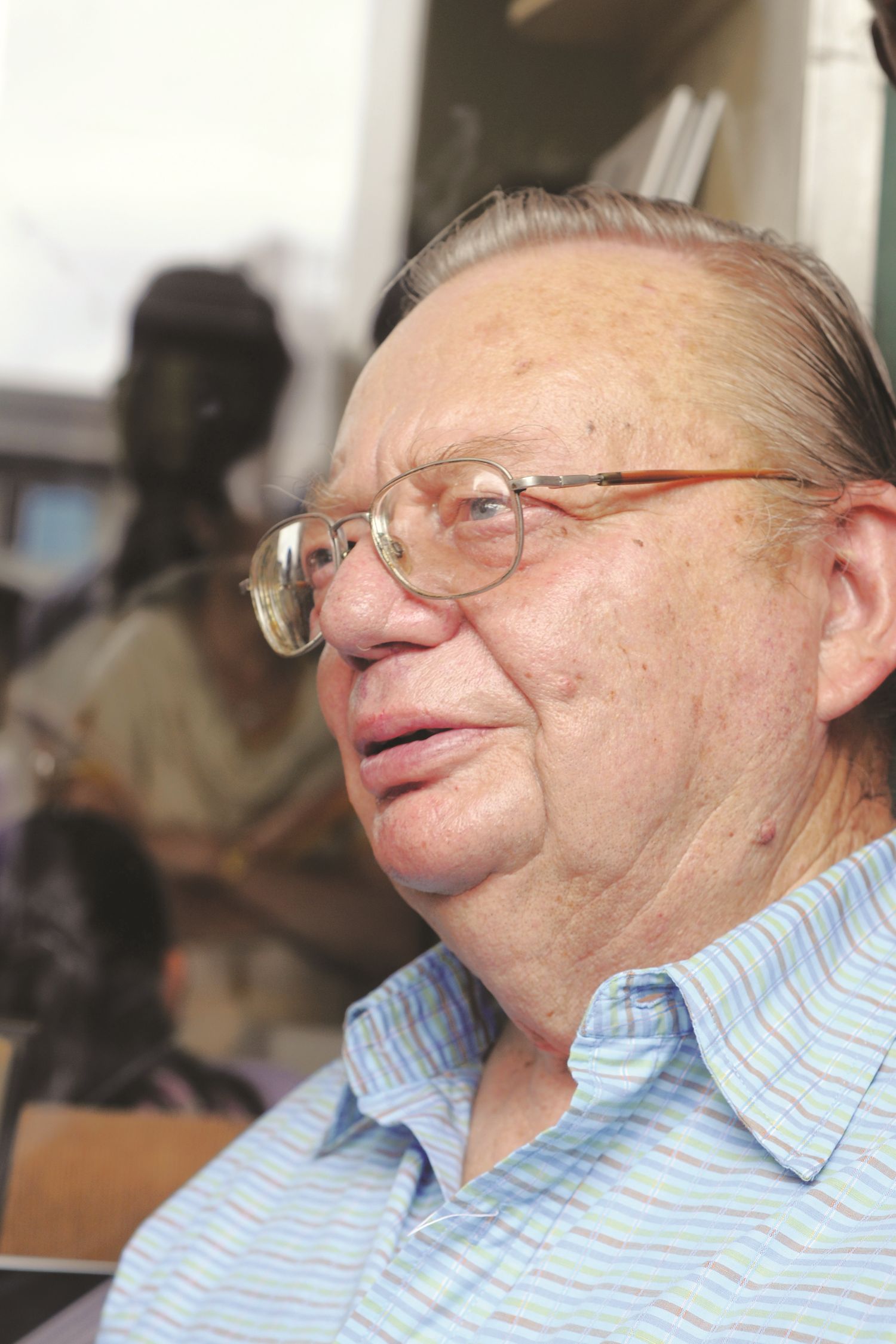
Seeing Ruskin Bond down here doesn’t feel like seeing a writer out of his element. It feels like watching a grand old tree that has weathered a storm, resting its roots in the warm soil of Doon before reaching back up toward the Mussoorie sky. When I sat down with him for a quiet, writer-to-writer conversation, the familiar grand desk and misty window of Landour were absent. Yet, looking at the sharp blue eyes behind his spectacles and that characteristic, mischievous, childlike smile, he proved that the “quiet space of happiness” he so often writes about isn’t a matter of altitude. It is an internal state of grace.
The View From Below
We began our conversation talking about this sudden change in geography. For decades, Bond has given us the view from the top. What happens when the writer looks up at his own home?
“I can’t actually see the mountains from here,” he confessed with a gentle smile. “But in my mind, I can imagine every single nook and corner of Mussoorie and Landour very vividly.” It is a beautiful revelation—the hills haven’t left him; they have simply moved entirely indoors, safely tucked into his memory.
Having turned 92, Bond is an elder statesman of letters who has weathered changing times, shifting landscapes and the inevitable vulnerabilities of aging—yet his spirit has never lost its innocence. I was curious to know how, despite the world transforming so rapidly around him, he has managed to remain so remarkably content.
“Happiness lives in a quiet space in our minds,” he reflected softly. “The world out there may be in turmoil, but 92 years of Sunshine and Solitude with Ruskin Bond Grounded in Dehradun for recovery, the country’s most beloved storyteller reflects on home, the geometry of happiness and looking up at his beloved hills. we have to stay calm, remain content and find peace inside our own little world.”
Power of Print in a Digital Age
As a writer deeply invested in the survival and enduring power of Printed Media, I asked Bond how he views the habit of reading books in an era drowned in digital noise. Despite the modern obsession with screens, Bond remains a resolute optimist. For him, the proof is simply in the numbers.
“Books are absolutely still being read,” he asserted, pointing out that the continuous, robust sales of his own books stand as living proof. He noted that regions like West Bengal and Kerala continue to be fierce bastions for the written word, boasting a massive, dedicated reading public. Even closer home, he pointed out a heartening trend: more book stores are actively coming up, even right here in Dehradun.
While he agreed that the reading habit is visibly more alive and deeply woven into the daily culture of many Western countries, our discussion took a delightfully whimsical turn when I mentioned the concept of community book kiosks in residential areas across the United States—small, free libraries where neighbours share books.
Bond chuckled and recalled his own attempt at bringing that community spirit to the hills. Once, wanting to share his work freely with passersby, he placed a copy of one of his books in a makeshift kiosk in Mussoorie. He went back to Ivy Cottage, hoping to see a passionate reader discover his words. Instead, looking out from his famous window to see who was engaging with his literature, he was met with a classic Himalayan sight: a wild monkey sitting on the kiosk, systematically and gleefully tearing away the pages of his book one by one.
Making a Friend of Solitude
The conversation drifted naturally back into his lifelong relationship with silence and the constant, quiet observation that turns the ordinary into literature. Where many writers complain about loneliness, viewing the blank page as a solitary exile, Bond has managed to make solitude feel like a warm friend.
“I can stay happily alone whenever I want, just with my thoughts,” he explained. But he is quick to add that his solitude is never isolating, credited entirely to the warmth of his loving and caring family, who are always around to keep him company.
Bond has always been a voracious reader and a prolific writer, firmly agreeing that to write well, one must read deeply. Today, however, age has brought its own compromises. Because his eyesight no longer permits heavy reading, his creative process has beautifully adapted. Every day, his mind still rambles over new thoughts, and his granddaughter, Shristi, lovingly takes down his dictation in longhand.
Shristi showed us a few samples of these handwritten pages. For a man known for always putting ink to paper himself, this passing of the baton is deeply moving. Even without his usual notebook, even away from the window of Ivy Cottage, Bond has never stopped writing.
A Landscape Printed on the Soul
This incredible ability to create without sight stems from an uncommonly sharp, vivid memory. The conversation soon turned into a nostalgic journey across the map of his youth—a geographical tapestry that would later form the backbone of his entire literary universe.
Being back down in the valley naturally brought back memories of the “old Dehradun”, where Bond spent some of his foundational early years. It was a quieter, greener Doon of winding canals, slow moving bicycles, and sprawling bungalows. From there, his memory drifted up to his school days in Shimla, a town wrapped in colonial architecture and crisp mountain air that shaped his early love for reading and solitary walks.
He spoke fondly of Kasauli, where his uncle worked at the prestigious Pasteur Institute—a place that added its own quiet, melancholic charm to his reservoir of stories. Yet, after all his travels, including his time in London, it was the ultimate, magnetic pull of the mountains that led him to pack his bags and move permanently to Mussoorie. Each station of his life was a chapter, and hearing him recall them felt like flipping through the pages of a classic memoir. It is this sharp, lifelong mental archive that allows him to continue penning down his dreams, a habit he maintains to this day.
The Craft of Childhood
The conversation took another whimsical turn as he narrated how he accidentally stumbled into writing stories and books for young readers. When asked what advice he would give to someone stepping into the world of children’s literature today, his answer was instantaneous and sharp: “You must be a true storyteller. Unlike adults, a child’s span of attention is very small. If you want to hold them, the story has to be completely engaging from the very start.”
The Hills are Waiting
As our hour-long conversation drew to a close, the room felt distinctly lighter. The shadow of a recent illness entirely dissolved into the sheer warmth of his presence. He remains our ultimate guide on how to find happiness halfway between too little and too much—the ultimate comforting presence in Indian literature.
Before leaving, I asked him about the inevitable journey back up the mountain. “Knowing that the entire ridge of Mussoorie is eagerly waiting for your return, what is the very first thing you want to do the moment you drive back up that hill?”
His response came with that inimitable, lightning-quick humour: “Rearrange some of my books!”
Outside, the summer haze softened the steep climb back up to Mussoorie. But watching the country’s most loved and adored author rest, one gets the reassuring sense that, whether he is up on the ridge or down in the valley, Ruskin Bond is always exactly where he belongs: the world of books, wrapped tightly in the deep affection of a country that loves him.
(Alok Joshi is a Dehradun-based Management Professional, Corporate Trainer, Interview Coach, Image Consultant, Motivational Speaker, Author of three bestselling books and a freelance writer. He has a multi-cultural background and has worked in top management positions in global companies across many countries including India, Sudan, Middle-East and China.)