 By Kulbhushan Kain
Imagine driving through the lush green countryside of New Zealand’s South Island, thousands of miles away from India….
The road winds past orchards and farms. Mist hangs over distant hills. Somewhere beyond lies the blue waters of the Tasman Bay.
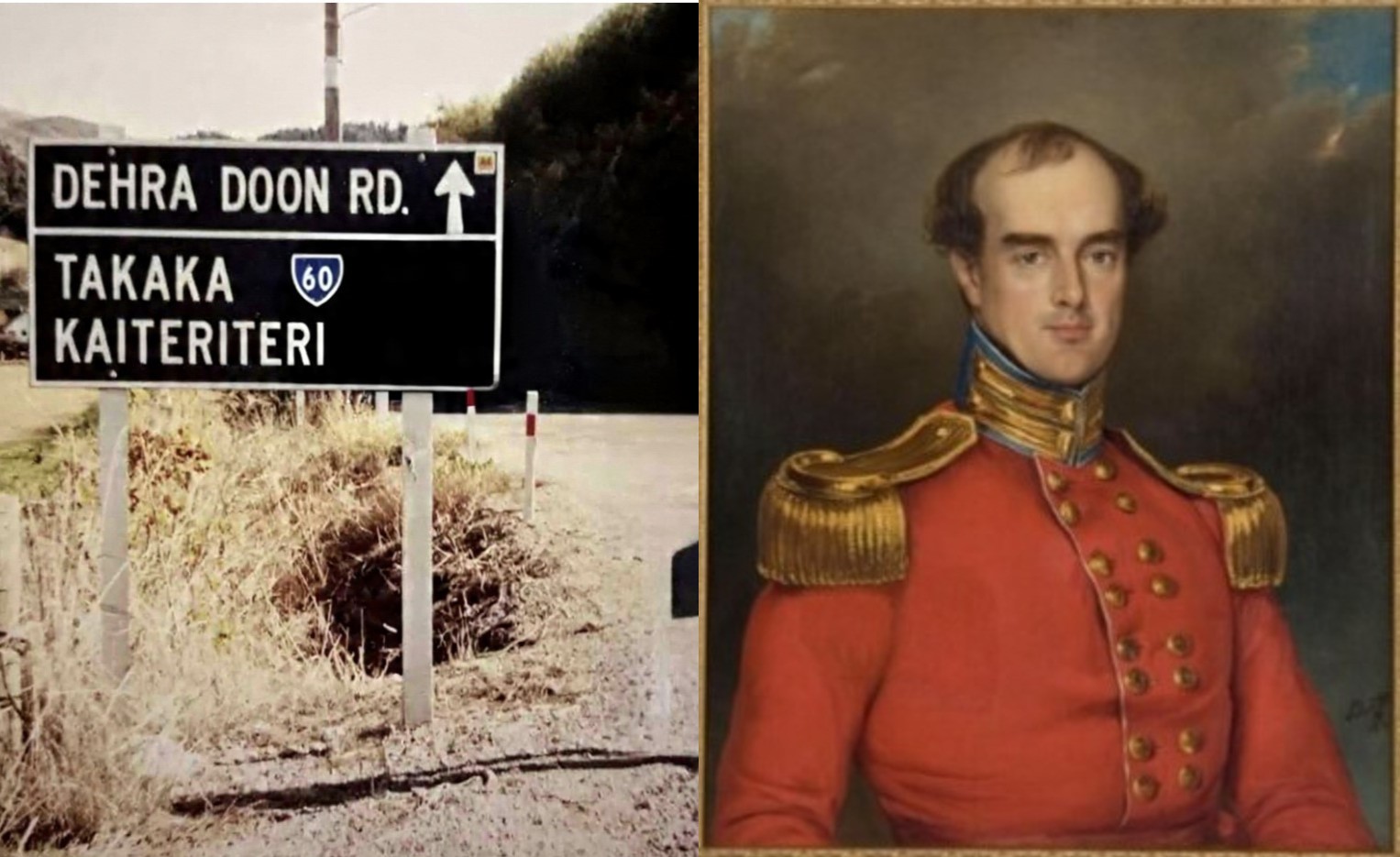
And then, suddenly, you see a signboard – “Dehra Doon Road”.
You slow down. Dehra Doon? Here?
Not in Uttarakhand. Not in India. But on the other side of the world, deep in the southern hemisphere.
At first, it seems impossible. Perhaps it is a coincidence. Perhaps the name means something entirely different in this distant land.
It does not. And here is why.
More than 160 years ago, an old British soldier stood among these green hills and remembered another valley he had left thousands of miles behind. A valley where he had spent some of the most important years of his life. A place whose quiet beauty had followed him across oceans and continents.
He could leave Dehradun.
But, it seems, Dehradun would not leave him. It clung and wrapped itself around him – just the way it does most of us.
I came across this remarkable story quite by chance. An old student of mine, now settled in New Zealand, sent me clippings from a magazine there. She had come upon the story of a place called Dehra Doon and immediately thought of me.
“Did you know of a Dehra Doon in New Zealand?” she asked.
I did not.
Then came a photograph. Then a map.
And there it was, unmistakably, in a remote corner of New Zealand — ‘’Dehra Doon Road’’.
I began searching and researching its origins.
What emerged was one of those extraordinary footnotes of history that make the past seem suddenly alive.
To discover how Dehradun travelled halfway around the world, we must go back to the nineteenth century, when the Doon Valley was still a quiet frontier landscape.
Following the Anglo-Nepalese War of 1814–16 and the legendary bravery witnessed at the Battle of Nalapani, or Khalanga, the British took control of the valley. Gradually, roads were opened, settlements grew and Dehradun began its transformation from a secluded valley into an important military and administrative station.
British officers came and went. Some saw the Doon merely as another posting in a vast empire.
Others fell in love with it.
One of them was an Englishman named Charles Thynne Thomas.
Born in Bath, England, in 1797, Thomas sailed for India as a young man in 1820. He spent decades in the Bengal Army and rose to the rank of Colonel. In 1829, he married Anne Tovey, who had herself been born in India.
Somewhere during those long years, the Doon Valley entered his heart.
Historical records tell us that Thomas and his family had made their home in Dehra Doon. It was a very different valley then – quiet, sparsely populated and wrapped in forests, with the Himalayas beyond and the lower hills enclosing it like protective arms.
Perhaps it was the silence.
Perhaps the green hills.
Perhaps the quality of the light after rain.
Those of us who have lived in Dehradun know that it is not always easy to explain why the valley stays with us. You leave its roads, its trees and its mountains behind, but years later, a smell, a cloud, a certain shade of green can suddenly bring it all back.
By the time Thomas left India, he was no longer a young soldier. After nearly four decades in the country, he sailed for New Zealand and arrived there in 1861.
He settled near Riwaka, at the northern end of New Zealand’s South Island, not far from what is today the famous Abel Tasman National Park.
There, surrounded by green hills and fertile countryside, the old soldier found something strangely familiar.
The landscape reminded him of the place he had left behind – Dehra Doon.
And so he gave his new home the same name.
It was a simple act of naming. Yet names have a curious way of outliving the people who give them.
Colonel Thomas could hardly have imagined that more than a century and a half later, the name would still survive on the map of New Zealand.
But this is where the story becomes even more remarkable.
Dehra Doon did not simply fade into an old map or survive only on a weathered signboard. The land remained connected with the Thomas family. The Colonel’s descendants, Frederick Charles Thomas and William Rhys Thomas, continued the family’s association with the area through Thomas Brothers, a fruit-growing, packing and cool-storage enterprise.
The old estate, in other words, did not become a ghost.
It remained alive.
The orchards grew. Fruit was picked, packed and stored. Generations came and went. The world changed beyond recognition.
But Dehra Doon remained.
Today, there is still a Dehra Doon Road.
Think about that for a moment.
Empires have disappeared. Borders have changed. The British Raj itself has passed into history. The quiet Dehradun that Colonel Thomas knew has grown into a crowded modern city.
Yet, thousands of miles away, a road still carries the name of the valley he remembered.
The old Colonel did not live long enough to see how enduring his act of nostalgia would become. On 23 June 1874, Charles Thynne Thomas died in Motueka after injuries suffered in a fall from a cart. The soldier who had crossed oceans and spent much of his life far from the land of his birth was buried in New Zealand.
But the name he carried from India remained behind.
And perhaps that is what makes this story so moving.
We often think that places belong to us. The truth may be the other way around. Sometimes, a place takes possession of us so completely that distance cannot loosen its hold.
For those of us born and brought up in Dehradun, this is more than a curious piece of geographical trivia. It is a reminder of the extraordinary magic the old valley once possessed—and perhaps still does.
A magic powerful enough to travel across the equator.
A magic strong enough to survive for more than 160 years.
So, if any Doonite ever finds himself or herself travelling through New Zealand’s South Island, take a detour towards Riwaka.
Drive slowly through the green countryside.
Pass the orchards that still make the land live.
Look for the signboard.
And when you find it, stop for a moment at the “DEHRA DOON ROAD”.
Perhaps the hills will be covered in mist. Perhaps there will be rain in the air. Perhaps, for one fleeting moment, the distant landscape will remind you of home.
And somewhere, between the orchards and those faraway New Zealand hills, you may hear the faintest echo of another valley, thousands of miles away.
The old Colonel is long gone.
The Dehradun he knew is gone too.
But the orchards still grow.
And the name remains.
At the far end of the earth, our beloved Doon still echoes.
(Kulbhushan Kain is an award winning educationist with more than 4 decades of working in schools in India and abroad. He is a prolific writer who loves cricket, travelling and cooking. He can be reached at kulbhushan.kain@gmail.com)