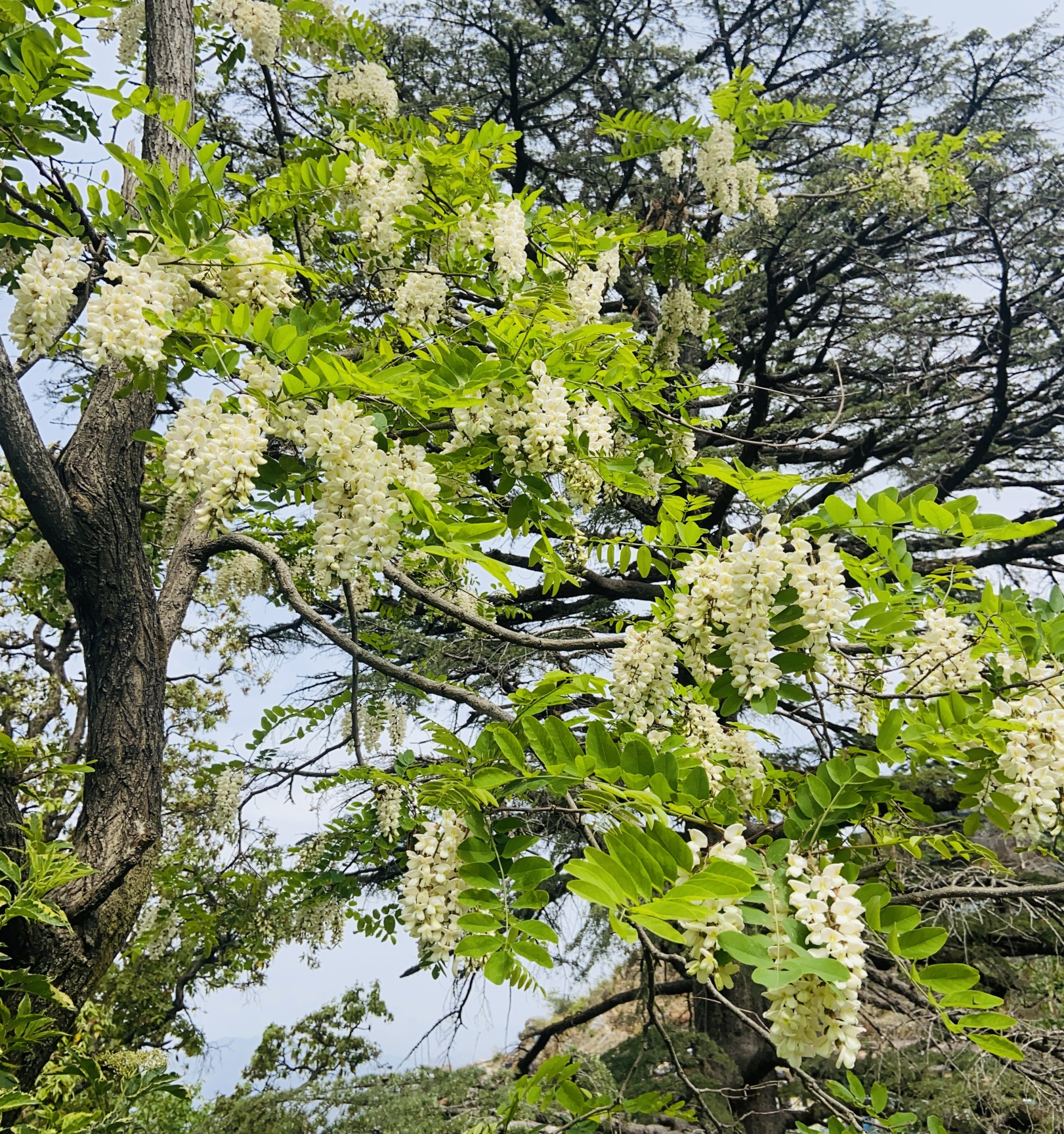
Landour’s three hillocks are encircled by a looping road that traces a graceful figure of eight. Follow it past the Language School until you reach a modest dargah nestled into the rockface beneath an ancient oak tree. Go the other way, and you’ll arrive at the charming Villa de Bethany.
I’ve always admired couples like Amarjit and Sunita Kuddle for their genuine mastery of hospitality — they have that rare talent for making every guest feel truly at home.
A weathered boundary pillar marked ‘CBP 42’ stands as a reminder of the dividing line between the Cantonment and the Municipal Board. Dates to the Gurkha Wars, when this border marked the edge of disputed Rajah’s territory. The matter remained unsettled until 1904, when E.H. Ashworth of the Indian Civil Service established the enduring paani-dhaal principle — boundaries henceforth would be determined by the natural flow of water.
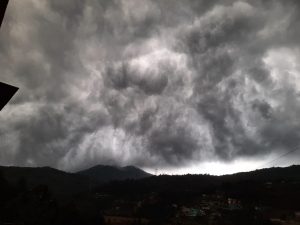
Pic. courtesy: Tulika Singh Roy.
To your left is Oaklands, once the summer home of B.E. Getter, a missionary who served in the Sarguja district of the then Madhya Pradesh. His son Kenneth, roughly my age at the time, studied at a local school. On Saturday, 21 February 1970, Kenneth Getter (17) and Fred Baur Jr. (16) were among a group of thirty-one students returning to school after their winter break. They decided to watch the moonrise by climbing atop their coach of the moving train. Hit by an overhead girder, the two perished instantly.
If you can get past this tragedy, at the next bend, before the now abandoned Stray Dog Bar, you see a slate-roofed house named Bothwell Bank, which the locals naughtily called Brothel Bank. It was home to Reverend Charles Warren, the pastor at Union Church. With owners changing frequently, at present it is but an extension to Rokeby Manor. In the servants’ quarters lived Madan Singh Kaintura, the chowkidar, who made more than pocket money by selling hooch brought in from nearby villages. Moonlighting as the chowkidar of Mount George (we used to call it ‘Mount Abu’ after Abu Tripathi of the famous family from Benares), Madan’s claim to immortality was his saying: ‘Could you please explain to Lakshmi memsahib that salary has nothing to do with work? The work of clearing weeds is the gardeners. It has nothing to do with my salary.’
Below them is Sisters’ Bazaar. A. Prakash and Co. have made a name for themselves by making the most delectable homemade cheese, cucumber relish, jams, and jellies.
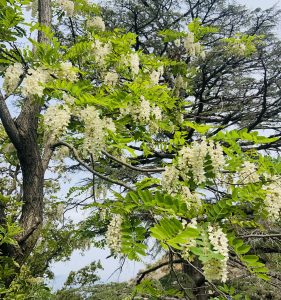
Pic. courtesy: Tania Saili Bakshi.
Meanwhile, at Dahlia Bank, sat Sanjay Narang with his talented sister Rachna. A proposal came up regarding a shop in the Sisters’ Bazaar area. ‘How much flour, maida, sugar, and butter can one sell in a day?’ Sanjay wondered.
His answer lay in the unfolding of Landour Bakehouse. Today, no matter where you are in Landour, the question you’re always asked is: ‘Does this go to the Bakehouse?’ Or ‘Is this the road to the Cakehouse?’ Or ‘How do I get to Bakeby?’
Instagram fuelled fame ensures folks arrive in droves; those who cannot get in hang around and spill over, clogging the road that runs through our smallest bazaar.
One day I met a young boy who had driven all day from Rajasthan to arrive two hours after closing time. He pleaded, ‘How can I go back home without having seen the Cakehouse?’
Opposite A. Prakash & Co. is the Sisters’ Barracks, which was snapped up by the actor Dev Anand. His wife, Mona Singha (who later adopted the name Kalpana Kartik), had a brother in the Indian Administrative Service. On retirement, he hunkered down in nearby Kanatal.
After Dev Anand’s infamous tiff with Suraiya, she stepped in to fill the gap. Together they made films like Taxi Driver, House No. 44, Nau Doh Gyarah, and Baazi. Putting the children, Sunil and Devina, into a local school, they acquired the nursing barracks in Sisters’ Bazaar. When Dev Anand passed away in 2011, they had been together for sixty-four years.
On rare occasions that are getting increasingly fewer and far between, she can be seen stepping out for a walk. Now aged ninety-three, she is watched over by the eagle-eyes of her granddaughter, Gina.
Ganesh Saili, born and homegrown in the hills, belongs to those select few whose words are illustrated by their pictures. Author of two dozen books, some translated into twenty languages, his work has found recognition worldwide.