 By Purna Chandra Jena
This August, heavy rain has reopened cracks on the hillside above Agastyamuni in Rudraprayag district. Multiple danger zones have appeared along the Kedarnath and Badrinath highways, and local authorities have banned trekking on several stretches while warning pilgrims away from riverbanks, according to district administration advisories. The Char Dham Yatra was suspended twice in July 2026 alone. It is a familiar story, and that familiarity is the point: Uttarakhand’s mountain economy — its pilgrims, its hydropower assets, its hill towns — is directly in the path of a hazard that is no longer occasional but structural.
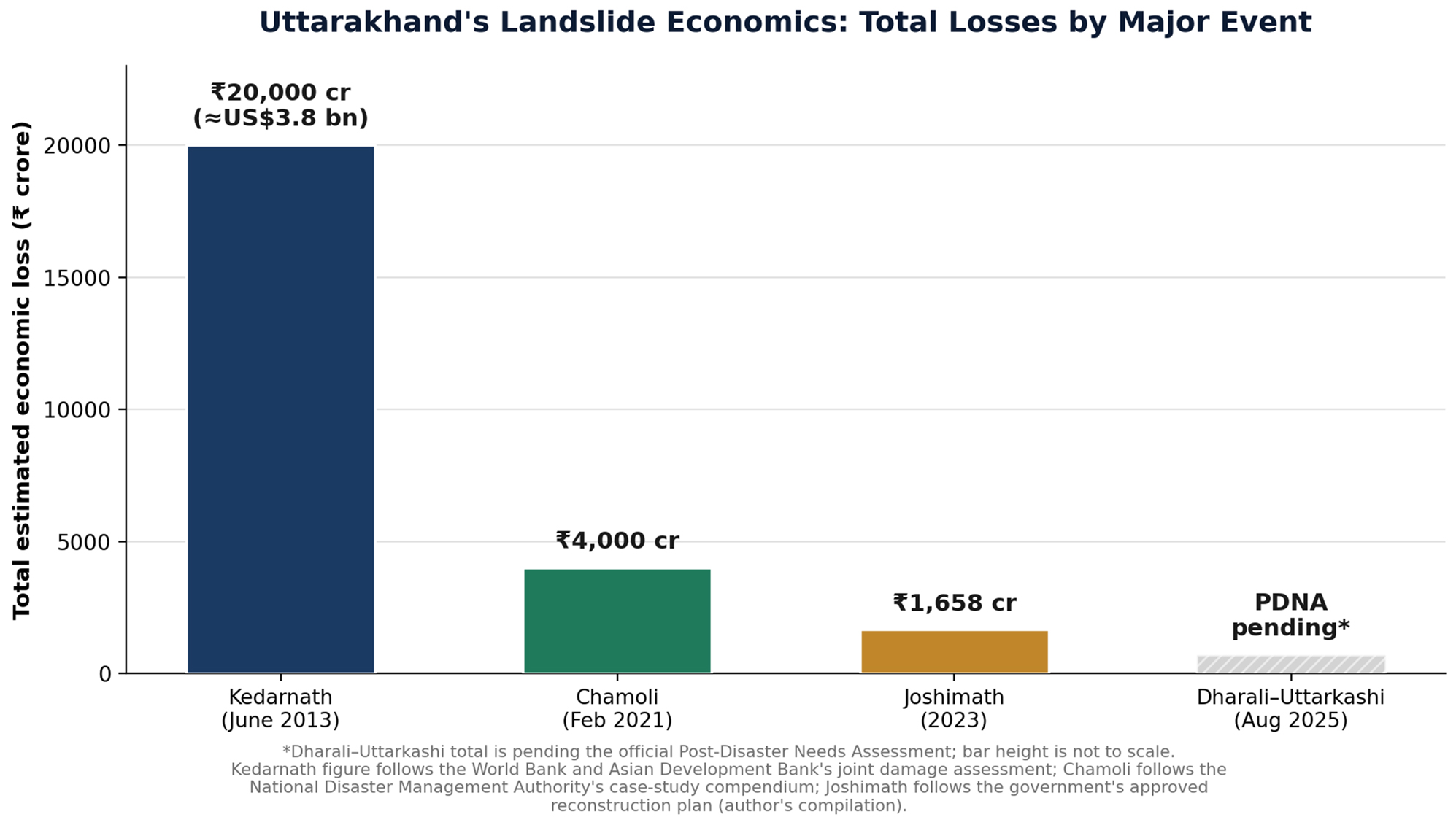
The financial record confirms this. The 2013 Kedarnath disaster remains the largest: a Joint Rapid Damage and Needs Assessment by the World Bank and the Asian Development Bank estimated total economic losses at over $3.8 billion, including around $1 billion in lost tourism revenue that year alone — commonly reported in the Indian press as approaching Rs 20,000 crore. The 2021 Chamoli disaster, where a rock-and-ice avalanche destroyed the Rishiganga hydropower plant and severely damaged NTPC’s Tapovan-Vishnugad project, recorded losses exceeding Rs 4,000 crore, with NTPC bearing roughly Rs 1,500 crore, according to the National Disaster Management Authority’s compendium of disaster case studies.
Joshimath’s 2022-23 land subsidence, which cracked hundreds of structures, prompted a central Recovery and Reconstruction Plan worth Rs 1,658 crore, approved by a high-level committee chaired by the Union Home Minister and announced by the Press Information Bureau in November 2023. Dharali, struck by a cloudburst-triggered debris flow on August 5, 2025, that destroyed around 65 hotels and 30 resorts, still awaits its official damage assessment. In just twelve years, these four events have caused measurable losses exceeding Rs 26,000 crore.
The scale is significant. Around 90% of Uttarakhand’s land is hill terrain, and the Indian Space Research Organisation’s Landslide Atlas recorded 11,219 landslide events in the state between 1998 and 2022 — the second-highest among Indian states. State disaster officials noted that the 2024 monsoon triggered an additional 1,521 landslides in the first 17 days alone. Tourism and pilgrimage account for nearly a fifth of the state’s gross domestic product, which reached approximately $45 billion in FY2024-25, an increase of 13.6% that year, according to the state’s Economic Survey. Considering Rs 26,000 crore in cumulative, documented losses, the state’s dedicated mitigation expenditure — a Rs 125 crore landslide project and Rs 615 crore in Special Capital Assistance — accounts for less than 3%.
Direct losses are those that make headlines: destroyed roads and bridges, damaged hydropower assets, buried or cracked housing stock, and the relief spending that follows. Indirect losses accumulate more quickly and endure longer: cancelled Char Dham bookings ripple through hotels, transport operators, and porters for an entire season; agricultural terraces take years to rebuild; insurance and financing costs on hill infrastructure increase; and investor confidence in a state seeking industrial and hydropower capital diminishes. Every rupee diverted to emergency repairs is a rupee not spent on schools, health centres, or irrigation — the typical opportunity cost of reactive rather than proactive public finance. Over a twelve-year period, that opportunity cost gradually adds up to a quiet but measurable drag on the state’s long-term growth trajectory.
In the short term, the highest returns come from the most affordable interventions: dense early-warning and slope-sensor networks, quicker rule-based disbursement from the State and National Disaster Response Funds, pre-positioned SDRF-NDRF-ITBP teams throughout the monsoon, and enforceable evacuation protocols for mapped red-zone hamlets. Chamoli’s 2021 daylight event, evacuated more rapidly than Kedarnath’s monsoon-night tragedy, serves as a reminder that preparedness alone can alter outcomes even against a similarly violent hazard.
The effective solution is structural, and the most clear global example is Hong Kong’s Geotechnical Engineering Office. Since it was set up in 1977, its Slope Safety System — which involves systematic slope registration, retrofitting of inadequate man-made slopes, and public risk communication — has lowered landslide risk to less than a quarter of what it was in 1977, according to the office’s own published assessments.
Japan’s century-old Sabo check-dam programme and Switzerland’s binding hazard-zonation codes provide complementary lessons that Joshimath needed a decade before it slipped. Engineering choices also matter: new slope-stabilisation works in the Himalayas should favour fibre-reinforced polymer (FRP) plates and bars over steel for soil-nailing and retaining structures, as FRP resists high-altitude corrosion and, being non-conductive, does not attract lightning strikes like steel reinforcement. The economics justify this shift: a 2019 study by the US National Institute of Building Sciences found that every dollar spent on federally funded mitigation grants saves society six dollars in avoided disaster costs, and that every dollar spent on stronger building codes saves four dollars.
Financing architecture must follow this logic. The State and National Disaster Response Funds, replenished under Fifteenth Finance Commission guidelines, remain inherently reactive; out of the Rs 125 crore allocated for landslide mitigation, only Rs 4.5 crore has been disbursed so far for survey work. Uttarakhand should create a dedicated Mitigation Fund, supplemented by a modest tourism cess, and seek concessional finance from the Green Climate Fund and World Bank disaster-risk programmes rather than relying solely on post-disaster relief — a shift that the global adaptation-finance debate is also advocating, with the United Nations Environment Programme’s latest Adaptation Gap Report highlighting developing-country needs at $310-365 billion annually by 2035, against flows of just $26 billion.
Five priorities are outlined. First, make geotechnical clearance legally mandatory, Hong Kong-style, before construction in ISRO-mapped high-risk zones. Second, establish a dedicated State Mitigation Fund funded jointly by the Centre, the state, and a tourism cess. Third, extend dense, real-time slope monitoring and early warning systems across the 130-plus critical stretches, specifying FRP rather than steel for new retaining and soil-nail works. Fourth, shift from ad hoc rehabilitation to planned, compensated relocation for hamlets on confirmed landslide debris, taking lessons from Joshimath. Fifth, create a standing concessional financing mechanism for Himalayan slope stabilisation, aligned with India’s climate adaptation commitments.
Uttarakhand’s mountains will continue to shift; its pilgrims, tourists, and investors should not bear the cost of that reality every monsoon. An economy growing at nearly 14% cannot treat resilience as an afterthought. The evidence from four events over twelve years points to one conclusion: prevention is not a deferred expense but the highest-return investment in Uttarakhand.
(The writer serves as Economic Adviser, Advisory Support Group, Chief Minister’s Office, Government of Uttarakhand, and Consultant with Chief Policy and Strategy Advisors, New Delhi. Views are personal.)