The Books from My Shelves – 4
 By Ganesh Saili
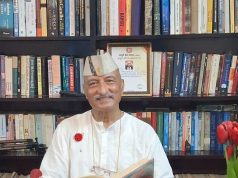
If you catch me lurking around my bookshelves there’s this poetry anthology, with Walt Whitman’s Leaves of Grass which is the sheet anchor of American literature on the other side of the ocean. ‘I sing myself, /I celebrate myself. / What I shall assume you will assume.’ Yes! I know there are listings too which would make a telephone directory blush, but be patient – you are in the company of a great poet who can say, ‘It is not upon you alone the dark throws its patches / The dark has thrown its patches upon me too.’
Turning the pages, we find the path leading inwards, it was chosen by Emily Dickenson when she said: ‘Success is counted sweetest by those who never succeed. /To comprehend a nectar requires sorest need. / Not one of all the purple host who took the flag today can tell the definition of victory. As he defeated dying /on whose forbidden the ears /the distant strains of triumph/ break agonized and clear.’ Writing stuff like this, almost two hundred years ago required more than just guts and gore!
And there is America’s poet laureate, Robert Frost. I still remember his greying hair billowing as he read The Gift Outright on a windswept day at President John F Kennedy’s inauguration. I am guilty of stealing his famous saying: ‘Poetry without rhyme is like playing tennis without a net.’ I use the phrase especially when a book of poems is thrust into my reluctant hands, perhaps by a doting mother, or sometimes a loving aunt. All that is they expected of me is do a quick foreword or a skewed review.
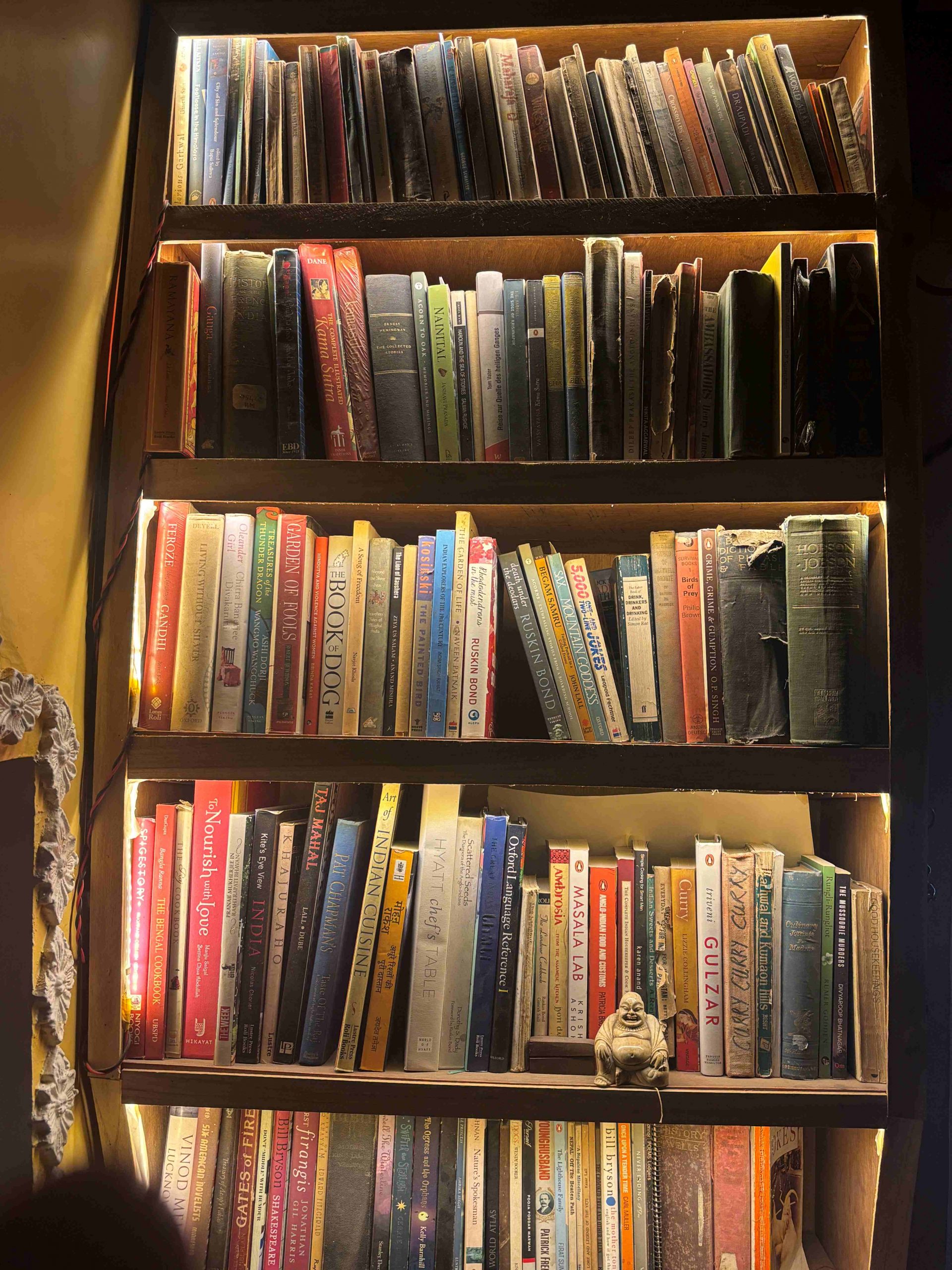
There are some books that I hold on to for no rhyme or reason. Take Bill Bryson’s ‘Shakespeare’. Let us dip into it. Can you imagine the gall and effort that must have taken to write this book on the Bard of Avon? In the last para the author too says: ‘We reflect upon the works of William Shakespeare it is of course an amazement to consider that one man could have produced such a sumptuous, wise, varied, thrilling, ever-delighting body of work, but that is of course the hall mark of genius. Only one man had the circumstances and gifts to give such incomparable works, and William Shakespeare of Stratford was unquestionably that man – whoever he was.’
Lurking around in my bookshelves are some books on the Himalaya, those mighty mountain ranges that loom large behind me. Close to my heart are books like The Heart of the World (which includes a journey into Tibet’s lost paradise) by Ian Baker, a book that I can pick up and start reading anywhere, anytime. And lest I forget, there is aways the late Patrick French’s Younghusband which is a glorious biography on the last imperial adventurer.
Or perhaps I had early intimations; I knew that one day I would write about these hills of home. Why else would I have kept The Magic Mountains (Hill Stations of British India) by Dane Kennedy? That’s why I am in debt to GRC William’s Memoirs of Dehradun; I must remember to thank Upendra Arora for the reprints by Natraj or the Green Bookshop. The reprint of Edwin Thomas Atkinson’s tome in three volumes of the Himalayan Gazetteer, is a staggering 2800 pages of print!
Of course, as a scribe, I owe a lot to the precious guides to these hills: it begins with John Northam (1884) a reprint by Pagoda Tree Press, UK, Frederich Bodycot’s (1907) Guide to Masuri, Landaur, Dehradun and the Hills North of Dehra, and there’s ‘the Rambler’ as Charles Williams (who edited The Mussoorie Times) who rattled together A Mussoorie Miscellany (1935). General Frederick Young’s biography by his daughter L Hadow Jenkins’ (printed in 1923) is special to me because, despite its faults, it’s a rare treasure because this wonderful book is about the old, greying whiskered man who came in his sunset years with fuzzy tales of his days spent in India. Remember! As a youngster he had fought alongside James Frazer (who was later the Resident of Delhi) in the Battle of Khalanga, during the Gurkha Wars.
And there is AR Gill who wrote Valley of the Doon (1952) listing closed and open cemeteries, which reads like a telephone directory of those interred on hallowed grounds. I knew his nephew, Phillip Ryper who worked as an operator in the telephone exchange in the 1960s, to him goes the credit for single-handedly turning the Chandranagar cemetery into a beautiful garden.
I constantly promise myself to put some of these books under lock and key! Especially the rare ones. I keep muttering to myself, but thus far I have done nothing! And the way things are going presently, in my heart of hearts, I know I never will!
You may beg, you may borrow or, in extremity, you may steal. Books, after all, are meant to be read. Oftener than not, we may lose ourselves in books, or end up finding ourselves in them.
(Ganesh Saili, born and home-grown in the hills, illustrates his words with his pictures. Author of two dozen books, some translated into twenty languages, his work has found renown worldwide.)