Book Review
 By Dr Anoop Virendra Kathait
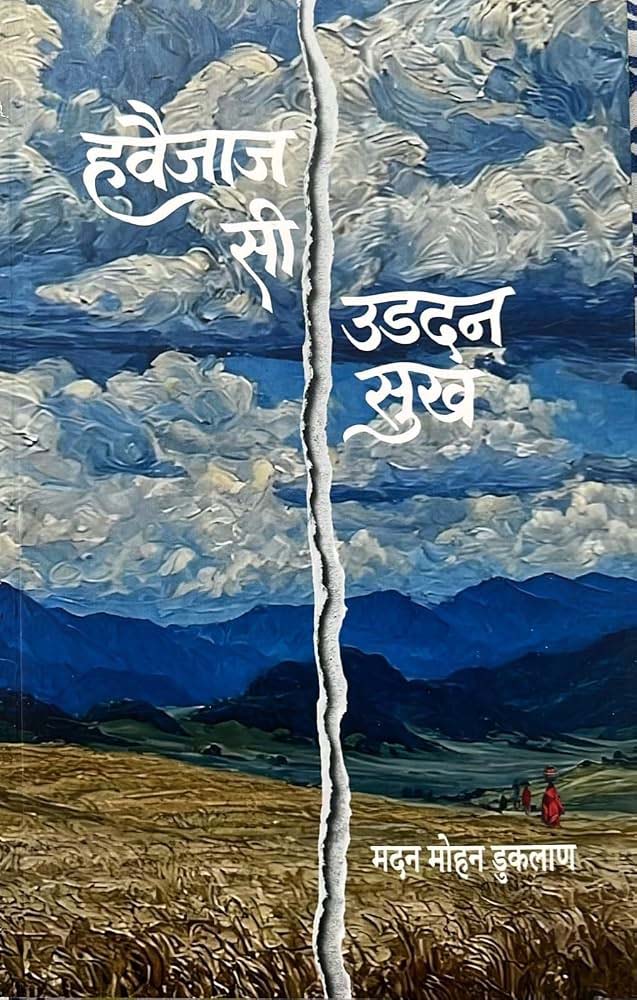
Madan Mohan Duklan’s new collection brings together love, longing, memory and emotional landscape of the mountains. The day unfolded not simply around a book, but around the world created by its words. Literature blended with music, poetry acquired a voice, and emotions moved naturally between the stage and the audience.
At the heart of the collection are ninety compositions, each carrying a distinct emotional colour. Love, separation, memory, longing, mother, relationships, loneliness, dreams and the quiet intricacies of life find expression in different forms. Titles such as ‘Arj’, ‘Kori Jikudi’, ‘Hamte Thungna Chhan’, ‘Maatu Rusaanu’, ‘Karli Nazar’, ‘Paapi Praan’, ‘Sweena’, ‘Maan’, ‘Wo’, ‘Khud’, ‘Kaima Sunaan’, ‘Teri Maya’, ‘Kile Ajmaanu Chhai’, etc., and the title piece ‘Havejaaj Si Udhdan Sukh’ offer glimpses into a deeply personal yet widely recognisable emotional universe.
There is a natural musicality in these compositions. The ghazals do not merely communicate an idea; they create a mood. Their language carries rhythm, pause and emotional movement, making several pieces feel as though they are waiting to be sung. This musical quality was reflected in the launch programme itself, where literature and music came together. The book seemed to move beyond the printed page and become an auditory experience.
Duklan’s long association with acting and the performing arts also appears relevant to his literary expression. His experience of dialogue, gesture, silence and emotional performance seems to lend his writing a certain dramatic quality. His words often feel less like descriptions and more like moments being enacted before the reader.
Madan Mohan Duklan may have spent much of his creative life beyond the immediate landscape of the mountains, but the mountains continue to travel with him. They appear not only through references to place or language, but through memories, relationships, emotional warmth and a particular way of observing the life. The hills in this collection are therefore more than geography. They become an inner landscape.
This is particularly significant in contemporary regional literature, where language increasingly becomes a bridge between cultural memory and modern experience. Duklan’s compositions seem to preserve something intimate from the mountain world while simultaneously speaking to the emotional realities of the present.
Good poetry begins with a personal experience but acquires meaning when a reader discovers his or her own life within it.
A poem about love can become a memory of someone we once loved. A composition about separation can awaken the ache of distance. A reference to the mother can suddenly bring back an entire childhood.
A flight suggests movement, freedom and the possibility of seeing the familiar world from a different height. Poetry performs a similar function. It lifts the mind for a moment above the routine of everyday existence and allows us to revisit memories, dreams and emotions.
The reader travels through affection and anguish, hope and loneliness, remembrance and desire—and returns perhaps with a slightly different understanding of the world.
With this collection, Madan Mohan Duklan continues to bring together the different dimensions of his creative personality—literature, acting, cinema and music. These disciplines appear to meet naturally in his writing.
Havejaaj Si Uddan Sukh is consequently more than a collection of ghazals. It is a record of emotional experiences transformed into language. It is a conversation between the writer and his memories, between the mountains and the city, and ultimately between the poet and the reader. His 40 years’ experience ever since the ‘80s with his renowned ‘Chitthi Patri’ yearly book also a shining star of galaxy of Garhwali literature.
For anyone who has loved, waited, remembered, lost, hoped or simply paused to listen to the voice within, these ninety compositions may offer something familiar.
Outside may be the city; within, the mountains remain. And in Duklan’s new book, those mountains speak through poetry. ‘Havejaaj Si Uddan Sukh’ is, ultimately, an invitation—to listen, to remember and, for a while, to let the words take flight.
(The author is an educator, poet, critic, and short story writer living in Dehradun.)