Books from My Shelves
By Lokesh Ohri
Books, to my utter good fortune, have been a constant presence in my life. I was born into a modest home rich with books. Those early encounters with the written word have outlined the course of my life. My father was an avid reader and had built a large collection of books, many of them sourced from kabadi shops. My mother, a teacher who was otherwise very strict about the household budget, always indulged my requests for books and magazine subscriptions.
Before long, the school library became my favourite refuge. I remember that our principal, Brother JC Carroll, would often walk into the library and discuss with us the books we were reading. Those were times, when, as students about to enter the rat-race, reading remained a passion for only a few, even as technology was beginning to invade young people’s mind-space, through television and video games. It was probably under the influence of books that having embarked on a promising career path in the corporate world, I soon realised that, even if I were to win that rat-race, I would still remain, just a rat. So I quickly abandoned the pursuit of an elusive exalted spot, and returning to my hometown Dehradun, became a teacher, accepting a humdrum existence as my destiny.
But life had other plans, and I would soon find myself in the world of academia. Awarded two Anthropology fellowships in prestigious universities in Europe, I found myself in an intellectually stimulating, but equally challenging environment, with opportunities to meet eminent scholars from various disciplines. Now, academics need to read a lot, as my PhD supervisor, Professor William S Sax impressed upon me while welcoming me to the South Asia Institute at the University of Heidelberg. “At least a hundred pages a day, and no weekends,” was his mild prescription for a successful doctoral researcher.
Once, he forwarded to me a text with a recommendation that I would find it very useful in making my theoretical argument. A few days later, he ran into me in the lift and inquired about how I was progressing with it. All I wanted to do was eject with a parachute. I toyed with the idea of saying that it was quite useful and interesting. Instead, I blurted out the truth, that I found it quite obscure, and that I couldn’t make any sense of it at all. He laughed out aloud and readily accepted that having tried to read it, he couldn’t either. With that admission, he also recommended that we start a reading circle for all those who were struggling with it. When I gave out an online call, to my surprise, many students and professors responded. So, once a week we would sit together – students, as well as some of the finest intellectuals in the world – and read the book together, trying to make sense of it, word for word. Once we had done that with diligence, I indeed found the book quite relevant to my research.
So, friends, no book is boring or tedious, if we apply ourselves to the text in earnest. Here are ten titles, randomly chosen, from my rather overflowing bookshelves that have helped shape my life and work. Quite a few, of course, are related to Ethnography, which is what I myself write, but I am sure they would be of immense interest to avid readers in the Himalaya.
‘Wanderlust: A History of Walking’ by Rebecca Solnit
“Can anyone write a history of something as basic as walking?” I thought to myself, as I picked up this book. The author thought otherwise, and described walking not just as physical activity, but also as cultural practice, and a way of thinking. Tracing the history of walking, she examines how walking has shaped literature, art, politics, philosophy, and everyday life. Soon I began wondering what wholeheartedly adopting walking and cycling could do for my hometown Dehradun. A movement called Been There Doon That (BTDT) was born as a result and has since been joined by over a million people in its various walks.
‘Dancing the Self’ by William S Sax
This book is a journey into Garhwal, where identity, devotion and transformation move together, like a dance. It explores possessions, rituals, and the mysterious ways people encounter gods, ancestors, and themselves. The self here is never still – it shifts, dissolves, and returns through music, movement, memory, and belief. The book reveals how ritual reshapes who we are. It is a great introduction to mountain life, delving deep into ancestor worship and possession rituals, intrinsic to pahadi culture.
‘History of Chipko’ by Shekhar Pathak
Tracing the origins and development of the Chipko Movement, the book highlights villagers’ resistance to commercial forest exploitation. It emphasises the crucial participation of women, local communities, and environmental activists in Chipko. The work connects forest conservation with livelihoods, social justice, cultural identity, and a long history of community struggles. A must read for anyone interested in the mountains.
‘The Pasteurization of France’ by Bruno Latour
Unfolding like a scientific detective story, the book involves microbes, laboratories, doctors, farmers, and politicians as unlikely actors in a great transformation. At its heart is Louis Pasteur’s invisible world of bacteria, where the smallest organisms acquire the power to reshape medicine, agriculture, and society. The book turns the laboratory into a stage and science into a living negotiation between humans and non-humans, a subject that interests me, since it explores the agency of invisible microbes. With wit and imagination, it asks who truly changes the world—the scientist, society, or the microbes themselves?
‘Animal Intimacies’ by Radhika Govindarajan
Have you ever wondered why mountain people who share lives with animals, also offer them for sacrifice? This Kumaon based text takes us into a world where humans and animals share more than physical space. The work reveals intimate bonds formed with animals where they emerge not as distant subjects but as feeling beings with their own presence, agency, and ways of knowing. Through these relationships, boundaries between human and animal become fluid, challenging the idea that humans stand apart from nature.
‘Dhari Devi: Goddess of the Flood’ by Frances Anke Neibuhr
Neibuhr’s work examines the dynamics that unfold when on the sacred Alaknanda appears a hydroelectric power plant. As a result, a temple and its presiding deity need to be relocated and this contingency is accompanied by a series of flood events. In Uttarakhand, the Dhari Devi Temple has come to epitomise the idea of watersheds as catastrophes and by diligently exploring flood discourses from as early as 1894 to the ones in 2012, and the Himalayan Tsunami emanating from Kedarnath in 2013, the book helps make sense of entanglements that surround our pahadi society, and its mechanisms of coping with adversity and disaster.
‘Indica’ by Pranay Lal
A fascinating exploration of India’s natural (as against human!) history, tracing the evolution of its landscapes, plants, animals, and ecosystems over millions of years, this book explains how geological changes, climate, continental movements, and evolution shaped the diverse environment of the Indian subcontinent. I loved this book because it helped me appreciate India’s ecological diversity. The book has especially helped me understand the processes that led to the formation of India’s sacred rivers, Ganga and Yamuna, subjects I have written on extensively.
‘Gun Island’ by Amitav Ghosh
Gun Island is a haunting journey where myth, memory, and migration drift across borders and centuries. From the mangroves of Bengal to the canals of Venice, the story follows hidden threads connecting people, places, and the restless forces of nature. The text, not perhaps as popular as Amitav’s other titles, brings out the connection between nature and culture, a subject that fascinates me no end, as I try to explore similar topics, not through fiction as done brilliantly here, but through Anthropological theory.
‘Friction’ by Anna Lowenhaupt Tsing
Friction is a journey through the tangled pathways of globalisation, where distant worlds meet, collide, and unexpectedly transform one another. Moving through forests, markets, villages, and political landscapes, Tsing listens to voices often lost beneath the grand language of development and progress. Here, the global scrapes against local histories, desires, conflicts, and dreams. Like two surfaces rubbing together, this friction generates heat, movement, and possibility. Though set in the Indonesian rain forests, I found it to be an accurate descriptor of how the ecological wealth of Uttarakhand is being plundered in the name of ‘development’.
‘The Body Multiple’ by Annemarie Mol
This book explores how disease, particularly Atherosclerosis, is experienced and produced through medical practices. Rather than treating the body as one fixed reality, Mol shows how different clinical settings enact different versions of illness. The work reveals medicine as a process of coordination, negotiation, and multiple realities. In fact, this was the ‘obscure’ text given to me by the professor!
When I talk books, I think of the several journeys books take us on. Even as we wander away from home, we continue to find newer homes everywhere within the written word. Reading an engaging book is also an exercise in empathy, as it allows us to step into another person’s shoes for a while. This, perhaps, makes the world more comprehensible.
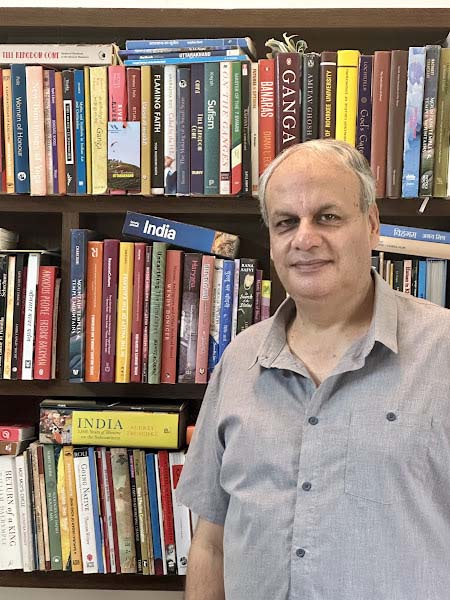
(Lokesh Ohri is an Anthropologist, Author and Wanderer. He has written over ten books on the Himalaya. His well known titles include ‘Till Kingdom Come’, ‘Ganga Katha’ and ‘Ambles Across Godland’.)