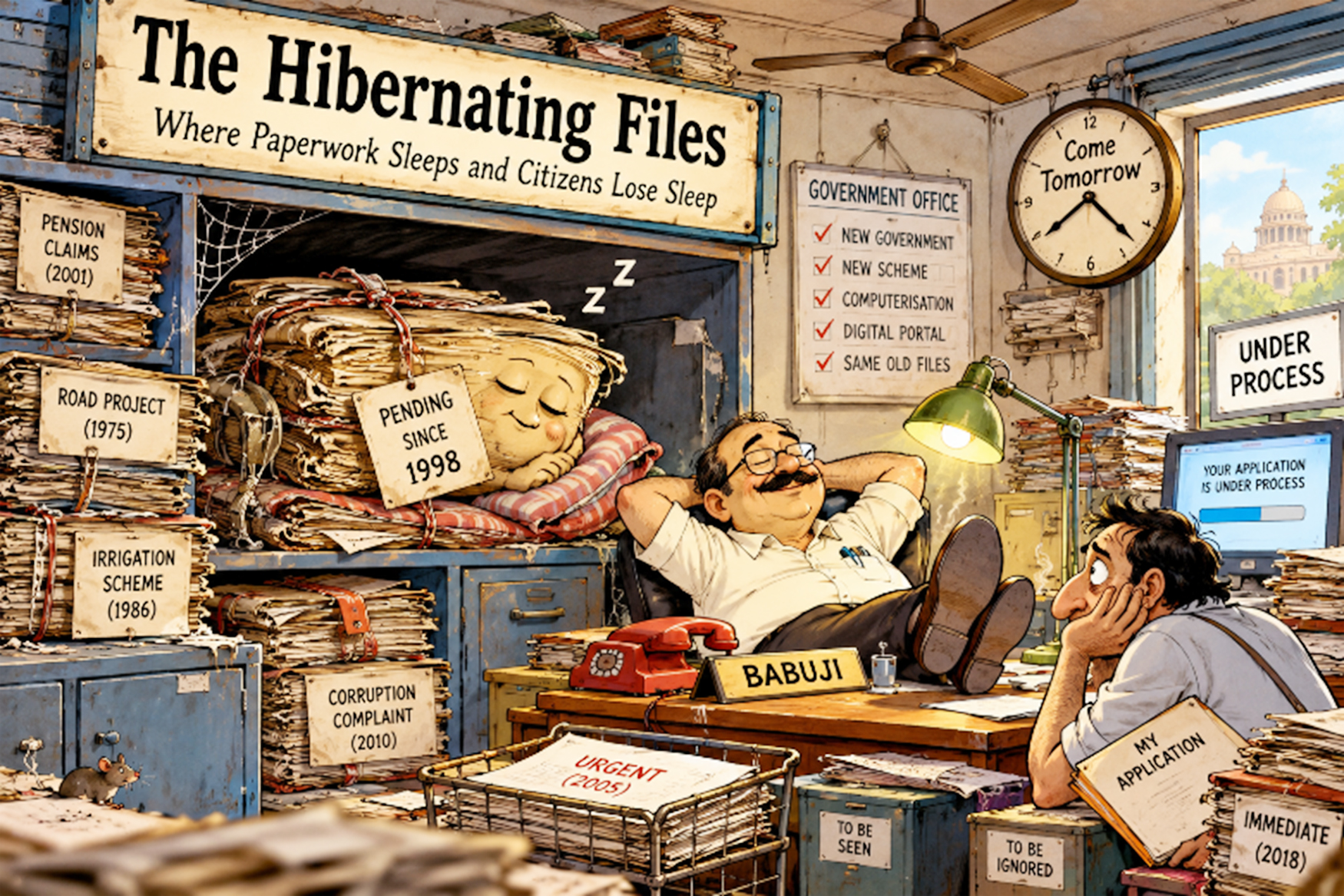
The Hibernating Files
 By Aloke Lal
You may spend an entire lifetime searching for God without ever finding Him. But walk into any government office in India, and you are certain to find something equally mysterious: the place where files go into hibernation. These files have an affectionate colloquial name: thanda basta.
God’s whereabouts have puzzled philosophers, saints and theologians for centuries. The whereabouts of a hibernating file, however, are known to one man: the babu.
He knows which cupboard contains it, which shelf holds it, which bundle conceals it, and which layer of dust has accumulated over it.
He may even remember what the file contains. But knowledge is one thing. Sharing it is quite another. The Babu is a firm believer in the conservation of knowledge. And energy. Especially his own.
The Science of Hibernation
In nature, animals hibernate to survive unfavourable weather. Bears retreat into their dens, metabolic activity slows, and life enters a state of suspended animation. Government files have perfected this technique. Unlike bears, however, they require neither winter nor adverse weather. They can hibernate in May, when temperatures touch 45 degrees Celsius, or in December, when the Babu is too cold to remove his hands from his pockets. Their hibernation is not seasonal. It is institutional. Scientists have discovered that hibernating animals survive by slowing their metabolism. Government files achieve the same result by slowing the metabolism of everyone around them. A file may remain motionless for twenty years, while the applicant grows old, his children graduate, his grandchildren marry, and the government launches six schemes to improve administrative efficiency. The file sleeps through all of them. It has learnt to ignore political change, administrative reform and technological innovation. It is, in short, the most stable institution in Indian democracy.
Every File Has a Weight
Physics teaches us that every object has mass. Indian bureaucracy has made an important addition to this principle. Every file has two weights. The first is its physical weight, measured in grams or kilograms. The second is its administrative weight, measured by a method known only to experienced government employees.
A gentleman once visited a government office to have a property transferred into his name. The Babu examined his documents.
“Everything seems to be in order.”
The gentleman was delighted.
“So my work will be done?”
“Certainly.”
“When?”
“That is difficult to say.”
“Why?”
“The file has no weight.”
The gentleman lifted the thick bundle.
“No weight? It must weigh at least two kilograms!”
The Babu smiled with the indulgence of a professor encountering a particularly slow student.
“You are new here, aren’t you?”
“Yes. This is my first visit.”
“That explains it. Here, the weight of a file has nothing to do with the number of pages.”
The gentleman looked puzzled. Fortunately, his companion was an experienced visitor to government offices.
“Sir,” the companion interrupted, “may we offer you some tea?”
The Babu’s expression softened.
“Now,” he said, “we are beginning to make progress.”
The file had not moved. But negotiations had begun.
The Democracy of Hibernation
One must acknowledge the remarkable democratic character of the hibernating file system. It does not discriminate. A farmer’s application for irrigation assistance may hibernate alongside a millionaire’s request for industrial clearance. A widow’s pension claim may sleep peacefully beside a proposal to construct a bridge. Complaints about corruption are particularly well suited to hibernation. And if the complaint happens to concern the official responsible for handling the file, special arrangements can be made. The file is placed at the very bottom of the pile. For security reasons. Occasionally, a file sleeps for so long that its retrieval becomes an archaeological exercise. In one government office, a fifty-year-old file was discovered concerning the repair of a village road. The road no longer existed. The village had become a town. A shopping complex stood where the road once ran. Three of the officials who had dealt with the file were dead. Two others had retired. One had entered politics and was now campaigning against bureaucratic inefficiency.
The last note on the file read: “Current status of the road may be obtained from the department concerned.”
A conscientious young officer added: “MOST URGENT. IMMEDIATE ACTION REQUIRED.” The file was returned to storage. There is a subtle distinction between urgency and action. Urgency is an emotion. Action is a disturbance. Government offices discourage unnecessary disturbances.
The Digital Revolution
Then came the great technological revolution. Digital India happened. The government announced that everything would become digital. Paperless offices! Online applications! Electronic approvals! Real-time tracking!
The Babus were initially alarmed. “What will happen to our files?”
A senior colleague reassured them. “Technology may change. Traditions do not.”
He was right. The hibernating file adapted magnificently. Previously, a file could disappear into a cupboard. Now it could disappear into a server. Previously, the Babu said, “The file cannot be traced.” Now he says, “The system is down.” Previously, signatures remained pending. Now digital signatures remain pending. Previously, an applicant had to visit the office repeatedly to discover that nothing had happened. Now he can discover the same thing from the comfort of his home. Twenty-four hours a day. Seven days a week.
The portal displays a reassuring message: YOUR APPLICATION IS UNDER PROCESS. The message remains unchanged for months. Sometimes years. It may eventually become a family heirloom.
A citizen once asked a helpdesk official: “How long will my application remain under process?”
“Until processing is complete.”
“And when will processing be complete?”
“When the status changes.”
“But when will the status change?”
“When processing is complete.”
The citizen thanked him. There is no point arguing with perfection.
A Word of Advice
If you ever visit a government office and discover that your file has gone into hibernation, do not despair. At least it is safe. It is protected from the dangers of premature approval, unnecessary movement and reckless administrative enthusiasm. Remember, a sleeping file is not necessarily a dead file. It is merely waiting for the right season. In the animal kingdom, spring awakens the hibernating bear. In the government kingdom, the awakening may require a telephone call, a powerful recommendation, a court order, or an envelope of appropriate weight. The bear wakes up hungry. The Babu prefers to be fed before waking up. And if none of these methods works, you must learn patience. After all, your file may be enjoying the longest uninterrupted holiday of its existence. Why spoil its peace?
There is, however, one scientific mystery that remains unsolved. Newton discovered gravity when he saw an apple fall from a tree. Had he visited an Indian government office, he might have discovered an entirely different law of motion. A file at rest remains at rest unless acted upon by an external force. And the greater the force, the faster the file moves. Newton would have recognised the principle. He might even have admired its elegance. But he would certainly have asked one question: “What happens when the external force is insufficient?”
The Babu would have smiled.
“Elementary, Mr Newton.”
“We increase the weight.”
Footnote: At least one government institution has survived and is still prospering: the thanda basta.
(Aloke Lal is a former DGP, author of six bestselling books, painter and TEDx speaker. He is the festival director of the Crime Literature Festival of India.)