The Books from My Shelves
By Vibha Puri Das
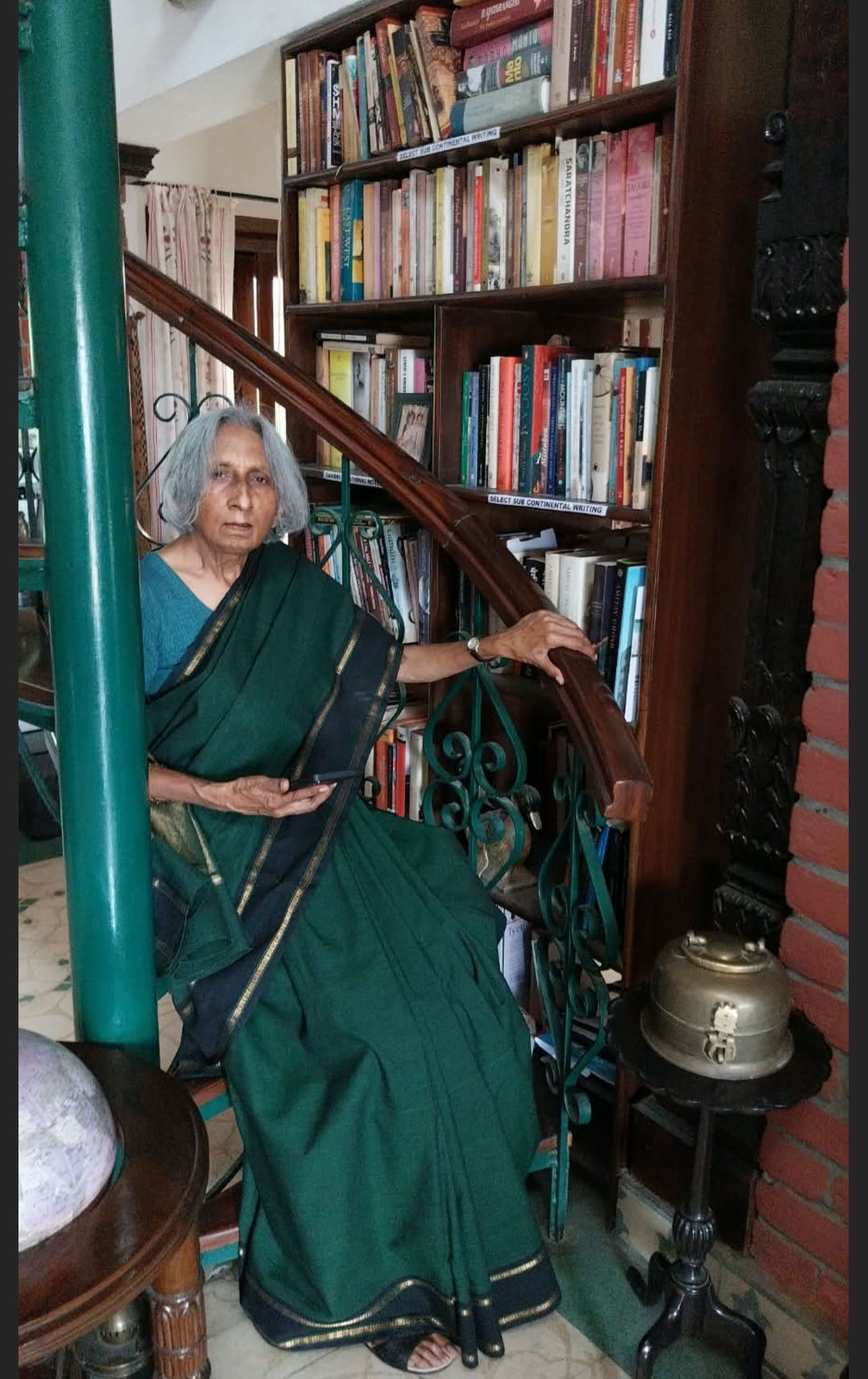
Books have been my lifeline for as long as I can remember. My parents, both educationists, and both part of important educational institutions in our small town, also had access to these institutional libraries. From early days, ‘my bookshelves’ expanded to encompass bookshelves of these cavernous, well stocked libraries. I not only got to read a diverse range of books, consult the reference section, check catalogues, but also learnt the basics of library consistent conduct: never a loud whisper, never a continued buzz of low frequency whispers, a stern rebuke from Mrs Alexander, our diminutive and kindly, yet stern librarian, would follow, silencing recalcitrant readers, and preserving quiet in deference to books.
Combined with this, the lending libraries did their bit to expand readership. Our lending library would deliver magazines, journals every day of the week. English magazines Imprint, Reader’s Digest, Illustrated Weekly of India invariably had fiction. My introduction to Hindi short stories and writers came from magazines like Sarita, Kadambini. In another small town in Punjab, where I would be for vacations, a book could be borrowed from a shop, for a small payment. For weekends, you got a double mazaa, in two books for the price of one!
Bookshelves then, were an integral part of growing up, and libraries played a yeoman role even for someone like me, fortunate, in having a collection of owned books.
Our accumulated collection of books is large and diverse; a snapshot below is somewhat random.
- The Country of First Boys: Amartya Sen
This little book is a delightful collection of writing which brings forceful arguments in the service of stated positions of the Nobel laureate.
One essay that has stayed with me, is prescient: ‘The Smallness Thrust Upon Us’ based on a lecture on ‘The Idea of Social Identity’ at the College de France in 2001. The essay begins with something Peter Sellers is supposed to have said in an interview, “There used to be a me, but I had it surgically removed.” The real me is a fresh identity towards which we get propelled. “We are suddenly informed that we are not really what we took ourselves to be: not Yugoslavs but actually Serbs (‘You and I don’t like Albanians’), or not just Rwandans, but Hutus (‘We hate Tutsis’). A timeless meditation on the smallness we choose to embrace.
Another essay in this fine collection ‘What Should Keep Us Awake at Night’ is really his own abridged version of his seminal work Idea of Justice.
- The Epic Fast: Pyarelal
A riveting account of the fast undertaken by Mahatma Gandhi at Yeravda prison, Poona, in September 1932, to protest against separate electorates for depressed classes and the response of key individuals, including Rabindranath Tagore, Padmaja Naidu and C Rajagopalachari. The writings incorporated in this book, by Pyarelal, offer a peep into the moorings of this country, the profundity of Mahatma Gandhi’s vision of social justice and its moral clarity in the face of opposition to a foreign imperial power and has a powerful lesson for the conduct of public life in all times.
- Blue is like Blue: Vinod Kumar Shukla
This is the only collection of short fiction by this writer, which, as the inner jacket says, ‘deals with smaller than life people’. The seamless flow from the quotidian, to the spiritual or ethereal life as it moves, sometimes, stuck in the smallness of life, at others, rising above. The book offers a perspective, fresh, even while so everyday.
- My Moy’s Circle: Suchitra Shenoy
This book is a window into one of the organisations that gives Dehradun its soul. The book starts with the Latika vision statement which reads to provide specialized, localized services to children with disabilities and their families and help others do the same. This as a response to our current obsession with scale. Moy Moy, the child who was the inspiration for the setting up of the organisation and who in a way became it.
- Amritsar to Lahore: Stephen Alter
Stephen Alter offers vignettes of life in cities on his journey across the border as the two neighbours complete 50 years of living in hostility wrapped in familiarity. This is an inside-outside story where one carries complete understanding of the other, while being the outsider. The jeweller’s family in Amritsar, the Customs officials at the Wagah border, the portrait of Lahore, and strewn across the book, images from writings of Manto, Faiz, Khushwant Singh, and even VS Naipaul to help us make sense of it all, come in to sketch a portrait of life of those displaced, but living seemingly normal lives after the holocaust.
- Kabir: Hazariprasad Dwivedi
Kabir’s hymns are familiar to most of us, and this book while giving a historical perspective to the discovery of many of Kabir’s writings also showcases Tagore and Kshitimohan Sen’s contributions, to what we know of Kabir. This supplemented by other compositions is a staple on my book shelf.
- The Undying Light: A Personal History of Independent India: Gopalkrishna Gandhi
A charmingly written, creatively organised around key defining events of select years, along the life span of the writer, this book is a must read for anyone even casually interested in the contemporary history of India. Each essay brings delightful nuggets, insights into personality and thought process of key players of this time. Page 176 of the book carries a letter that the author wrote to Jayaprakash Narayan as a young student in September 1964 and reveals his passionate advocacy for peace with neighbours. He quotes Ruskin Bond writing in 1997 that ‘Race did not make me an Indian. Religion did not make me an Indian. But history did. And in the long run history is what counts’.
- Flying Yogini: Irwin Allan Sealy
The insurgent female energy constitutes the leitmotif of this power packed little travelogue. Intriguing yoginis, from the Bellringer Yogini, to the Winnower yogini at the Smithsonian, there are many. There is something about this book that tantalisingly hovers at the penumbra of comprehension. Presence of Siri, may even enhance the mystery!
- Why We Die: Venki Ramakrishnan (Nobel Prize Winner 2009)
This book, as most blurbs declare, makes the science of aging accessible, such that the high science begins to seem almost commonplace. In an age where we obsess relentlessly about aging and how to live longer, look younger, be what we were, the pages of this volume reveal in disarmingly clear eyed tones that the boundaries of life are blurry, even as we think of birth and death as instantaneous. At the same time, Venki postulates, while individuals die, life itself continues. It is ‘remarkable that every creature alive today is a direct descendant of an ancestral cell that existed billions of years ago’. (p15) A fascinating read.
- Where the Creature Is, There is the Creator ‘Poems by Akho and Vasto’: Translated by Gieve Patel, Introduced and edited by Arundhati Subramaniam
This book features poems of Seventeenth century Gujarati poet Akho and Vasto, (whose dates are uncertain). Each little poem is a gem. The title poem of the collection is a classic, as is the introduction by Arundhati Subramaniam.
“Where the creature is
There is the Creator,
But you wander elsewhere,
Search in faraway places.
The first false step, says Akha,
Was that you forgot to look within.”