By Nitin Gairola
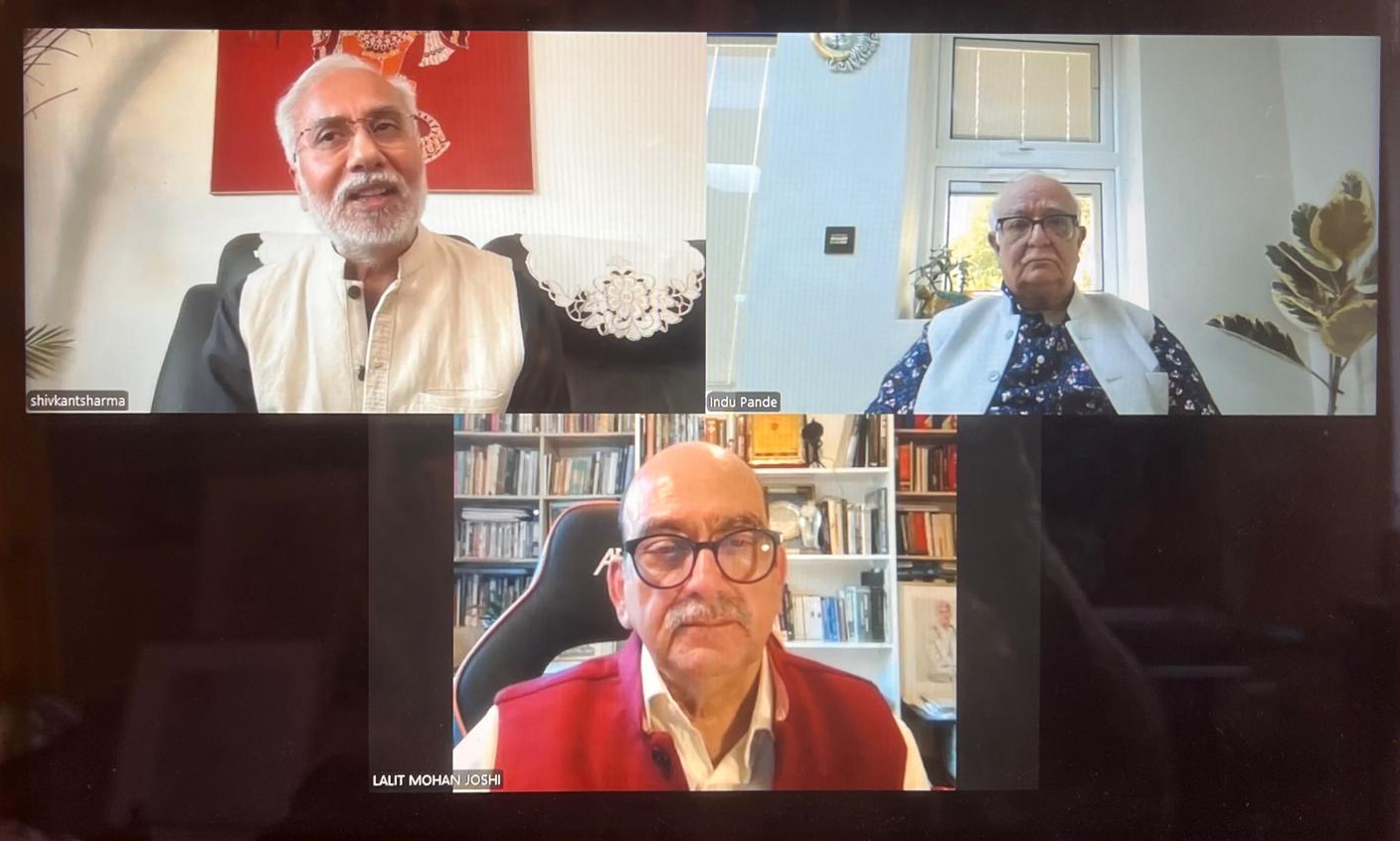
LONDON (UK), 26 Sept: Former Chief Secretary of Uttarakhand, Indu Kumar Pande’s English novel ‘That Thou Art: The Unknown Dimensions’, is an ambitious attempt to bring the philosophical traditions of India into a contemporary narrative. In a wide-ranging virtual conversation from London with Lalit Mohan Joshi, Indu Pande discussed the intellectual journey behind the book, its fictional protagonist Anna, and his exploration of Vedanta, Yoga, the Bhagavad Gita, psychology and Western philosophy.
The novel follows Anna, a German psychotherapist, whose unusual attraction to Indian philosophy and spirituality led her to India. Through her encounters and experiences, the narrative examines questions of consciousness, human psychology and the meeting of Eastern and Western intellectual traditions. Pande underlines that the novel is not intended to provide definitive answers. Instead, it raises questions, reflecting his view that knowledge has no fixed boundary.
Pande said he deliberately chose fiction rather than writing another philosophical commentary. While Yoga, Vedanta, the Upanishads and the Bhagavad Gita have been extensively interpreted by scholars and spiritual teachers, he felt that Indian philosophy was less accessible in narrative form. His objective was therefore to make these ideas easier to approach through storytelling.
The idea for the book emerged from a conversation with a filmmaker friend who asked whether India possessed a distinctive cultural subject capable of communicating something uniquely Indian to the world. Indu Pande identified Indian philosophy and spirituality as an important part of that inheritance. His own realisation that he knew comparatively little about this tradition prompted him to begin reading extensively and eventually got him to write the novel. ‘That Thou Art’ invites readers to undertake their own inquiry. Pandey invoked the Indian knowledge tradition of hearing, reflection and meditation and said that understanding must involve personal examination and experience. In that sense, the novel does not seek to close a philosophical debate; it opens a door to further questioning about consciousness, reality and the nature of knowledge.
His intellectual preparation included the works of Sri Aurobindo and Swami Krishnananda. He found Aurobindo’s writings demanding but was deeply influenced by Krishnananda’s treatment of Yoga, Vedanta and the Gita. These influences are reflected in the philosophical conversations and characters within the novel. The fictional settings and characters, however, are not presented as direct representations of real events.
A central concern of the discussion was the relationship between Indian philosophy and psychology. Pande argued that psychology was historically part of philosophy and that Indian thought does not sharply separate the two. He contrasted Western intellectual approaches with the Indian idea that ultimate reality may not merely be understood intellectually but experienced directly—a form of “knowledge by identity”.
The Bhagavad Gita received particular attention during the conversation with Lalit Mohan Joshi. Pande explained its conception of Yoga as union, equanimity and skill in action, while emphasising the importance of wisdom in guiding action. He presented the Gita as a work that brings together Sankhya, Yoga and Vedanta rather than treating them as mutually exclusive systems.
The engaging interview also examined the contemporary commercialization of Yoga. Pande observed that Yoga has increasingly become a marketable commodity. While this has helped spread its popularity, he cautioned that commercialization can also distance Yoga from its original philosophical and spiritual pursuit.
Born in Nainital in 1949, Pande studied physics, taught at Almora Post Graduate College and later joined the Indian Revenue Service before entering the IAS in 1975. He served in Uttar Pradesh and Uttarakhand and retired as Chief Secretary of Uttarakhand in 2009. Alongside his administrative career, he developed a sustained interest in Indian philosophy and poetry. The session, attended virtually by many eminent personalities, also had the official launch of the book and was concluded very eloquently by Shiv Kant Sharma.