The Books from My Shelves
By Nrip Singh Napalchyal
“There are decades where nothing happens, and there are weeks when decades happen.”- Lenin
These past six weeks have seen an unprecedented intensity in our engagement with the books which had not been witnessed in the past few decades.
As this Book Fest winds down for now, I must thank all the thirty five writers for sharing their enjoyment of the books and the Garhwal Post for hosting it. We do hope that our readers too must have found their joy in reading about close to 350 books introduced in this series.
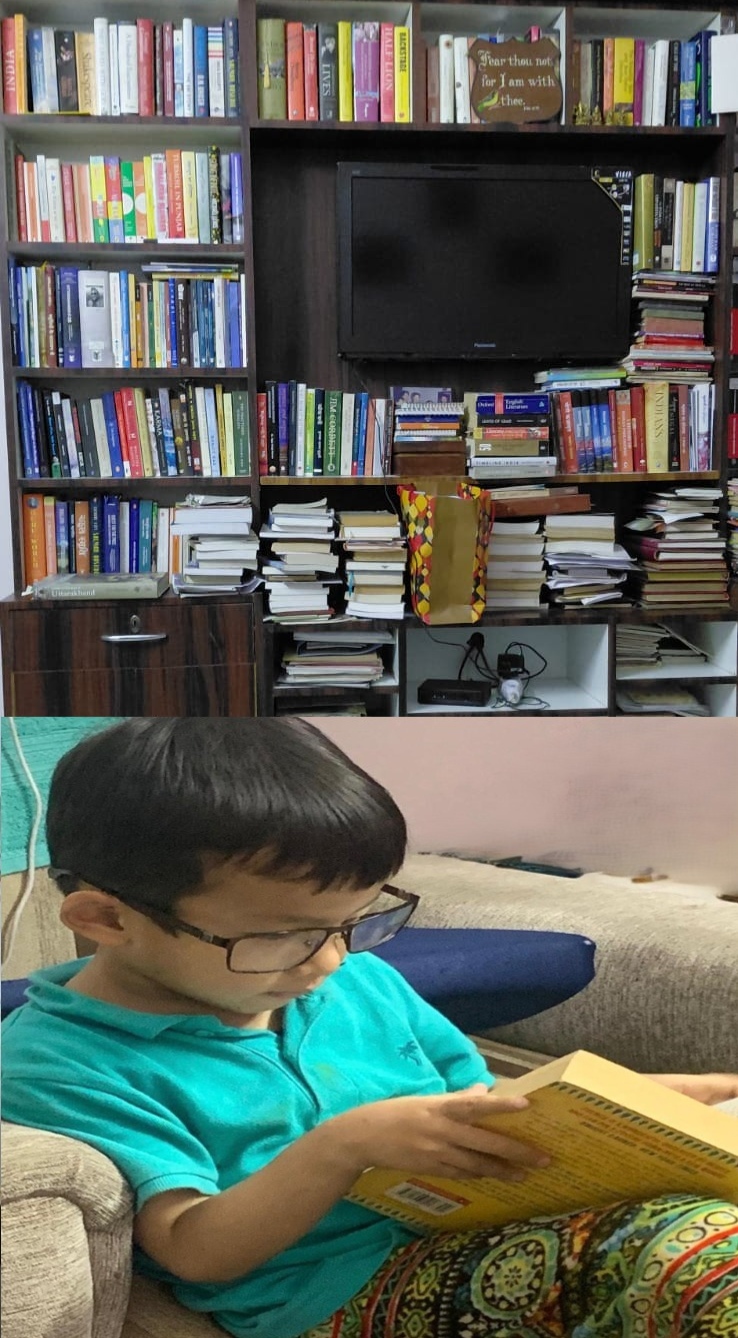
Books made a rather belated entry into my life as, in the 1960s, we had neither any bookshops nor any library in that part of the remotest Himalayan region where I grew up. But much later, when the books became accessible, I acquired them as if driven by a greedy impulse and built up, over the years, a modest library of my own. My deep connect with the printed word has led to the books and papers tumbling over one other in my small study.
Reading books is so much like meeting people in one’s life. We meet people because we are destined to meet them. This applies equally to the books. We find them and, quite often, we are found by them. So, the books that I introduce here are amongst the ones that have found me at different times and spoken to me in many different voices.
Over the last two decades, my reading interest has veered round to history, culture, economy and national security. Through this motley selection, I invite the readers to glance through some lesser known titles from the non-fiction genre.
Cultural History of Uttarakhand –
Prof DD Sharma (Indira Gandhi Centre of the Arts, New Delhi)
It is a seminal work on the history of Uttarakhand, as a single entity and a cultural area. Prof. Sharma adroitly juxtaposes the ethno-cultural sub-strata of Uttarakhand with the proto-historic races, the mythical races and the subjugation and denunciation of some, culminating in the era of cultural fusion and assimilations including changes in ethnic nomenclatures. He takes a broad chronological sweep across regions and races in their socio-cultural and linguistic frameworks and the emerging regional and folk cultural landscape of the area which lies between the Tons and the Kali rivers.
Banaras: City of Light – Diana L Eck (Penguin Books)
It is a classic on the city of Benaras about the antiquity of which Mark Twain said, “Banaras is older than history, older than tradition, older even than legend, and looks twice as old as all of them put together!”
From Diana Eck’s meticulously researched and documented work emerges the ancient city of Shiva, eternally steeped in spirituality while also nonchalantly embracing the everyday business of living and enjoying life with ‘Banarasi-masti’. Take life as naturally as it comes as dying here is liberation, is the common belief in Banaras.
Diana Eck concludes, “The true secret of Kashi is just this …. Being here is dharma enough, is yoga enough. And to live in Kashi is to enter the spiritual path, as naturally as one breathes.” Being Here!
Banaras also goes by the ancient name of Kashi, derived from the Sanskrit root kashin which means shining -The Luminous One, and hence the sub-title of the book, City of Light.
JFK’s Forgotten Crisis: Tibet. The CIA And The Sino-Indian War – Bruce Riedel (Harper Collins India)
The Cuban Missile Crisis of October 1962 coincided with the Chinese invasion at multiple fronts along the India-China borders, and as India sought assistance from the USA, JFK rushed arms and military supplies and also firmly restrained Pakistan from getting involved in the conflict: actions that sent strong signals to China which declared unilateral ceasefire and withdrew, of course, after achieving their strategic objective of undermining Nehru and India’s standing.
Bruce Reider, then a senior CIA operative, gives a gripping account of JFK‘s leadership during this crisis and the proactive role of the US Ambassador to India, John Kenneth Galbraith. He also reveals that Mao’s decision to invade India lay more than in response to India’s Forward Policy as the Chinese were uneasy with Nehru’s ‘approach’ towards the resolution of the border issue. India’s Tibet policy also played no small a part.
Scholar Extraordinary: The Life of Friedrich Max Muller – Nirad C. Chaudhuri (Orient Paperbacks)
Friedrich Max Muller, the great Indologist, Sanskrit scholar and philologist, was a highly celebrated figure of his times in Europe. Through his lectures, his edition of the Rig Veda and the 39 volumes of The Sacred Books of the East, which he edited, Max Muller brought India into the forefront of the western consciousness. The Rig Veda kept him occupied for nearly thirty years. India “was adopted as a boy’s dream and pursued through life as an object of love”, by him.
Nirad Chaudhury brilliantly unfolds the life, love and work of Max Muller while also highlighting his masterly command over Sanskrit and his life-long fascination with India. It’s a scholarly biography of an extraordinary scholar written by an extraordinary Indian.
From Surprise To Reckoning: The Kargil Review Committee Report (Sage Publications)
The Kargil War (May-July 1999), which claimed the supreme sacrifices of four hundred and seventy four officers and men of the Indian Armed Forces, left a deep impact on our nation’s psyche; and led to an intense debate in and outside Parliament over the question of why the armed intrusion at such a largescale could have gone undetected?
A four-member Review Committee, with Dr. K.Subrahmanyam as its chair, was set up. It gave its findings but the uncomfortable question of ‘Could Kargil Have Been Avoided’ still hangs. The conclusion is that we were caught napping. It recommended, inter alia, the appointment of a full-time NSA; strengthening of the National Security Council; periodic intelligence briefing of the CCS; defence modernisation and technology upgradation.
This book presents the published text of the ‘declassified’ parts of the Report tabled in the Parliament. Nevertheless, it merits a closer look by our security experts.
The Fall of a Sparrow – Salim Ali (OUP)
A bird, shot by a young boy, is identified as the Yellowthroated Sparrow. That was the beginning of the life-long obsession of the Grand Old Man of Indian Ornithology, Salim Ali with the birds. He names his riveting autobiography after that sparrow!
This book is as much about the people and the places as about the birds. Salim Ali had close links with Dehradun and Mussoorie also. He conducted the first bird surveys and was a staunch advocate of the conservation of the natural habitats. One chapter in the book is devoted to his ‘ornithological pilgrimage’ to Kailash-Manasarovar in 1945. This is an engaging life story of a man of the great outdoors and an internationally acclaimed authority on the birds, their habits and habitats.
All I really Need to Know I learned In Kindergarten: Uncommon Thoughts on Common Things – Robert Fulghum (Grafton Books)
About this bestseller, Fulghum claims that his observations reveal the “simple truths about small lives with big meanings”.
I found this story about V.P. Menon particularly fascinating: A Member of the Viceroy’s Executive Council, post-independence, Menon was the Secretary of the Ministry of the States, and the key aide of Sardar Vallabhbhai Patel in integrating more than 562 Princely States with India.
He was a self-made man. When he arrived in Delhi to seek a job, all his possessions were stolen at the railway station. In desperation, he turned to an elderly Sikh gentleman and asked for a temporary loan of fifteen rupees, and was given that money. When Menon asked him for his address, the Sikh said that Menon owed the debt to any stranger who came to him in need. Menon never forgot that debt and always helped the needy. Before Menon died, his last conscious act was to give fifteen rupees to a beggar to buy new sandals!
This slim book is replete with such interesting stories.
Shyam Benegal by Sangeeta Datta (Roli Books -2003) Datta traces Benegal’s illustrious career as a film script-writer, editor, director and the pioneer of New Wave Cinema, also known as Parallel Cinema or Alternative Cinema. She dwells at length on how he transformed the idiom of film- making and credits him ‘with a clever balance between art and commerce’ offering ‘character driven narratives set in specific sociological contexts’. His oeuvre, from Ankur to Zubeida, testifies to this. Datta has tried to position Benegal in the context of the new cinema movement in India. Personally, I believe that his trilogy of Ankur, Nishant and Bhumika (and Manthan) did to Hindi cinema what Satyajit Ray’s Appu trilogy did to Indian cinema.
THAKURBADI: Gurudev Rabindranath Tagore Ka Kutumb Vritant – Animesh Mukharji (Penguin Swadesh)
In this delightfully revealing book in Hindi about the Tagore clan, Mukharji packs history with such nuggets as to how the Battle of Plassey gave birth to the Bengal Renaissance, the metropolis of Kolkata and the bhadralog of Bengal. And how Tagores too came to wealth with Kolkata becoming the hub and the EIC setting up their headquarters at Fort William. And, how, after breaking away from Pathuriaghat to Jorasanko, they built Thakurbadi. That the actress Meena Kumari also had a Tagore connection. That Rabi Babu had a platonic relationship with a British lady called Victoria whom he named Bideshini. And that Rabindranath Tagore was the pioneer of the micro-credit banking for the poor peasants of East Bengal which was partly funded by his Nobel Prize money and became a model for another Nobel laureate Mohd Yunus’s Grameen Bank.
Mukharji weaves all such stories into the saga of the Tagore clan.
Finally, the one book which I have not read and wish to read, is-
The Everest Mystery: Sandy Irvine and George Mellory and the Truth Still Buried on Everest – Julie Summers & Jochen Himmleb (Macmillan)
On 8 June 1924, the two climbers, George Mellory and Sandy Irvine, were seen climbing towards the summit of Everest but they never returned from that expedition. Their bodies were not found and their disappearance baffled the climbing community and remained a mystery. This book is about that expedition and the mysterious disappearance of the two climbers.
Books will continue to find us as long as we cherish their presence on our shelves.
(Nrip Singh Napalchyal is a former civil servant who is now passionately involved in building up The Himalayan Studies Resource Cell within the Doon Library and Research Centre, Dehradun, and The Cultural Heritage Museum in his hometown, Dharchula.)