By OUR STAFF REPORTER
Dehradun, 19 Oct: The School of Technology at Doon University organized a special session on “Artificial Intelligence: Future Trends, Innovation and Career Opportunities”.
In her message on the occasion, the Vice-Chancellor of the university, Prof. Surekha Dangwal, said that the objective of the programme was to familiarize students with rapidly evolving artificial intelligence technologies, emerging research directions, innovation opportunities, and future employment and entrepreneurship prospects.
She stated that artificial intelligence is one of the most significant technological advancements of the present era and is reshaping the future of education, research, industry, and society. She emphasized that the role of universities should not be limited to training students in existing technologies; rather, they must also develop scientific temper, critical thinking, creativity, and the capacity for innovation among them.
She further stated that it is essential to equip today’s students with the knowledge and skills required not only to address future technological challenges but also to contribute to solving real-world problems. The Vice-Chancellor highlighted that, with the growing use of artificial intelligence, it is equally important to understand its ethical, social, and human dimensions. Technological development must be aligned with the objectives of human welfare, social inclusion, and sustainable development.
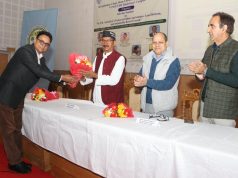
The keynote speaker, Prof. Amit Seth, a renowned computer scientist and the Founder-Director and CEO of the Indian AI Research Organisation, delivered an extensive presentation on the evolution of artificial intelligence, current technological transformations, and future possibilities.
He explained that artificial intelligence is no longer confined to being a specialized subject within computer science; rather, it is bringing about widespread changes across education, healthcare, industry, research, administration, and various aspects of everyday life. He observed that the pace of technological advancement would accelerate further in the coming years. Therefore, knowledge of existing technologies alone would not be sufficient; understanding the scientific principles underlying them and developing new applications would also be essential.
Explaining the evolution of artificial intelligence, Prof. Seth discussed technological advancements ranging from early symbolic AI and rule-based reasoning systems to modern Small Language Models (SLMs) and Large Language Models (LLMs). He explained that different AI systems are developed for different purposes, and their usefulness depends on the problem being addressed, the resources available, and the outcomes expected.
While explaining the distinction between “Small AI” and “Big AI”, Prof. Seth emphasized that success in artificial intelligence does not depend solely on developing large and complex models. In many cases, a focused and efficient solution that operates with fewer resources can prove more useful for addressing a specific problem.
He particularly stressed the importance of developing technology according to actual needs, evaluating its efficiency, and understanding its application in real-world situations.
Prof. Seth also discussed the vision of the Indian Artificial Intelligence Research Organisation and outlined the four major objectives of the organization in its efforts to develop India into a “Product Nation”. He stated that India must move beyond merely using technologies developed in other countries and focus on creating world-class artificial intelligence products through its own research, technological capabilities, and innovation.
He explained that collaboration among research institutions, universities, and industries could facilitate the development of technological solutions tailored to India’s needs while remaining competitive at the global level.
He further emphasized that, if India aims to establish ownership of its technological capabilities and intellectual property in the field of artificial intelligence, it must begin strengthening its research institutions, technological infrastructure, and innovation initiatives without delay.
Prof. Seth noted that technological changes are inevitable, but students with a strong foundation in fundamental concepts can understand emerging technologies more easily and adapt themselves to changing circumstances.
He advised students to identify research areas aligned with their interests, seek guidance from experienced teachers and experts, and begin with small projects before gradually progressing towards solving more complex problems.
He also highlighted that future opportunities in artificial intelligence would not be limited to software development or programming. AI applications are increasingly emerging in healthcare, education, agriculture, environmental protection, industry, public services, and scientific research. Consequently, computer science students will have growing opportunities to collaborate with experts from other disciplines.
During the vote of thanks, programme coordinator Dr. Preeti Mishra expressed her gratitude to Prof. Amit Seth. She also thanked Dr. Narendra Kumar, Dean of the School of Technology; Dr. Arun Kumar, Dean of the School of Physical Sciences; and the faculty members of the Department of Computer Science, including Dr. Maheep, Dr. Anuj, Ashutosh, Ishan, Nishant, Yashvi, Jagdish Goswami, Divyanshu, and Archana, along with the members of the student organizing committee.