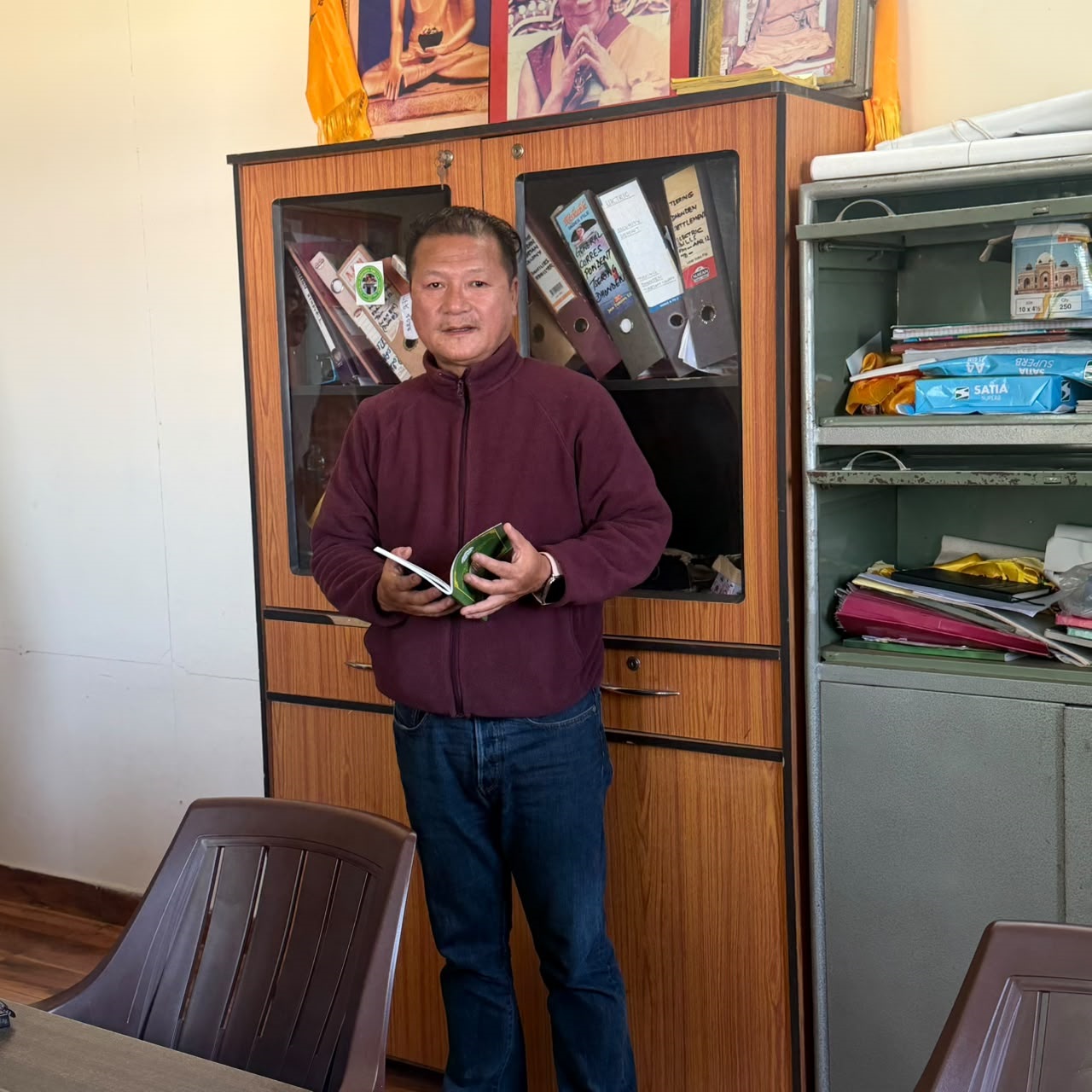
Books from My Shelves
By Norbu Wangchuk
Some of my fondest memories of reading date back to my eighth-grade years, when I was deeply engrossed in Alfred Hitchcock’s mystery series. Reading was a true passion of mine, and I vividly remember exploring many of the classics by Robert Louis Stevenson, as well as losing myself in the enchanting tales of Arabian Nights. One of my most fascinating reading experiences was discovering Arthur Conan Doyle’s four-volume collection and the captivating short stories featuring the legendary detective Sherlock Holmes.
As I grew older, my reading interests gradually evolved towards more thoughtful and serious works, particularly autobiographies and biographies of influential personalities such as Mahatma Gandhi, His Holiness the Dalai Lama, Bertrand Russell, and others. In recent years, my interests have taken a more spiritual direction, and I find myself increasingly drawn to books on Buddhism, which offer profound insights into life, mindfulness, and the human spirit.
I am introducing five books that I have read or am currently reading, particularly the first one, A Guide to the Bodhisattva’s Way of Life. The Political History of Tibet is perhaps one of the few works by a Tibetan author that traces Tibet’s history from the pre-Christian era to the present day. The third book, Cradle, offers a thoughtful exploration of how our senses function in relation to what we call the “mind” and examines the nature and workings of the mind itself. My Land and My People holds a special place in the hearts of Tibetans, as it is the first autobiography of His Holiness the Dalai Lama. The final book, The Great Game by Susan Whitefield fills me with immense pride, as it highlights the height of the Tibetan Empire’s power and influence during the early centuries.
Guide to the Bodhisattva’s Way of Life (Bodhicaryāvatāra) by Śāntideva “Shiwa Lha” in Tibetan
Shantideva was a renowned scholar at ancient India’s prestigious Nalanda University. Though born a prince and destined for the throne, a profound dream altered the course of his life, leading him to ordain as a monk at Nalanda. He authored a masterpiece of Buddhist literature, a practical guide consisting of ten chapters, The Benefits of Bodhicitta, The Preparation of the Mind, Fully Adopting Bodhicitta, Carefulness, Vigilant Introspection, Patience, Enthusiasm, Meditation, Wisdom and Dedication. As a Tibetan Buddhist, I consider this book a profound treasure and an invaluable guide to understanding Buddhist philosophy, cultivating spiritual practice, and leading a meaningful life.
Political History of Tibet by Tsepon Shakapa
Originally published as two volumes in Tibetan, this work has been translated and condensed into a single English edition. The book chronicles the history of Tibet from its first king in 127 BCE through the invasion by Communist China in 1940, culminating in complete occupation by 1959.
Among its key historical highlights are the concerted efforts of Tibetan kings to introduce Buddhism from India between the 6th and 12th centuries, as well as the religion’s eventual, complete destruction in central Tibet. Furthermore, the text details how British India opened trade routes to Tibet in 1904, subsequently establishing a mission office that remained active until the Chinese occupation. It also explores British India’s growing political influence in the region, marked by the opening of British schools and the development of a well-disciplined army.
Cradle by Tarab Rinpoche
A deeper examination of the mind reveals that it is rarely static; except during sleep, it remains in constant motion. Our thoughts continuously move between memories of the past and projections of the future. Thus, although our physical body may be sitting, standing, or walking in the present, our minds are often preoccupied with what has already happened or what is yet to come. Whereas the calmness of mind can be achieved only by having your mind in the “Present”. In this sense, the Nalanda tradition’s emphasis on understanding and disciplining the mind remains deeply relevant to the challenges of modern life.
It is intriguing to observe that our sensory faculties—visual, hearing, taste, touch, and smell—function only in the present moment. They perceive and respond to what is occurring here and now, rather than directly experiencing the past or the future. This contrast between the immediate experience of the senses and the tendency of the mind to dwell on what has already happened or what is yet to happen offers an important insight into the nature of human experience. Understanding this tendency and learning to cultivate greater awareness of the present is therefore an important aspect of the ancient Indian intellectual and contemplative traditions.
My Land and My People by His Holiness the Dalai Lama
This is the first autobiography of His Holiness the 14th Dalai Lama, in which he recounts his early education under his senior and junior tutors at the Potala Palace and describes how the immense responsibility of governing Tibet fell upon his shoulders when he was just seventeen years old. He provides an account of the beginning of the Chinese invasion and the circumstances that ultimately forced him to flee Tibet on 10 March 1959. On that day, the Chinese general invited His Holiness to attend a theatrical performance without his bodyguards. Fearing for his safety, thousands of Tibetans gathered outside his summer palace, Norbulingka, to prevent him from attending the event. Amid the growing tension and confusion, His Holiness disguised himself as one of his bodyguards and escaped into the wilderness. He vividly narrates the arduous journey that lasted nearly a month, eventually bringing him to the Indian border. The autobiography also describes his efforts to rebuild the lives of thousands of Tibetans who followed him into exile and to establish a new foundation for the Tibetan community in exile.
The Great Game by Susan Whitfield
This book explores the struggle among various empires for control of the ancient Silk Route, which stretched from Persia to Dunhuang in present-day China. Control over this important trade network enabled empires to collect taxes and duties from merchants and travelling caravans. From the seventh to the ninth centuries, much of the Silk Road came under the control of the Tibetan Empire, ruled by the Yarlung dynasty, highlighting Tibet’s significant role in the political and commercial history of Central Asia.
One of the most fascinating aspects of this history is the discovery of the hidden caves of Dunhuang, particularly Cave 17, also known as the “Library Cave”. In the early twentieth century, the Hungarian-born British archaeologist Aurel Stein explored the site and acquired a large collection of ancient manuscripts. The cave contained thousands of handwritten documents dating from different periods, including the ninth to twelfth centuries, written in Tibetan and Chinese. The Tibetan manuscripts, numbering over 10,000, are among the most significant surviving sources for the study of early Tibetan language, history, and culture. The collection includes Buddhist scriptures, such as texts related to the Prajñāpāramitā, as well as tantric writings and other historical documents. Following their discovery, explorers such as Aurel Stein and Paul Pelliot removed substantial portions of the collection, and many manuscripts are now preserved in institutions overseas, including the British Library in London and the National Library of France in Paris. These remarkable discoveries offer valuable insights into Tibet’s historical influence along the Silk Route and its religious, cultural, and commercial connections with neighbouring civilizations.
(Norbu Wangchuk started his professional journey in 1995 at Tibetan Children’s Village (TCV) in Dharamsala, the headquarters of Central Tibetan Administration (Tibetan Government-in-Exile), where he worked as a Political Science teacher. After that, he served as an Assistant to Prof. Samdhong Rinpoche during the latter’s tenure as the Speaker of the Tibetan Parliament in Exile. In 2000, he moved to Dehradun to take up a position as a Computer Science teacher at Tibetan Homes Foundation and later he joined Songtsen Library as its Secretary. In early 2005, he met the founders of Tarab Ling and in 2006 he joined the newly established Institute, Tarab Ling as its General Secretary, a position which he holds to this day. Tarab Ling Institute was established to promote and preserve the academic tradition of the Ancient Nalanda University by focussing on its studies of Inner Science of Mind and Reality.)