Books from My Shelves
By Dr Kiran Sood
Knowledge is power. Since time immemorial humans have gained knowledge through various means and in different forms. Rishis could see beyond time and travel beyond space with antardrishti evolved with tapas.
Knowledge has been carried on through generations by shruti and smriti from ancient times. The artist has created paintings in caves and other archaeological areas as expression of contemporary life. Gurus have built a race of shishya to hand over the flame of gyan for posterity since Vaidik times. Upanishads are created by delivering knowledge to disciples sitting with Gurus or rishis.
Slowly wise women/men discovered that ideas or happenings may be written on stones or taadh patras or later in ink and paper and thus books have taken shape through centuries. Web space is a comparatively new medium and yet evolving. Books still reign supreme in the world of words and cultured civilisations. Moreover books are free of advertising materials. Books can be carried in hands anywhere. A reader can read books without any external constraints or aid.
Such accumulated knowledge in books has majorly influenced human minds and helped to develop one’s capacity to read and check veracity of information and exploring new ideas as well as carry on their own creative pursuits.
To fill in the abyss of ignorance or climb up the heights of wisdom, we find ourselves increasingly dependent on books as verified resources of historical facts and understanding of gaps between reality and fiction. Computers or other sources like URLs or electronic devices are handy yet the source behind may not be reliable enough for carrying on as seeds of wisdom. There is serious danger of repeating the same old stories because of algorithms. These websites are often used by many people at the same time for preparing lectures to be delivered to the same audience. Moreover there is danger of tyranny of artificial intelligence. Anyone can lose one’s own ability to comprehend and create or interpret.
In the present times, one can feel or even claim rightly or wrongly that all knowledge is available on one’s palm or under one’s thumb. Still, I and many others find ultimate solace and gratifying solutions in books only.
The mind and soul of any human is restless for being caught up in seekers’ unending quest. Our ancient books are in form of dialogue for understanding several aspects of life and beyond. A traveller in the realm of curiosity is ready to cross temporal and spacious lines. There is definitely a scope for meeting point for seekers somewhere.
To start with my all-time companion is “Bhagwat Gita: a dialogue between Sri Krishna and Arjun”. This is a scripted secret of progressive steps for life in accordance with principles of yoga or science of Life originally written in Sanskrit. To understand deeply I take support from “Essays on Gita” by Sri Aurobindo. This brings us out of sadness or anxiety and provides profound knowledge carrying answers to complex issues. No wonder, along with Arjun, we find ourselves understanding the meaning of life and death and way or spiritual method to endure grief. This amalgamation of sermons by Krishna to Arjun miraculously leads us to karmyog, bhakti yog and sankhya and gyan yog and so on to reach the pinnacle called Purushottam Yog.
Indian philosophy is much deeper than ocean and much higher than Himalayas. In spite of being a Sanskrit-scholar, I read commentary in English also on Vedic and sanatan values and beliefs.
I appreciate “Eternal Values for A Changing Society by Swami Ranganathananda” for deeper understanding of Upanishads and Gita and other aspects of Indian philosophy and contemporary society of India, including Buddhism.
A small book “Hour of God” by Sri Aurobindo is all time my favourite for understanding the Universe and moreover to find answers for eternal questions like what is the goal of human life. Sri Aurobindo makes it so clear and simple that so called claimants of know-all may take a back seat. Sri Aurobindo says, “In the hour of God cleanse thy soul of self-deceit and hypocrisy and vain self-flattering that thou mayst look straight into the spirit and hear that which summons it.”
For comparative studies of various cultures and religious beliefs, there is a book “The Masks of God: Oriental Mythology” by Joseph Campbell. This book has covered much wider aspects of mythology and ancient civilisation. It is quite comprehensive being based on philology as well as covering wider aspects: from Vedic hymns and Upanishads from Bharat to far eastern countries like Japanese mythology. A few Chinese beliefs have also been introduced in this book. Buddha has prominently featured in details alongside ancient Korean myths. The concept of New Happiness of Buddha throws light on Tibetan culture.
To have a realistic view of modern India, there are “Letters” by the legendary JRD Tata in two volumes. The relationship between governance and corporate world is an example of deep understanding and historical interdependence. It contains an authentic history what we would lack because of the age of e-mail. My personal concern is ‘with interference of artificial intelligence, natural expressions may be omitted forever’. A hand-written letter is treasure indeed.
We know well that the decade of seventies is historically known for women empowerment. In 1979, a book called “A Woman of Substance” by Barbara Taylor Bradford was published and became the talk of the town across nations. This is pure fiction but taken to be true by many readers. This novel describes the process of transforming a woman, working as a maid in an affluent household into the most powerful business woman. In her formative years she is fascinated by the younger son of the family who gets scared and leaves her alone to find her own way. She turns into a successful business woman and finally buys the same house. After the deal is done, she commands to demolish the house and erase those remaining memories by transforming the landscape into a rose garden for children. And when she comes to know schemes of her own children for taking over her business, she proves her pragmatic approach. She calls all members of her family and makes an announcement regarding her business empire to be owned and managed by her granddaughter Paula. This story has seen replication by many women knowingly or unknowingly through twentieth century and going on in twenty-first century as well.
Understanding the brain has been my primary interest for we believe in going beyond mind in yoga, especially in Integral yoga. “The Mind Map” by Tony and Barry Buzan aims at helping us in ‘remembering things and brilliant ideas’. This is something like Capra tried to guide how to improve focus.
A modern outlook on the simulation and concentration for brain is “Your Brain is Running Old Software” by BVRC Purushottam. The book is dedicated to his brilliant daughter Dixita, an inspiration for an ideal father. This book can help us understand how we get addicted with social media and how to manage self-discipline in modern times. This is a dialogue between Alexa and Siri with comprehensive approach for modern generation as well as older ones. One might like to gift the book to Gen Z showing the path ‘Let’s talk’ across the table. Sometimes for breaking our shells and renewing our cells vigorously we need to be updated.
The latest addition to my book shelf is “Echoes from The Heights: A narration by Anup Sah, Padma Shri awardee to Group Captain Achchyut Kumar”. This is quick browsing and reading material for deep understanding of mountaineering. The book describes: “A story of Traill’s Pass After 53 Years is challenging for touching Higher Himalayas is unpredictable always. The description is short and crisp and holding attention of the reader.” All photographs by ace photographer Anup Sah are heartwarming delight for one and all.
A just arrived new book is titled Santiniketan: Nature’s Gateway to Spirituality” by Bitan Chakraborty and Kiriti Sengupta. This is a pictorial book with commentary like “He embodies comfort, joy and peace of my soul.” (Rabindranath Tagore). This book is refreshing and keeps streams of quest and knowledge alive. With age we tend to go back to our forgotten treasures time and again. This book combines historical facts alongside philosophical commentary in modern life.
This is how I conclude ‘books from my shelves’ with joy of travelling beyond time and space. A journey for much more to know and contemplate continuously to explore beyond horizons from within. Some books are meant for touching hearts. Knowledge is all time spark for spurring minds. A question for pondering further: “Time is not linear and space is ten dimensional”.
We can surmount time and space with books for sure!
We can spread wings horizontally or vertically…. Choice is ours!
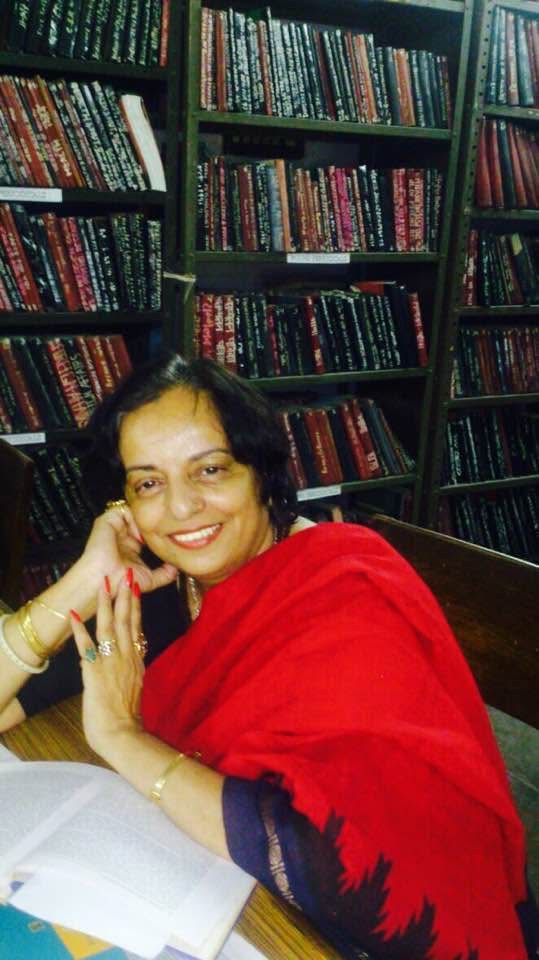
(Dr Kiran Sood is a poet, writer, academic researcher and filmmaker. She is asolo traveller. Her passion is yoga and spiritual quest. Kiran Sood is recipient of the Rashtriya Shiksha Purskar by Education Department of the Union Government for her book “Yuvaman ki Udaan: A Psychological Approach Towards Management Concepts” which was also appreciated by President Kalam. Her novel “Avgun Chit na Dharo” is a story of an empowered woman. “Koi sun raha hai kya” is an anthology of short stories published in prestigious magazines like India Today, Dharamyug, Kadambini, Saptahik Hindustan, etc. Her stories and talks have been regularly broadcast by AIR, Najibabad and Dehradun. She has made a documentary film ‘Purnamidam Purnagiri’ with Girjashankar Vohra. She is a certified film critic by Film and Television Institute of India. Currently she is working on translating Poetry by Sri Aurobindo.)