Books from My Shelves
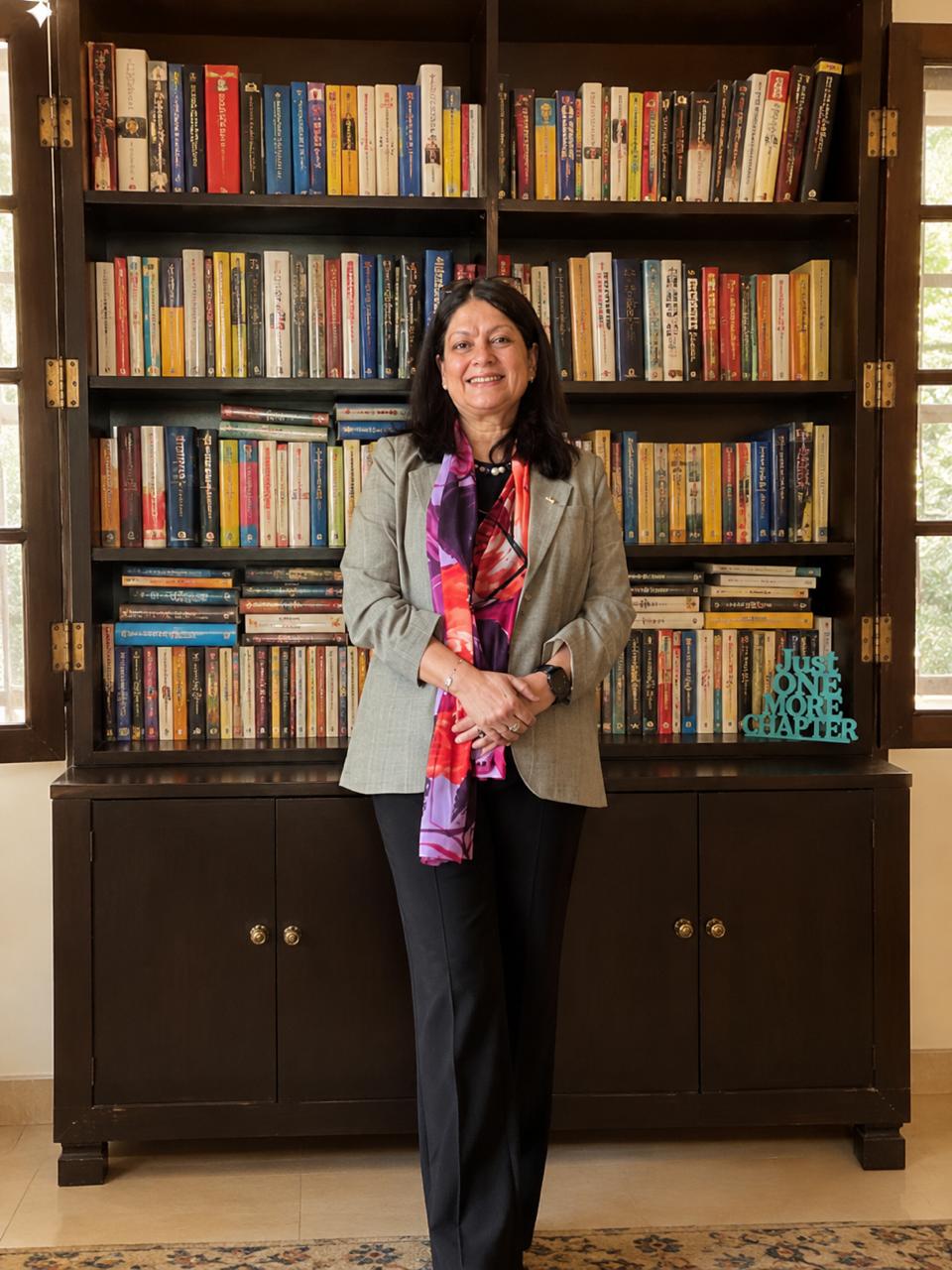
By Wg Cdr Anupama Joshi (Retd)
As a young restless girl I would dream of many places Tintin visited or the valour depicted in Amar Chitra Kathas. Then came the adventures of Nancy Drew. I wanted to live all the characters that I would read about. Books have this great magic that they allow us to sit in one corner of a room and become a different person, travel across continents, centuries, and civilisations. They introduce us to ideas that may forever change the course of our thinking.
My habit of reading was inculcated by my father when he gifted me My Experiments with Truth. It takes us into the courage of looking inward. In this, Gandhi is willing to examine his own weaknesses, mistakes, doubts, and contradictions. If imbibed, the lessons that are brought about are willingness to learn, change, and strive towards a higher ideal. It sets your moral compass.
John F. Kennedy’s Profiles in Courage. It brings life into American senators who chose principle over political expediency, the book explores the difficult choices that define true leadership. It reminds us that courage is not always about winning applause or standing with the majority; sometimes, it is about standing alone for what one believes to be right. It opened my horizon into world politics.
While in university I chanced upon A. L. Basham’s The Wonder That Was India. It took me on a journey towards India’s intellectual, artistic, religious, and cultural achievements, revealing a society rich in philosophical inquiry, scientific thought, literature, and social complexity and the extraordinary diversity of India’s past. The best, I remember, is the chronology of who preceded before the Mughals, a ready reckoner of richness of India. It also reminded that understanding history requires curiosity rather than blind glorification. It was an immersive experience and would credit for my love for history and travel around India.
Makers of Modern India, edited by historian Ramachandra Guha, should be prescribed as a syllabus for all to remember where and how our democracy was shaped. In Guha’s words, the makers not only wrote on social reforms but also acted upon them. It gave me a true insight into the life of Periyaar. The voices of these reformers come alive on issues of liberty, equality, religion, caste, nationalism, and social justice. The book is an important reminder that a democracy flourishes when citizens are willing to think critically, listen to differing opinions, and engage in meaningful dialogue.
Not all books speak through history or political thought. Some reach us through the intimate stories of ordinary human beings caught in extraordinary circumstances. Khaled Hosseini’s The Kite Runner is one such book. Set against the changing political and social landscape of Afghanistan, it explores friendship, betrayal, guilt, sacrifice, and redemption. The novel takes us into the complexities of human relationships, showing how a single act of cowardice can cast a long shadow over a life. “I could step into that alley, stand up for Hassan—the way he’d stood up for me all those times in the past—and accept whatever would happen to me. Or I could run. In the end, I ran.” I cried reading this. That burden of guilt, and the hope of forgiveness is well woven.
And then there are books that do not attempt to explain the world or change its course but simply help us fall in love with it. Ruskin Bond’s My Tree Grows in Dehra belongs to this evocative tradition. Years back, when posted in Vadodara, I picked this book with Jacaranda on cover hoping to come and settle in Doon. It happened after over two decades of yearning, just like in the book. Through his reflections on trees, birds, childhood, and life in the hills, Bond captures the natural world and makes us notice what we often overlook: the changing seasons, the rustle of leaves, the companionship of trees, and the memories that become attached to familiar places.
An English August has a personal tone, as I could see the dilemma of the protagonist Agastya Sen. I would travel to the hinterland in Madhya Pradesh, where my father was posted, leaving Delhi during vacations and would wonder how one would survive a different culture and dialect. This, subsequently, over multiple postings brought the love of rural India and its people alive in me. I found my calling unlike Agastya in Jompana.
Each of these have had a personal lesson for me whether moral conviction; self-examination; enriching knowledge of civilisation and heritage; about the complexities of human relationships; and about our intimate connection with nature and rural tribe and learning the diversity.
Perhaps the greatest gift of books is that they you can visualise the narration as your own, the images are personal. There is a tryst between the reader and the book, a bond without expectations. They remain available to us all the time, irrespective of moods and idiosyncrasies.
(Wg Cdr Anupama Joshi (Retd) is from the first batch of women in the Air Force.
She was Founder CEO of Sahastradhara Khestriya Grameen Financial Services, providing last mile services to rural hills.
Post that, she served as Director, Personnel, at The Doon School; and Founder Director, Personnel and Compliance, at Wellington College.
(Wg Cdr Anupama Joshi (Retd) is from the first Batch of Women in the Air Force. She was Founder CEO of Sahastradhara Khestriya Grameen Financial Services, providing last mile services to rural hills. Post that she served as Director, Personnel, at The Doon School; and Founder Director, Personnel and Compliance, at Wellington College. Currently she is an Advisor at Samunnati Foundation working with Agri value chain)