The Books from My Shelves
By Manoj Pande
There are not many books on my shelf. Much less than those I have read in the past. And there are reasons for it.
In a 37 year career with the Indian Railways spread across 7 states, one had to shift homes multiple times – 16 to be precise. Thus, the first reason – keep it light. Gift away what one has read and do not intend to read again. And not proactively seek return of a book borrowed by someone else.
Not all books come cheap. Enter the library (and in younger days, the lending library) where one can read what one does not intend to purchase. IIC membership in Delhi gives me that opportunity and nearer home, I intend joining the Doon Library.
It fills me with a sense of pique if I buy a book but am unable to read it. So, I usually restrict myself to purchasing one or two books at a time and having read, passing it on to others to read. After all, like an economist would say, gold at home generates no value for the economy.
The last reason for fewer books on my shelf is sentimental. It pains me when I pick up a book purchased so lovingly in the past, turn its pages only to find them yellowing and faded over time. Nonetheless I still retain many of them.
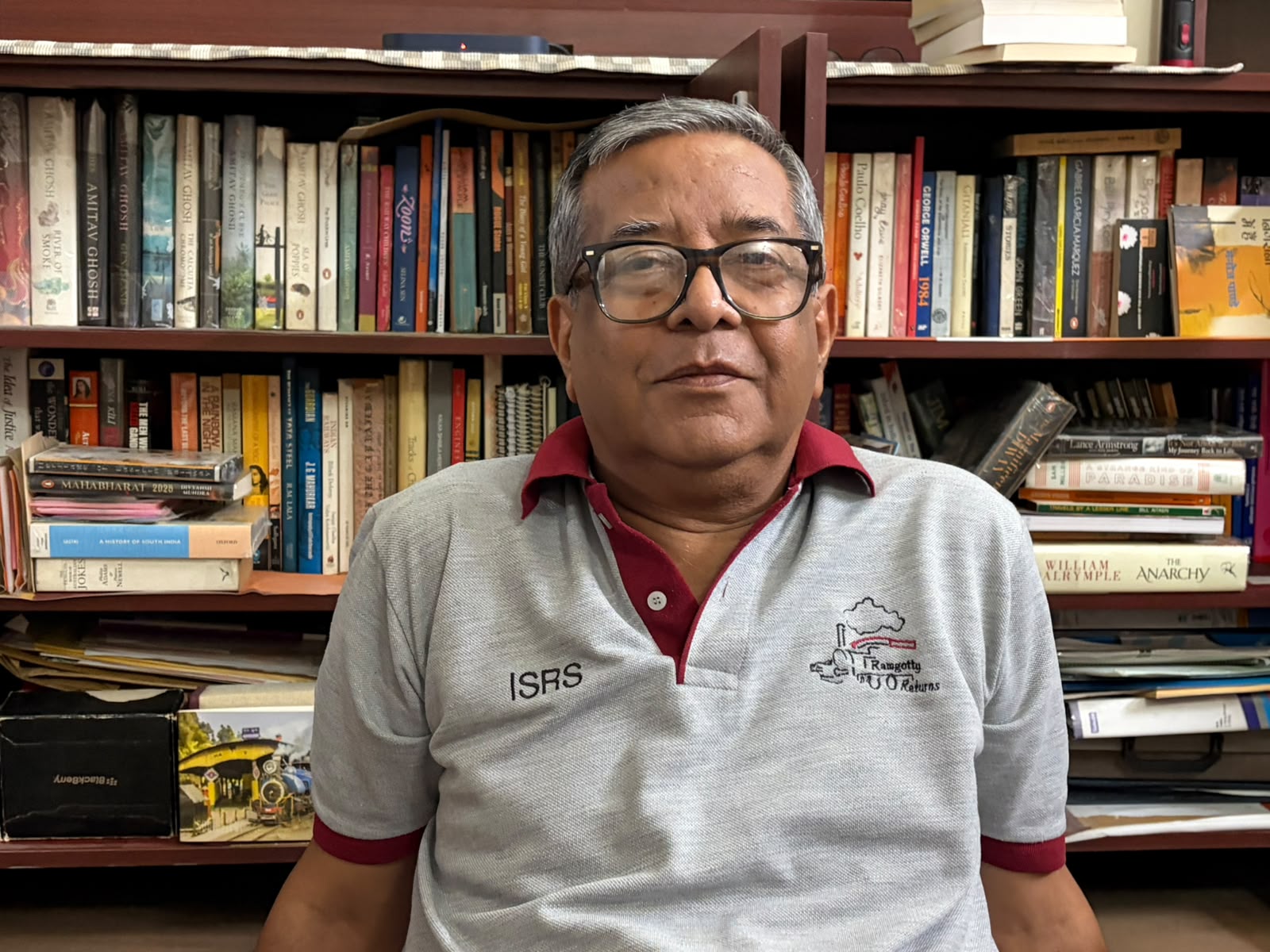
In the past few weeks the last page of Garhwal Post has been enlightening and engaging. Several individuals have taken us through their collection of books, some of which I have read, some of which I would like to read and some I know little about. So here is the list of books on my shelf, no longer on my shelf and which I intend to read/procure in the future.
- Ibis trilogy (‘Sea of Poppies’, ‘River of Smoke’ and ‘Flood of Fire’) by Amitav Ghosh: He is my favorite author. I have all his novels and many non-fiction ones too. In fiction, the Ibis trilogy opened my mind to the Opium Trade during the 18th and the 19th century and how money was made by intoxicating an entire populace in the name of free trade.
Over a decade back, I attended a lecture by Ghosh on the grounds of the Victoria Memorial in Kolkata. He began by telling the audience that the imposing building on whose background the event was being held, was mainly financed from the earnings of the opium trade. Indeed it is difficult to fathom at this age and time how peddling of narcotics could have been considered respectable.
The trilogy then moves on to indentured labour moving from India to Mauritius and how it was also a facilitator for individuals escaping from the clutches of a society moribund by fetters of caste and discrimination.
- ‘Pehla Girmitiya’ by Giriraj Kishore about Mahatma Gandhi in South Africa is not yet on my shelf, I intend buying it soon.
‘Girmitiya’, of course refers to indentured labour, sort of a colloquial for the term ‘agreement’ which took thousands of Indians to distant lands.
This was still humane considering the brutal and horrific slave trade in the 16th century onwards by the white Europeans (who else?).
- ‘Roots’ by Alex Hailey: I read it while in college. The story of Kunta Kinte’s kidnapping, voyage on an overcrowded ship with other unfortunates doomed to be enslaved and sold, the violence and the efforts to free himself reveal the true face of the white man. It is a moving book which must be read, especially by the young.
- ‘To kill a Mockingbird’ by Harper Lee: Set in a fictional town in Alabama in the American South during the 1930s, it brings out the racial bias against the Blacks, traces of which we hear about even today, when policemen have assaulted and even asphyxiated young black individuals to death on mere suspicion.
Besides slavery, Europeans set foot on distant lands to colonize them through violence, deceit and massacres wiping out almost all the indigenous population in the Americas and Australia. The lure of mammon and (partly) evangelical zeal were mainly behind these voyages.
- The Nutmeg’s Curse by Amitav Ghosh: As colonials, the Dutch were cruel in their pursuit of profits from spice trade, especially in the East Indies. Ghosh makes us aware of how the humble nutmeg or ‘jaiphal’ which was a prized commodity in those times led to the 1621 Banda Island massacre in Indonesia. It goes on to explain how replacing indigenous trees with cash crops have brought about changes in ecosystems. A well-researched book, it should be read by those who care for rapid environmental changes that affect us all.
Working for the Indian Railways gave me the opportunity to travel widely across the country. Travelogues are therefore of particular interest.
- ‘Travels by a lesser line’ by Bill Aitken: It may account for only 1.68 percent of the total route length of the Indian Railways now, a sharp drop from almost 40 percent in the 1900s, but once the Metre Gauge network connected the country too with its own Express and Passenger trains. It was in 1989-90, a few years before the commencement of Project Unigauge that Bill Aitken travelled across the country on the Metre Gauge system.
An absorbing travelogue of many small chapters, from Assam to Kerala to Bikaner and much more, the book with its yellowing pages is my prized possession as rare as finding a nearby Metre Gauge line.
- ‘Sacred Virgin’ by Royina Grewal: The River Narmada is a rarity flowing from east to west. Flowing mainly through rocks, it has never changed its course and is considered a virgin. Many myths are associated with it. (My article dated September 1 in the Garhwal post mentions some of them.) And while a dip in other rivers is considered auspicious, a mere ‘darshan’ of Narmada is enough. Many devotees perform the arduous ‘parikrama’ from its source (Amarkantak) to where it meets the sea (Bharuch). Royina’s book is about all that and more. And as I pulled out this book from my shelf, I have started reading it yet again, so lucidly is it written, even getting praise from Khushwant Singh.
- ‘A Strange Kind of Paradise’ by Sam Miller: In the words of William Darlymple, “a wonderfully witty, wise and idiosyncratic book. At once a touching personal memoir, a droll and discursive travelogue… It is also a moving love letter to India.” The style and tongue-in-cheek comments, sometimes corny sometimes risqué make it an interesting perspective on India.
- ‘In Patagonia’ by Bruce Chatwin: I know that I shall never be there, both the costs and the sheer travel time being beyond me. So, based on a book review, I read Bruce Chatwin’s account of Patagonia, a huge area in the South of South America spanning three nations – Argentina, Peru and Chile. This is the advantage of reading a travelogue. In short, this sparsely populated region never became popular with the settlers.
- ‘Ghummakad Shashtra’ by Rahul Sankrityayan: He was a great traveler who has written many accounts of his travels. I hope to begin with ‘Ghummakad Shashtra’. Buy it if available, or borrow it if Doon Library has one, of course once I become a member.
- ‘It’s Not About the Bike’ by Lance Armstrong: One of my bosses presented me this one with the intention of inspiring and motivating me. I read it only to learn some years later that Mr Armstrong had been stripped of all his titles including Tour De France. This book though, remains on my shelf for this very reason!
- ‘The Magnificent Diwan’ by Dadabhoy Bakhtiar: About the life and times of Sir Salar Jung I, Mir Turab Ali Khan, Dewan of Nizam’s Hyderabad State. Fascinating, informative and absorbing, this well researched tome sheds light on his personality, what he did for the state and how he was repeatedly betrayed by the British. Incidentally, the Salar Jung Museum in Hyderabad is about the collection of a later Salar Jung III (Mir Yousuf Ali Khan)
And finally, two books in Hindi that I hold dear, both less than 100 pages, yet remarkable in themselves.
- Darakhton ke Saaye Mein Dhoop by Dushyant Kumar, who needs no introduction. This is the only book I deliberately ‘forgot’ to return to the library in a place called Bhusaval way back in 1989 and paid a princely fine of Rs 25 for it. With his unique style of poetry, this classic figures in my collection.
- Aaj Bhi Khare Hain Taalab by Anupam Mishra. What a book! Only 86 pages with illustrations reminding us in simple language about the traditional ways of water conservation, which we have probably lost sight of in the grandiose irrigation projects that have come up everywhere often displacing communities. Those who know who Anupam ji was, would have read it anyway. I recommend it to anyone who thinks about water and the environment around us.
Can a book or lack of knowledge of its author stop one from becoming a Crorepati? In my case, the answer is YES.
I had participated in Kaun Banega Crorepati in 2007, the only time it was hosted by Shahrukh Khan. Mentioning that I was from Uttarakhand, I named Computerji as Computer daajyu and made Shahrukh speak to my Ija.
As I went from question to question, came the one crore test – “Who wrote Beyond Ten Thousand, My Life Story?” I had no idea. As I moved out after quitting at Rs 50 lakhs, Shahrukh presented me with a coffee table book about his life, which obviously finds place in my bookshelf.
For the record, the one crore answer was Alan Border.
(Manoj Pande is an IRPS officer of the 1981 Civil Services Exam Batch, who retired as Member Staff of the Railway Board (Ex-Officio Secy to GoI). An Economics Post Graduate from the Delhi School of Economics, he also holds an MBA and an LLB degree. Passionate about railway history and heritage, he was associated with ‘Indian Railways’, a coffee table book published by Dorling Kinderley in 2020. Apart from articles in various newspapers over the years, a collection of his stories and poems ‘Aap Nigrani Mein Hain’ was published in 2019. He now lives in Dehradun.)