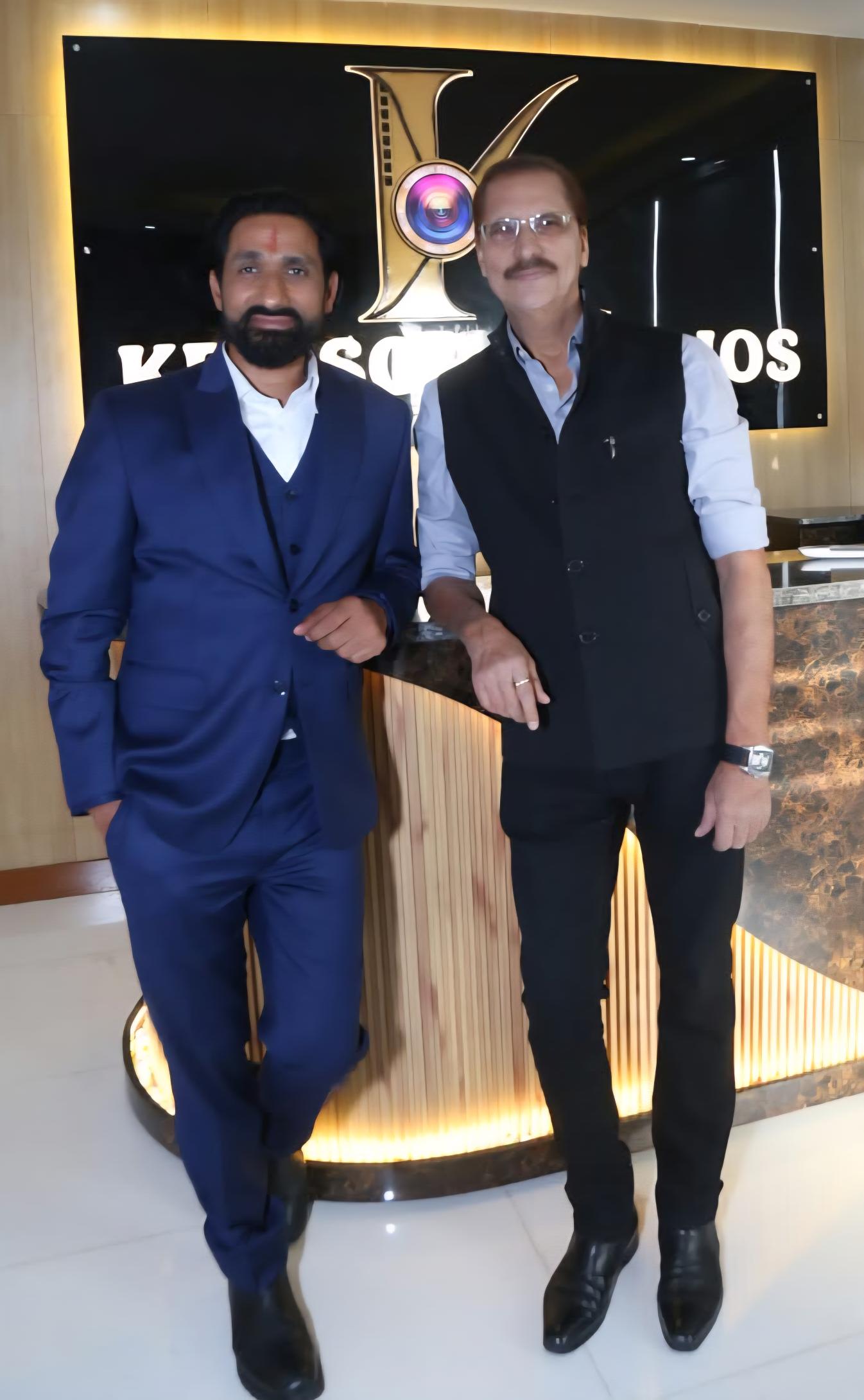
(Actor, hotelier and China hand Dev Raturi on cinema, enterprise, belonging—and the many meanings of home)
By Alok Joshi
In the crowded map of my China years, there was one blank space I had never expected to fill: another Uttarakhandi who had lived, struggled and built a life in that vast country. Then, in Dehradun, I met Dev Raturi.
Dev, a son of Uttarakhand who has earned recognition in Chinese cinema while also building his identity in the hospitality world, carries a life story that moves across borders. I, too, spent more than twelve years living and working in China—a period I have recounted in my memoir, “12 Sweet and Sour Years in China”. Yet, curiously, despite our shared Uttarakhand roots and our deep association with China, I had not known of Dev Raturi until recently.
That discovery itself is a story of the unexpected routes taken by people from the hills.
When I met him, I told him about my two published memoirs about China— more as a conversation starter between two people whose lives have been shaped by the same vast country in very different ways. China, after all, is never only one experience. It is a place of work, ambition, language barriers, friendships, food, discipline, opportunity, loneliness and constant surprise. For some it becomes a professional destination; for others, a second home; for many, it remains a complicated but unforgettable chapter.
Dev Raturi’s journey embodies this complexity. Coming from Uttarakhand and finding a space in Chinese films is no ordinary achievement. The Chinese entertainment world is enormous, competitive and culturally distinct. To be noticed there as an Indian actor requires more than good fortune. It calls for adaptability, patience, self-belief and the courage to remain visible in a place where one is inevitably seen as an outsider before being accepted as a professional.
From Bollywood dream to Beijing
Dev Raturi’s journey into films did not begin in a casting office. It began with an unfulfilled childhood ambition, a long struggle in the hotel trade and a chance encounter in China. Interested in acting from an early age, he had earlier tried his luck in Mumbai but did not get a break. In 2005, he moved to China to work in a hotel because his Bollywood dream had busted. He learned Chinese, rose through the hospitality business and eventually established his own restaurant ventures.
The turning point came when a Chinese filmmaker visited his restaurant, reportedly looking for a location and an Indian face for a low-budget production. Dev volunteered. His first screen break came with Special SWAT in 2016—a small role, but one that reopened a dream he had carried for years. As he has said in an earlier account, “I never forgot about my dream.”
What followed was not an overnight celebrity story, but a gradual accumulation of roles across Chinese films and television. He has played detectives, gangsters, kidnappers, police-linked characters, entrepreneurs, pirates, mercenaries and even an astronaut—roles that demonstrate a willingness to step beyond the narrow stereotypes often assigned to foreign actors. His career has included work in popular Chinese screen productions such as My Roommate Is a Detective, Xing Chen Da Hai, Wolf Pack and Strange Legend of Tang Dynasty. I shared with him an interesting coincidence. I too was selected for a role as the President of Philippines in a Chinese TV historical serial but had to give up because of outstation shoots.
Two China stories, one common thread
Our conversation quickly became a weaving together of two China narratives. He went to China in 2005 to work in a hotel because his Bollywood dream had not been realised. I went in 2007 on invitation, without a formal interview—having resigned my fast-track corporate job in India to work for a state-owned Chinese oil major, explore and experience a new world.
Different work experiences, but same common challenges as a foreigner: language, cultural distance, being the “other” in a society that is intensely proud of its own identity, and the constant effort to prove oneself professionally while remaining true to one’s roots. We were both in China, even in Beijing, around the same time during our early years—but we never met. And now, in Doon, we had so much to share.
He spoke of the discipline of Chinese work culture, the speed with which decisions are taken, the importance of relationships and reputation, and the way ordinary people balance ambition with family responsibilities. I spoke of my own years in a Chinese corporate environment, the learning curve, the friendships that felt like family, and the bittersweet feeling of eventually leaving a place that had become a second home.
For readers in Uttarakhand, his story holds a special appeal. It reminds us that talent from the region need not remain limited by geography. The mountains teach resilience, but the world demands initiative. Dev’s career—stretching from hospitality to cinema—suggests that success sometimes comes not from following a single, predictable path, but from remaining open to the next door that life presents. This obviously demands getting out of your comfort zones and the cozy, often protective and pampered home environment.
His work in hotels is equally significant. Cinema may bring visibility, but hospitality requires a different kind of performance: the ability to understand people, manage expectations and make strangers feel welcome. In that sense, both professions deal with human connection. One tells stories on screen; the other creates experiences in real life.
Amber Palace, Gurgaon and a Dehradun film dream.
When I met Dev, he told me that though he has hotels in China under the Amber Palace brand, he will mostly spend time in India from now on. He has a hotel in Gurgaon and is in the process of building his film production house in Dehradun. He plans to focus more on film production in Uttarakhand and run his hotel business on the side.
That shift is significant. For years, he has been an Indian face in Chinese cinema. Now, he is looking to bring that experience back home—to help create stories in Uttarakhand, to provide opportunities for local talent, and to use his China exposure as a creative and professional asset rather than merely a personal chapter.
KEMSOR Studios: A New Chapter
The most exciting development is that Dev Raturi has now formally launched KEMSOR Studios in Dehradun, a film production venture focused on Hindi cinema, Uttarakhand stories and culturally rooted storytelling. The studio’s first Hindi feature film is scheduled to go on floors in December 2026, with a theatrical release targeted for May 2027.
The studio was inaugurated by Chief Minister Pushkar Singh Dhami, marking a significant moment for Uttarakhand’s growing film ecosystem. For Dev, establishing KEMSOR Studios in Dehradun also represents a connection between his roots in Uttarakhand and his international professional journey.
A family moment
Incidentally, his sweet wife was also there during our talks. I presented her a copy of my China memoir as a small gesture of gratitude for the interest and the openness of their conversation. In that moment, the meeting felt less like an interview and more like a quiet celebration of two families whose lives have been touched by the same distant land.
Looking ahead
The question of what lies ahead is particularly interesting because Dev Raturi’s career continues to span both business and cinema. His official website lists Ark Peace, in which he plays a driver, as a current film project. It also indicates his continuing ambition to work with new directors, explore unusual roles and build projects that connect Indian and Chinese cultural worlds.
For Dev Raturi, China gave him the stage; Uttarakhand gave him the story. Now, with KEMSOR Studios rising in Dehradun, he is bringing both home. His inspirational journey reminds us that the hills do not merely send their children out into the world—sometimes, the world sends them back with new dreams, new skills and a new stage for Uttarakhand itself.
As I left our meeting, I realised that Dev Raturi and I had not merely exchanged China stories. We had recognised something familiar in each other: the restlessness to explore, the resilience to survive far from home, and the quiet joy of returning to Uttarakhand with a richer story to tell.
(Alok Joshi is a Dehradun-based Management professional, Corporate Trainer, Interview coach, Motivational Speaker, Author of three bestselling books and a freelance writer. He has a multi-cultural background and has worked in top management positions in global companies across many countries.)